KSeF 2026: Who must use it and who is exempt?
Poland's mandatory e-invoicing system covers virtually all VAT taxpayers from April 2026. Find out who is exempt and what the penalties are.
TL;DR - Key points at a glance
From 1 February 2026, all businesses operating in Poland are required to receive invoices through KSeF - regardless of VAT status or turnover. On the same date, the obligation to issue invoices through KSeF began for VAT taxpayers with gross sales above PLN 200 million in 2024. From 1 April 2026, the issuing obligation was extended to virtually all taxpayers who issue B2B invoices - including, in principle, VAT-exempt taxpayers (there is no enumerated exemption for them in the statute). Source: Polish Ministry of Finance, Scope of mandatory KSeF.
Practical advice: if your company issues B2B invoices in Poland and has not yet integrated with KSeF, there is no legal "wait and see" option for standard commercial transactions - act now. Exception: if your monthly sales do not exceed PLN 10,000 gross, you may issue invoices outside KSeF until the end of 2026 (details below).
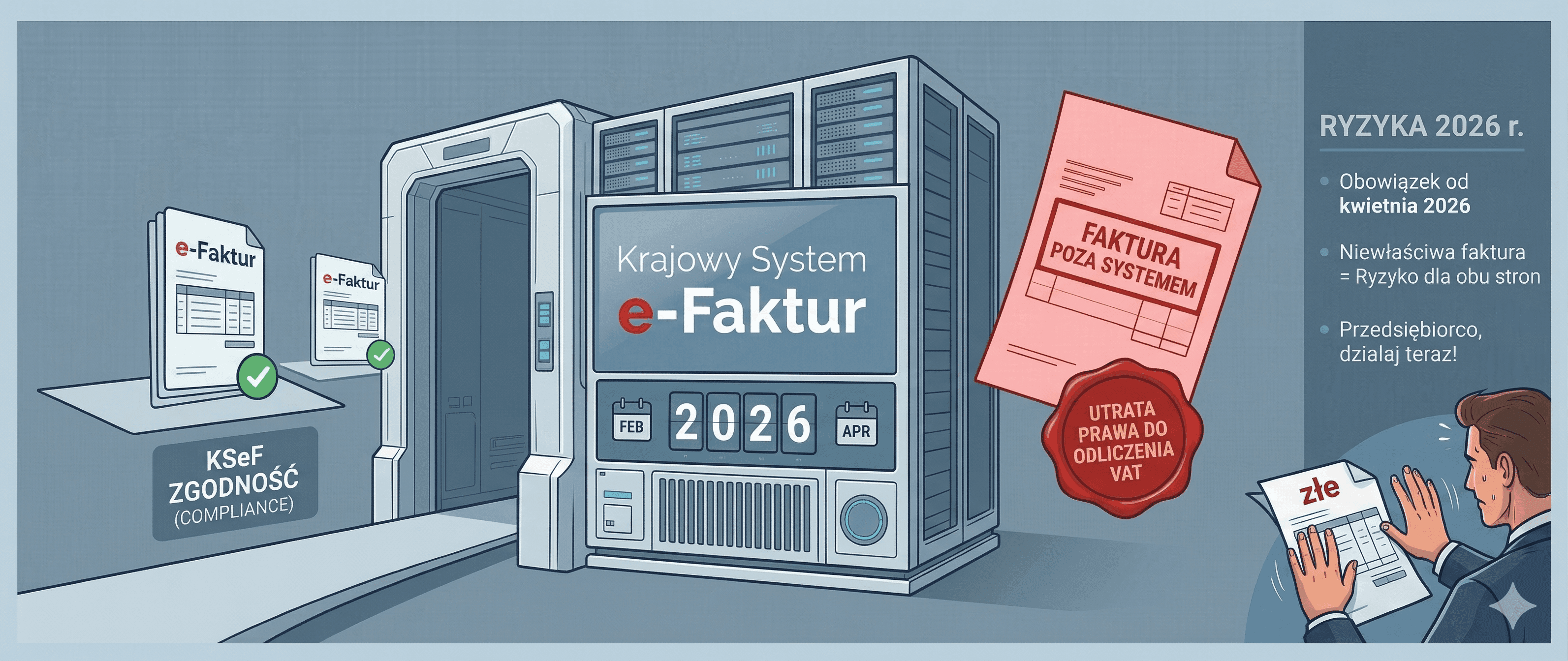
Warning: the buyer who receives an invoice outside KSeF (when it should have gone through the system) may lose the right to deduct input VAT. The risk falls on both sides of the transaction.
Who must use KSeF and since when?
Poland's mandatory structured e-invoicing obligation came into force in two waves. The Ministry of Finance divided taxpayers by turnover to give smaller businesses more preparation time - but that time has now elapsed.
From 1 February 2026: active VAT taxpayers with gross sales above PLN 200 million in 2024 are required to issue invoices through KSeF. Important: from 1 February 2026, all businesses - regardless of VAT status or turnover - are required to receive invoices through KSeF. The receiving obligation is therefore universal and predates the issuing obligation (source: Polish Ministry of Finance, Scope of mandatory KSeF). From 1 April 2026: the issuing obligation was extended to all other taxpayers who issue B2B invoices, including micro and small businesses and sole traders. Importantly, the statute contains no enumerated exemption for VAT-exempt taxpayers - the obligation applies to 'taxpayers who issue invoices', not only to active VAT payers. As of 10 April 2026, the obligation is in effect for essentially every business issuing invoices in Poland.
The table below summarises which group falls under which deadline. Status as of 10 April 2026.
Legal basis: Act of 11 March 2004 on goods and services tax (Journal of Laws 2004 No. 54, item 535, as amended), Art. 106ga - the provision introducing the obligation to issue structured invoices via KSeF.
Now that we know who is covered and since when, let us look at what the law actually permits as exceptions.
| Taxpayer type | Deadline | Status (10 Apr 2026) |
|---|---|---|
| Active VAT, gross sales >PLN 200m in 2024 | 1 February 2026 | Obligation active for over 2 months |
| Active VAT, gross sales ≤PLN 200m in 2024 | 1 April 2026 | Obligation active since 10 days ago |
| VAT-exempt taxpayer issuing invoices | 1 April 2026 (no statutory exemption) | KSeF obligation may apply - no enumerated exemption in the statute (verify individually) |
| Foreign entity without Polish VAT registration | Not applicable | No KSeF obligation |
Legal exemptions - who is genuinely allowed to skip KSeF?
Art. 106ga(2) of the Polish VAT Act lists the situations in which a structured invoice (faktura ustrukturyzowana) is not required. This is a closed list - if a transaction does not fall into one of the categories below, KSeF is mandatory.
The following are the main legal exemptions:
B2C invoices for private individuals: Consumers do not have a business NIP (tax ID). When the buyer is a private person not conducting business activity, the invoice does not go through KSeF. Important: this applies only where the buyer is genuinely a private individual - it cannot be used to reclassify B2B transactions.
Foreign taxpayers without Polish VAT registration: An entity without a Polish NIP and not registered for VAT in Poland has no access to KSeF and no obligation under Polish law. This applies to foreign companies invoicing Polish clients without a fixed establishment in Poland.
Cash register invoices (transitional provision until 31 December 2026): Invoices generated via fiscal cash registers are temporarily exempt from KSeF until the end of 2026. This is a transitional rule - the situation may change from 1 January 2027.
Transitional exemption for monthly sales ≤ PLN 10,000 gross (until 31 December 2026): This is one of the most important and most commonly overlooked transitional exemptions. Until the end of 2026, taxpayers whose monthly sales do not exceed PLN 10,000 gross may issue invoices outside KSeF. This means that for a large portion of sole traders and micro-businesses, the effective KSeF issuing obligation does not begin in 2026 but only from 1 January 2027 - not from 1 April 2026. Statements that 'the obligation applies to everyone from 1 April 2026' are therefore inaccurate for this group. Source: Polish Ministry of Finance, Scope of mandatory KSeF.
With the exemptions clear, the next question is: what actually happens if a company ignores the obligation?
| Case | Legal basis | What to use instead of KSeF |
|---|---|---|
| Buyer = private individual (non-business) | Art. 106ga(2)(1) Polish VAT Act | Traditional invoice or NIP receipt |
| Foreign issuer without Polish NIP | Art. 106ga(2)(2) Polish VAT Act | Invoice under the issuer's domestic rules |
| Cash register invoice (until 31.12.2026) | Transitional provision | Fiscal cash register invoice |
| Certain export transactions | Art. 106ga(2)(3) Polish VAT Act | Traditional invoice with export marking |
Penalties and tax risk for non-compliance
Failing to comply with the KSeF obligation is not just a procedural issue. The legal and tax consequences are concrete and can affect both the invoice issuer and the recipient.
Key consequences for the invoice issuer:
Financial penalty: Up to 100% of the VAT amount shown on an invoice issued outside KSeF in breach of the rules. The penalty can be imposed by the head of the local tax office.
Invoice validity risk: An invoice issued outside KSeF where the obligation exists may be treated as non-compliant. The issuer cannot rely on such an invoice as a valid settlement document.
Consequences for the buyer - loss of input VAT deduction: This is often the most important argument for business partners. A buyer who receives an invoice outside KSeF (when it should have been issued through the system) may lose the right to deduct input VAT. Tax authorities can challenge the deduction.
Audit risk: Discrepancies between JPK_VAT registers and missing corresponding invoices in KSeF are flagged by the Polish tax administration's analytical systems. The absence from KSeF is visible automatically.
Now that we understand the stakes, here is what to do if your company has not yet implemented KSeF.
| Party | Risk |
|---|---|
| Invoice issuer | Penalty up to 100% of VAT, invoice validity risk |
| Invoice recipient | Loss of input VAT deduction right |
| Both parties | Tax audit risk, declaration corrections |
Practical steps if your company has not yet implemented KSeF
If you are an active VAT taxpayer issuing B2B invoices in Poland, there is no time left for analysis - only for action. Here is a complete KSeF implementation checklist.
Step 1 - Token or certificate: KSeF authentication uses either a KSeF token (NIP + API key) or an XAdES certificate. You can generate a token through the Ministry's KSeF Taxpayer Application. Without authentication, no document can pass through the gateway.
Step 2 - Integrate your accounting system: Your accounting or ERP system must be able to generate FA(3) XML and communicate with the KSeF API. Check whether your software vendor has released the relevant update. If not, you need a middleware solution (such as ksefgpt) or a direct API integration.
Step 3 - Test on the Ministry's test environment: Before sending the first live invoice, test the full flow on the KSeF test environment (ksef-test.mf.gov.pl). Verify that the XML is valid, that sessions open correctly, and that UPO (official receipt) is returned for each invoice.
Step 4 - First live invoices: Send your first production invoice and immediately verify the KSeF number and UPO. Retain the UPO for every invoice issued - it is your proof of acceptance by the system.
Step 5 - Archiving and monitoring: Invoices are stored in KSeF for 10 years. Your system or KSeF management tool should allow you to download and export invoices to your own archive. Monitor the status of submitted invoices - a KSeF rejection means the invoice does not exist in the system.
With the action plan in place, let us zoom out and consider why KSeF is a different kind of change from previous VAT updates.
| Stage | What to check | Priority |
|---|---|---|
| Token / certificate | Active, linked to the company NIP | Critical |
| Accounting integration | Supports FA(3) XML and KSeF API | Critical |
| Test environment | At least one test invoice completed with UPO | High |
| Live invoices | Every invoice has a KSeF number and UPO | Critical |
| Archiving | UPO stored, invoices downloaded to archive | High |
Expert perspective - KSeF as structural change, not just another VAT update
For years, Polish companies adapted to VAT changes by adding a field to a declaration, updating their software, and moving on. KSeF is a different category of change altogether. It is not about a new form field or a rate adjustment. It is a fundamental redesign of how an invoice exists as a document - shifting from a paper or PDF artefact to a system event immediately visible to the tax administration.
This distinction has very concrete implications. Previously, an invoice was your document - you could issue it, correct it, archive it, and present it during an audit. Now, an invoice exists in a government system from the moment a KSeF number is assigned. The administration sees it in near-real time, without needing an audit. This changes the risk dynamic - errors are visible faster, discrepancies between JPK and KSeF are detected automatically.
Companies that in previous years said "let us wait until the obligation is live and see what others do" found themselves in a difficult position: the obligation came into force on a hard deadline, without additional extensions. Firms that delayed implementation until the last moment had to solve technical, organisational, and legal problems simultaneously, under time pressure.
A sound KSeF implementation is not just about sending invoices through the system - it is a process rebuild: who generates the XML, who is responsible for validation before submission, how to handle rejections, how to manage KSeF access rights for employees and external accountants. Companies that treated this as a technical and process project, not just an IT task, handled the transition far more smoothly.
KSeFGPT - AI assistant for KSeF management
KSeFGPT is an application that integrates with Poland's National e-Invoicing System and helps companies manage structured invoices without manually working with the Ministry's API.
The AI assistant answers KSeF questions in natural language - you can ask about the status of an invoice, search by KSeF number, check whether an invoice was accepted with a UPO, or ask why a specific XML was rejected. It is faster than searching documentation or calling a helpline.
KSeFGPT is not a government service - it is a tool for companies that want to manage KSeF invoices efficiently without building their own integration from scratch.
Ask the AI assistant about your KSeF
Check invoice status, understand rejection errors, and manage KSeF documents through an intuitive chat interface. No manual API work, no complex setup.
Frequently asked questions
Does a VAT-exempt company have to use KSeF? - This question requires precision. The statute contains no enumerated exemption for VAT-exempt taxpayers. The KSeF obligation applies to 'taxpayers who issue invoices' - not only to active VAT taxpayers. The Polish Ministry of Finance does not list VAT exemption among the exceptions to the KSeF obligation (see Scope of mandatory KSeF). VAT-exempt businesses that issue invoices should verify their individual obligation or consult a tax adviser. Status as of April 2026.
What happens if we send an invoice outside KSeF without realising it should go through the system? - Such an invoice is issued in breach of the regulations. The issuer risks a penalty of up to 100% of the VAT shown on the invoice. A buyer who deducts VAT from that invoice may be challenged by the tax authority. If you are unsure about a specific transaction, consult a tax adviser or check the official Ministry of Finance FAQ.
Do invoices to private consumers have to go through KSeF? - No. Invoices issued to private individuals who are not conducting business activity are excluded from the KSeF obligation. Such invoices can be issued in the traditional paper or electronic (PDF) format.
How long does KSeF store invoices? - Structured invoices are stored in KSeF for 10 years from the end of the calendar year in which they were issued. After that, the Ministry may delete them from the system. We recommend also maintaining your own archive by downloading invoices from KSeF via the API or a KSeF management tool.
Manage KSeF invoices with AI assistance
KSeFGPT integrates with Poland's National e-Invoicing System and lets you manage structured invoices through an intuitive AI assistant. Check invoice status, understand rejection errors, and export documents - without manual API work.
Try KSeFGPTRelated articles
Can you send a PDF invoice to KSeF? A step-by-step explanation
No. KSeF does not accept a PDF as a valid invoice. You submit FA(3) XML to the system; a PDF serves only as a visual representation or a source for conversion.
AI Streamlines Electronic Invoices in KSeF: 2026 Guide
How does artificial intelligence detect errors, fraud, and anomalies in KSeF invoices? A practical automation guide for entrepreneurs and accountants in Poland.