How to Issue an Invoice for a Private Individual in KSeF? A Practical 2026 Guide
B2C invoices in KSeF are voluntary – but how does it work in practice? We answer the most common questions: should you send a PDF, how does the QR code work, and what about the PLN 10,000 limit.
Introduction
From 2026, Poland's National e-Invoice System (KSeF) becomes mandatory in stages: from February 1 for large taxpayers (sales above PLN 200 million in 2024), from April 1 for all others. One of the most common questions from entrepreneurs is: what about invoices for private individuals (B2C)?
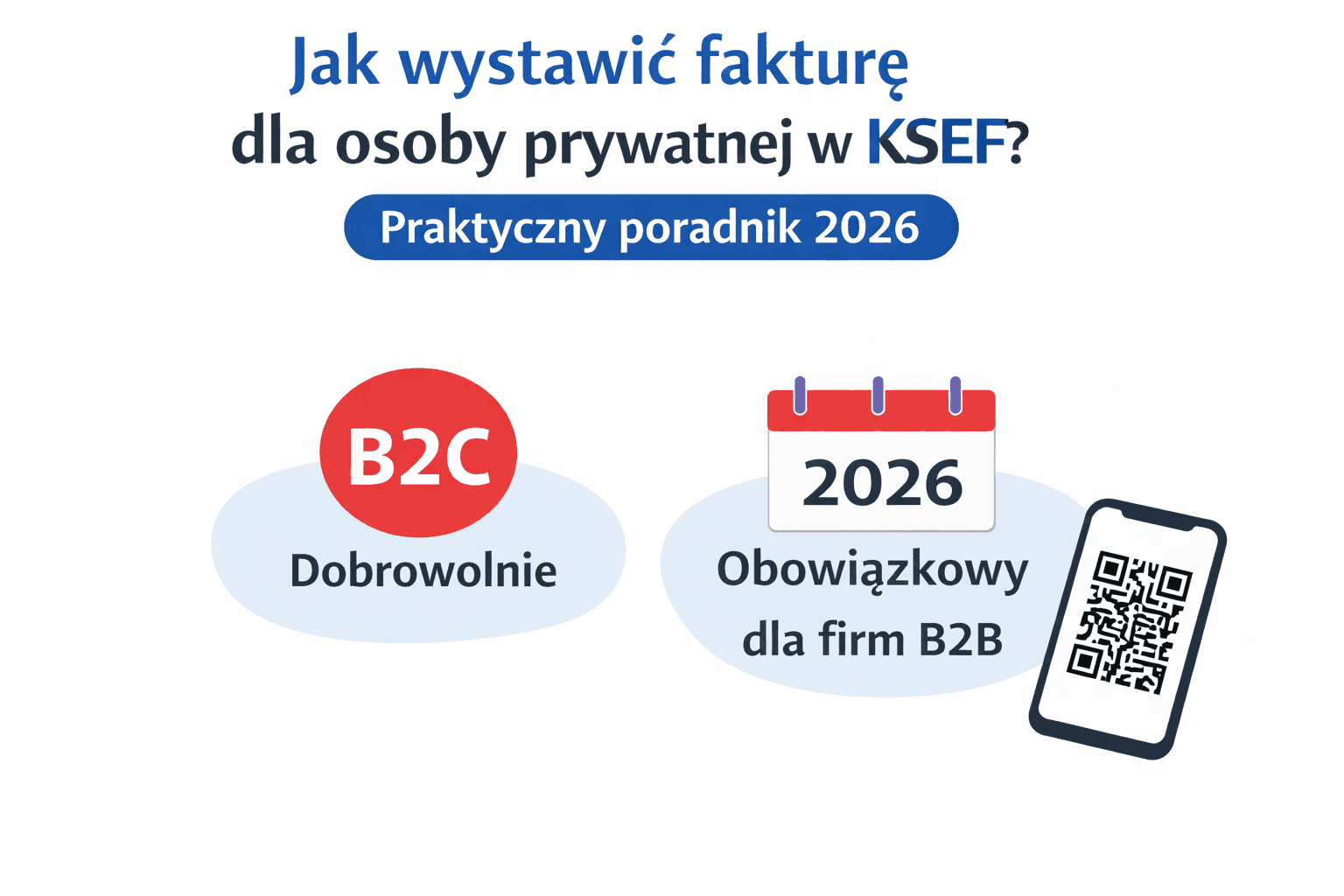
Under current law, invoices issued to consumers are voluntary in KSeF. This means an entrepreneur may issue an invoice for a private person in KSeF but is not required to do so.
Do You Have to Issue a B2C Invoice in KSeF?
No – the legislator excluded such invoices from the obligation. Under Article 106ga(2)(4) of the VAT Act, the obligation to issue structured invoices in KSeF does not apply to invoices issued to a buyer who is a natural person not conducting business activity. In other words, in all B2C transactions the entrepreneur may issue an invoice traditionally (outside KSeF) or not issue one at all (e.g., a fiscal receipt).
Legal basis: Article 106ga(2) of the VAT Act (as amended in 2025) explicitly states that documenting sales to non-business individuals is exempt from KSeF. The Ministry of Finance confirms: 'both before and after February 1, 2026, issuing B2C invoices in KSeF is voluntary.'
Who Is a 'Natural Person Not Conducting Business Activity'?
Simply put – a consumer. A person who does not run a business. Under tax law (Article 15(1) of the VAT Act), a taxpayer is a natural person conducting business activity. Anyone who does not conduct such activity is a non-VAT-taxpayer – a typical individual customer.
An example would be a customer buying goods or services 'for personal use', not for a company. Invoicing a private customer in KSeF is not mandatory.
Entrepreneur Making a Private Purchase
What if the counterparty is formally an entrepreneur (e.g., has their own company and NIP) but purchases goods or services 'for themselves' without using their NIP? In practice, such a purchase is treated as a B2C transaction.
In this case too, the invoice may be issued traditionally outside KSeF. As confirmed by the Ministry of Finance: issuing invoices to individuals conducting business who purchase goods or services for private use (i.e., essentially a B2C transaction) will be voluntary in KSeF.
How to Issue an Invoice for a Private Individual?
Option A – outside KSeF (paper/PDF): You can issue the invoice as before – on paper or electronically (PDF sent by email) without using KSeF. Since B2C invoices are fully excluded from the KSeF obligation, you can use this method without any amount restrictions – the PLN 10,000 monthly limit (described below) applies only to B2B invoices.
Option B – voluntarily in KSeF: You can also voluntarily issue a consumer invoice in KSeF. After generating the e-invoice in KSeF (using integrated software or the free Taxpayer Application), you will receive a KSeF invoice number. A private customer does not have their own KSeF account (no NIP), so they cannot log in to the system.
To deliver the document to the consumer, you should: provide the KSeF invoice number and ensure anonymous access. In practice, the seller can print or send the customer a PDF visualization of the invoice with a QR code containing the KSeF number.
QR Code and Anonymous Access – How Does It Work?
If you issue an invoice in KSeF (Option B), you must provide the consumer with access to the document. Article 106gb(6) of the VAT Act requires that when the buyer is not an active VAT taxpayer, the seller must provide access to the structured invoice by providing a QR code and data enabling identification of the invoice, or by marking it with a QR code enabling access to the invoice in KSeF.
The consumer can use the Taxpayer Application (on the MF website) in 'anonymous access' mode – simply enter the received invoice number or scan the QR code. No Trusted Profile or electronic signature is needed. Access is free and straightforward.
If the buyer (private person) does not need access to the invoice in KSeF, the legislator allows the seller to be released from this obligation – a mutual agreement is sufficient.
PLN 10,000 Limit – Transitional Facilitation Until End of 2026
The legislator provided a transitional exception. Until December 31, 2026, all taxpayers (not just micro-entrepreneurs) are not required to issue invoices in KSeF if the total gross sales value (with VAT) documented by invoices subject to the KSeF obligation does not exceed PLN 10,000 in a given month.
Important: once the limit is exceeded in any month, the KSeF obligation becomes permanent. As the official Ministry of Finance FAQ states: 'If in the second month the taxpayer exceeds the limit, they must issue in KSeF the invoice that exceeded the limit and all subsequent invoices. The fact of not exceeding the limit in the third month is no longer relevant.' There is no going back to issuing outside KSeF.
What counts toward the limit? Only invoices that would mandatorily need to be issued in KSeF (i.e., those with no exclusions). This means B2C invoices do not count toward the PLN 10,000 limit. Similarly, invoices from cash registers and fiscal receipts with NIP up to PLN 450 (treated as simplified invoices until end of 2026) are not included.
Example: if in a given month you issued B2B invoices totaling PLN 8,000 gross and B2C invoices for PLN 5,000, only PLN 8,000 counts toward the limit. The limit has not been exceeded.
Frequently Asked Questions (FAQ)
Should I send the customer a PDF or use KSeF? – If the invoice is for a private person (B2C), you can send it traditionally as a PDF or printout. There is no need to register it in KSeF. If you choose to issue it in KSeF (voluntarily), you can provide the customer with a PDF containing a QR code with the KSeF number.
Does a private person need a KSeF account? – No. A natural person not conducting business does not have a KSeF account (no NIP). They receive invoices through anonymous access – e.g., via QR code or by entering the KSeF number in the Taxpayer Application – without creating an account.
What about fiscal receipts with NIP up to PLN 450? – Until December 31, 2026, fiscal receipts with NIP up to PLN 450 are treated as simplified invoices and do not need to be issued through KSeF. Their value does not count toward the PLN 10,000 limit.
Does a rental invoice to a private person need to go through KSeF? – No. Renting to a private individual is a B2C transaction. Under Article 106ga(2)(4) of the VAT Act, the KSeF obligation does not apply to invoices for natural persons not conducting business – regardless of whether the service is VAT-taxable or VAT-exempt.
Summary
B2C invoices are not subject to the KSeF obligation – entrepreneurs can issue them as before (paper or PDF) or optionally in KSeF. When voluntarily issuing in KSeF, remember to provide the customer with anonymous access (via QR code or KSeF invoice number).
Additionally, until the end of 2026, all taxpayers may issue B2B invoices outside KSeF as long as monthly gross turnover on such invoices does not exceed PLN 10,000. B2C invoices and receipts with NIP up to PLN 450 are not counted toward this limit. Once the limit is exceeded, the KSeF obligation becomes permanent.
Sources: official KSeF FAQ by the Ministry of Finance (ksef.podatki.gov.pl), MF training materials (Środy z KSeF), VAT Act – Articles 106ga(2), 106gb(4) and (6), 145m.
Simplify KSeF Invoicing with AI
KSeF GPT helps you generate, analyze, and validate structured invoices. See how artificial intelligence makes e-invoicing easier.
Try KSeF GPTRelated articles
AI Streamlines Electronic Invoices in KSeF: 2026 Guide
How does artificial intelligence detect errors, fraud, and anomalies in KSeF invoices? A practical automation guide for entrepreneurs and accountants in Poland.
KSeFGPT: import, export, analytics and AI for KSeF - all in one application
How KSeFGPT connects directly to the KSeF API, what the AI Chat module, Counterparts module and Invoices module offer - and why the application is available in Polish, English, German and Ukrainian.