KSeF is Just the Beginning. Why AI Will Change Your Accounting More Than e-Invoicing Itself
February 1, 2026 – this date has been stirring emotions for months. But is KSeF really the problem? Or is it an opportunity that most companies don't see?
The Real Challenges of KSeF (Not in the Manuals)
In the first days of February 2026, the system recorded almost 2 million users. Seemingly a success. But the reality looked different: API outages that left goods in warehouses, multi-hour delays in assigning identification numbers, rigorous XML validation that rejected correct invoices due to minor errors.
No ability to attach documents to invoices (yes, still have to send them by email), login problems, certificates, tokens. Sound familiar? But KSeF isn't the source of the problem. It's the moment when tools that "somehow worked" are no longer enough.
What Really Changed
KSeF enforces one fundamental change: all invoices must be structured. This isn't just XML format – it's an entirely new quality of data.
Until now, a PDF invoice was a "pretty picture" for humans, but garbage for computers. Every company had its own internal coding system. Integration with contractors? Manual copying or complicated EDI. Archiving? Tons of paper or a chaotic hard drive.
Now every invoice is the same, readable format. Data is available through API. The system centrally archives documents for 10 years. You have access to transaction history in one place. This isn't a limitation. It's an opportunity. But only for those who know how to use it.
Why Most Companies Will Waste This Opportunity
Typical reaction to KSeF? "Fine, let's implement it and be done." And so half-measures are born: manually copying invoices from KSeF to Excel, printing e-invoices "just in case", double work: accounting system + manual fixes in KSeF, fear of errors because "what if something goes wrong".
The KSeF Paradox: A system created for automation becomes a source of manual work. Why? Because there's no connection between raw XML data and daily accounting work. Because the KSeF API is powerful but requires programming knowledge. Because small companies don't have the budget for dedicated integrations.
Enter AI. Not as a Gadget, but as a Tool
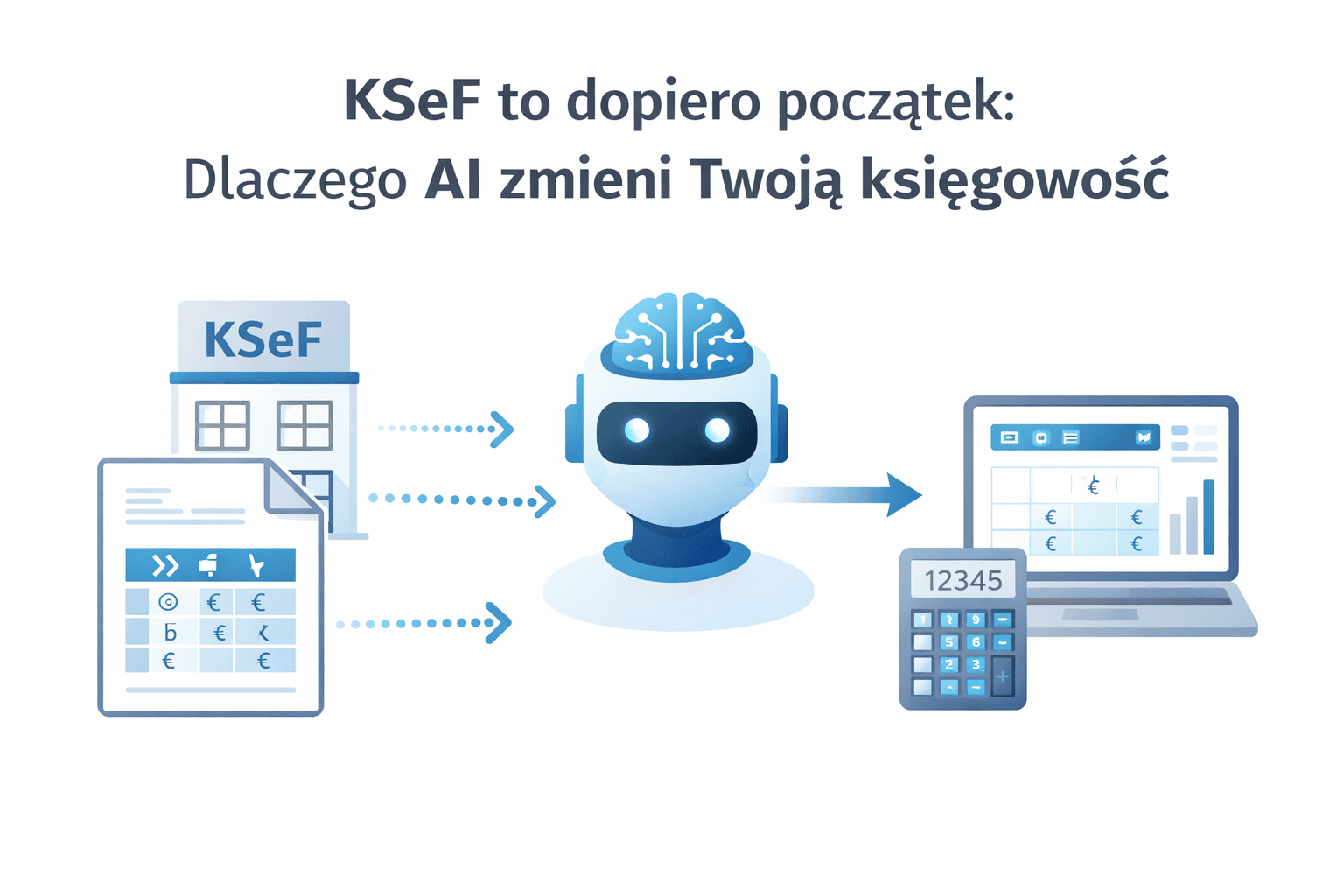
This is where KSeF GPT comes in – and it's not another "chatbot for everything". It's a specialized AI agent that understands the KSeF context.
What does this change in practice? Instead of hours spent manually importing invoices from KSeF to a spreadsheet, you can say "Show me all invoices from supplier X from the last quarter" and get a ready analysis.
Instead of copying data between systems, controlling every XML field, fear of errors, you can have AI verify the invoice before sending – the agent will catch missing items and irregularities. Instead of chaotic data export to various formats, you can export directly to Google Sheets or Excel while preserving structure.
How Does It Work Under the Hood?
KSeF GPT is not a magic black box. It's a combination of several technologies that together solve a specific problem:
Integration with KSeF API – direct connection to the ministry system, authorization by token or certificate. Natural language processing – you understand what you want to do, you don't need to know the API syntax. Data structuring – XML conversion to readable reports, charts, analyses. Automation of repetitive tasks – mass import, export, generating summaries.
Is It Safe?
That's a question you should ask. KSeF GPT operates in an "AI agent" model – meaning it performs operations on your behalf, but doesn't store passwords, doesn't have access to certificates after the session, all operations are logged.
Key difference: It's not an external system that "manages" your KSeF. It's a tool that helps you manage better.
Not Just KSeF. It's About the Future of Accounting.
KSeF is one of the first steps toward financial digitalization in Poland. More will follow: electronic financial statements, integration with banking systems, automatic reporting to tax authorities, real-time predictive analysis.
Companies that learn to use AI for invoice handling now will have a huge advantage. Those that continue doing it manually... will be fighting for survival.
Try It Yourself
You don't have to implement AI across the entire company right away. Start with a small step: go to ksefgpt.pl, test the beta version (test data, so zero risk), see how AI understands invoice queries, compare: how much time do you spend now on what KSeF GPT does in 2 seconds?
The statistics speak for themselves: 200+ active chats, 99.9% uptime, response time under 2 seconds. This isn't the future. It's happening now.
Summary
KSeF isn't the end of the world. It's the beginning of a new era – an era where financial data is structured, accessible, and ready for automation.
The choice is yours: you can treat KSeF as another mandate and struggle with manual copying, or you can use this change as a springboard to modern, automated accounting.
KSeF GPT is one of the tools that enables the latter. Is it the best solution for your company? It depends. But it's worth checking before the competition figures out what's going on.
Related articles
AI Streamlines Electronic Invoices in KSeF: 2026 Guide
How does artificial intelligence detect errors, fraud, and anomalies in KSeF invoices? A practical automation guide for entrepreneurs and accountants in Poland.
KSeFGPT: import, export, analytics and AI for KSeF - all in one application
How KSeFGPT connects directly to the KSeF API, what the AI Chat module, Counterparts module and Invoices module offer - and why the application is available in Polish, English, German and Ukrainian.