KSeF Invoice Issue Date and Payment Term: When to Count Invoice Delivery From?
Check when a KSeF invoice is deemed received, how to distinguish the issue date from the KSeF number date and why the payment term still follows from the contract and commercial transaction rules.

Article Summary
For a standard structured invoice received in KSeF by a domestic buyer with a NIP, the invoice receipt date is the day when the KSeF number is assigned. If the contract says payment is due within 7, 14 or 30 days from receipt of the invoice, that date is usually the practical starting point.
KSeF does not itself determine when the payment becomes due. The system helps establish the invoice receipt date, but the payment term still follows from the contract, the invoice content, rules on commercial transactions and the rules for counting time limits.
The greatest risk of error appears when a company mixes up the issue date, XML submission date, KSeF number assignment date and PDF email date. In a simple KSeF flow, the KSeF number date is key, but exceptions must be checked for buyers served outside KSeF, offline modes and unusual contract wording.
Short Answer: Which Date Starts the Term?
If a domestic buyer with a NIP receives an invoice through KSeF, the structured invoice is deemed received on the day its KSeF number is assigned. That means that for a contract clause such as "14 days from receipt of the invoice", the safest first step is to check the KSeF number assignment date.
This does not mean that KSeF itself sets the payment deadline. KSeF identifies the moment of invoice receipt in the system. The contract, invoice and commercial transaction rules decide whether payment is due after 7, 14, 30 or 60 days, or on a specific date stated on the invoice.
When counting a term expressed in days, remember the Civil Code rule: if a specific event starts the term, the day on which that event occurs is not included in the calculation. In practice, the day the KSeF number is assigned is not day one unless a special contract clause or legal rule says otherwise.
| Moment | What it means | Meaning for payment |
|---|---|---|
| Issue date | The invoice date or the moment of issue under KSeF rules. | It does not have to be the same date as receipt by the buyer. |
| KSeF number assignment date | The moment when KSeF accepts the invoice and assigns its identifier. | In the standard KSeF flow, this is the invoice receipt date for the buyer. |
| Invoice download date | The moment when the buyer actually opens or downloads the document. | Usually it does not move the receipt date in the standard KSeF flow. |
| Payment term | A date or number of days resulting from the contract, invoice or statute. | It is not created automatically by KSeF itself. |
Issue Date, Receipt Date and Payment Term
In conversations about KSeF it is easy to say that an invoice was "issued" while meaning three different things. For settlements, that is not enough. You need to know when the document was issued, when it was treated as received by the buyer and what payment term the parties agreed for the transaction.
The issue date matters for invoicing itself. The receipt date matters, among other things, for the buyer's invoice workflow and can be the practical starting point for clauses such as "payable from receipt of the invoice". The payment term is a separate layer: it may follow from a contract, order, terms and conditions, invoice or the Act on Counteracting Excessive Delays in Commercial Transactions.
If you want to organize the difference between issuing, sending and accepting an invoice, see the separate guide How long to send an invoice to KSeF?. This article does not repeat the whole submission process; it focuses on the receipt date and payment term.
| Concept | Where to find the date | Most common mistake |
|---|---|---|
| Issue date | On the invoice and in the document data. | Automatically treating it as the delivery date. |
| Receipt date in KSeF | In the KSeF number assignment date. | Waiting for the buyer to manually download the invoice. |
| Payment term | In the contract, on the invoice or in rules for commercial transactions. | Assuming that KSeF itself sets the due date. |
Standard Case: Online Invoice for a Domestic Buyer
In the standard case, the seller issues a structured invoice, sends the FA(3) XML to KSeF, the system accepts the document and assigns a KSeF number. If the invoice contains the domestic buyer's NIP, the invoice becomes available to that buyer in KSeF.
The VAT Act and Ministry of Finance materials state that a structured invoice is deemed received through KSeF on the day its KSeF number is assigned. This matters more than simply clicking "send" in the seller's system, because submission can still fail or processing can finish later.
The Ministry's example illustrates the midnight issue well. An invoice was submitted on 1 February 2026 at 23:56, but the KSeF number was assigned on 2 February 2026 at 00:01. For the domestic buyer, the receipt date is 2 February 2026, because that is when the invoice received its KSeF number.
The buyer does not have to manually open the invoice in the system for the receipt date to arise in the standard KSeF flow. This is not like registered mail, where you wait for physical collection. KSeF is based on the invoice becoming available after the system assigns the number.
How to Count 7, 14 or 30 Days from Invoice Receipt
If the term is expressed in days and starts from an event, that event may be receipt of the invoice in KSeF. The Civil Code provides that in such a calculation the day on which the event occurs is not counted.
Example: the KSeF number was assigned on 2 February 2026, and the contract says payment is due 14 days from receipt of the invoice. Day 1 is 3 February, and day 14 is 16 February. This is a simple example without addressing a situation where the last day falls on a Saturday, a public holiday or another day requiring additional assessment.
In practice, it is worth storing three fields in the system: the KSeF number assignment date, the method used to define the payment term and the calculated payment date. This lets accounting see whether the term follows from a specific invoice date or from a formula such as "X days from receipt".
| Step | What to check | Why |
|---|---|---|
| 1 | Whether the contract states a specific date or a number of days. | This determines the counting method. |
| 2 | When KSeF assigned the invoice number. | In the standard flow, this is the receipt date. |
| 3 | Whether the term is counted in days, business days or to a specific date. | Different wording gives different results. |
| 4 | Whether there are special contractual or statutory provisions. | Not every transaction follows the simple pattern. |
When a PDF or Email Does Not Move the Receipt Date
A PDF visualization of the invoice may be convenient for people: it is easier to read, approve internally or attach to correspondence. It does not change the basic rule for a standard invoice received in KSeF by a domestic taxpayer with a NIP.
If the invoice has been accepted by KSeF and received a KSeF number, a later email with a PDF preview should not be treated as a new receipt date for the structured invoice. Email can help operationally, but it does not replace the KSeF receipt rule.
The same works in the other direction: sending a PDF before the XML is accepted by KSeF does not mean that the standard structured invoice has already been received in KSeF. If you want to separate the PDF from the actual XML, also read Can you send a PDF to KSeF?.
Exceptions: Consumers, Buyers Without a NIP and Foreign Counterparties
Not every invoice reaches the buyer through standard receipt in KSeF. The VAT Act provides for groups of buyers for whom an invoice may be made available in a way other than through KSeF. In those cases, the receipt date may depend on the buyer's actual receipt of the invoice.
This applies, among other things, when the buyer does not use a Polish NIP in a way that allows the document to be received in KSeF, or when the invoice is made available outside KSeF under the rules for a given recipient group. In that case, you must not automatically apply the simple rule "KSeF number date = receipt date".
For the seller, the most important point is to identify the buyer type before sending a payment demand. The same clause "14 days from receipt of the invoice" may refer in one case to the KSeF number date and in another to the actual date of making the invoice available outside KSeF.
| Buyer type | Most common reference point | What to check |
|---|---|---|
| Domestic taxpayer with a NIP receiving in KSeF | KSeF number assignment date. | Whether the invoice has been accepted and has a KSeF number. |
| Consumer | Date of actual availability outside KSeF. | Which method was used to deliver the invoice. |
| Entity without a Polish NIP | Actual receipt date in the agreed channel. | Whether the invoice was made available outside KSeF. |
| Foreign counterparty | Depending on availability rules and party arrangements. | Whether the buyer belongs to a group served outside KSeF. |
Offline24, KSeF Failure and the Payment Term
Offline modes do not change the need to first determine how the invoice was effectively received. In offline24, for an ordinary domestic buyer receiving invoices in KSeF, the reference point remains the KSeF number assignment date after the invoice is submitted to the system.
However, if the invoice was made available outside KSeF to a buyer covered by special rules, the actual receipt date may matter. In the failure mode, Ministry of Finance materials also indicate additional rules depending on actual receipt and later KSeF number assignment.
This article does not repeat the full offline mode instructions, because that would distract from the main topic. If you need submission procedures, QR codes, UPO and statuses, go to the guide Sending invoices to KSeF.
Commercial Transactions: What Can Be Agreed in the Contract
In commercial transactions, the payment term is not an arbitrary text field detached from the law. The Act on Counteracting Excessive Delays in Commercial Transactions provides limits, including a 60-day rule for many B2B relationships and shorter terms where the debtor is a public entity, with exceptions listed in the Act.
It is also important that parties to a commercial transaction cannot simply agree that the invoice was delivered on a day other than the actual one. They can, however, precisely describe the payment mechanism, for example "14 days from the date of receipt of the invoice in KSeF" or state a specific payment date on the invoice that is consistent with the contract.
The safest drafting approach is to avoid artificially shifting delivery and instead describe the starting point clearly. For the standard KSeF flow, this may be the KSeF number assignment date. For invoices made available outside KSeF, the actual channel and moment of receipt should be described.
| Wording | Operational assessment |
|---|---|
| 14 days from receipt of the invoice in KSeF | Clear if the buyer receives invoices in KSeF. |
| 14 days from invoice issue | Simple, but it does not answer the delivery question. |
| Payment by 20 March 2026 | Clearest for settlements if consistent with the contract and law. |
| Term from sending the PDF by email | Risky as a standard for invoices received in KSeF. |
Invoice With a Specific Payment Date or a Term Counted from Receipt
From an accounting perspective, the simplest option is a specific payment date entered on the invoice. The settlement system then does not have to reconstruct a formula, count days and establish what date was the starting point. There is one condition: the date must be consistent with the contract and the rules for the transaction.
The formula "X days from receipt of the invoice" is flexible, but it requires good records. You need to know when the invoice was received in KSeF or when it was actually received outside KSeF. Without that, it is easy to send a payment demand too early or react too late to an overdue receivable.
In practice, many companies will combine both approaches: the contract describes how the term is counted, while the invoicing system already enters a specific payment date. In KSeF, it is worth keeping the KSeF number date with the invoice so that, in a dispute, you can show where the payment date came from.
What the Seller Should Check Before Sending a Payment Demand
Before sending a payment demand, do not look only at the invoice issue date. Check whether the document was accepted by KSeF, when the KSeF number was assigned, what issue mode was used and whether the buyer received the invoice in KSeF or outside the system.
UPO is a good operational source of evidence in this process because it links the invoice with system acceptance and the KSeF number. Read more about the confirmation itself in the article UPO in KSeF.
If the payment term is disputed, also check the wording of the contract, order and invoice. KSeF helps establish the invoice receipt date, but it will not answer for you whether the parties agreed on 14 days from receipt, a specific date, prepayment, partial payment or another mechanism.
| Check | Question | Purpose |
|---|---|---|
| KSeF number | Has the invoice been accepted and assigned an identifier? | Without this it is hard to speak of standard receipt in KSeF. |
| Number assignment date | When did KSeF assign the number? | This is usually the receipt date in the standard flow. |
| Invoice mode | Online, offline24, unavailability or failure? | The mode may change how the receipt date is determined. |
| Buyer type | Does the buyer receive invoices in KSeF? | When made available outside KSeF, the actual receipt date may matter. |
| Contract | Is the term counted from receipt, issue or a specific date? | This determines the payment mechanism. |
| Performance date | Was the invoice delivered before delivery or service? | The late-payment act provides special rules for such cases. |
How KSeFGPT Helps Control Payment Terms
KSeFGPT can help keep in one place the data that usually drifts between the invoicing system, email inbox and receivables spreadsheet: invoice number, KSeF number, submission status, UPO, buyer data, amounts and payment term.
For a finance team, the key point is not to count deadlines from memory. When the invoice shows the KSeF number, acceptance date and UPO status, it is easier to distinguish a sent document from an accepted one. This reduces the risk of premature payment demands and helps spot invoices without confirmation faster.
KSeFGPT is not a law firm and does not resolve disputes over when a receivable becomes due. It does, however, help collect the data needed for a safer conversation with accounting, a counterparty or an adviser: FA(3) XML, PDF, UPO, KSeF number and document status.
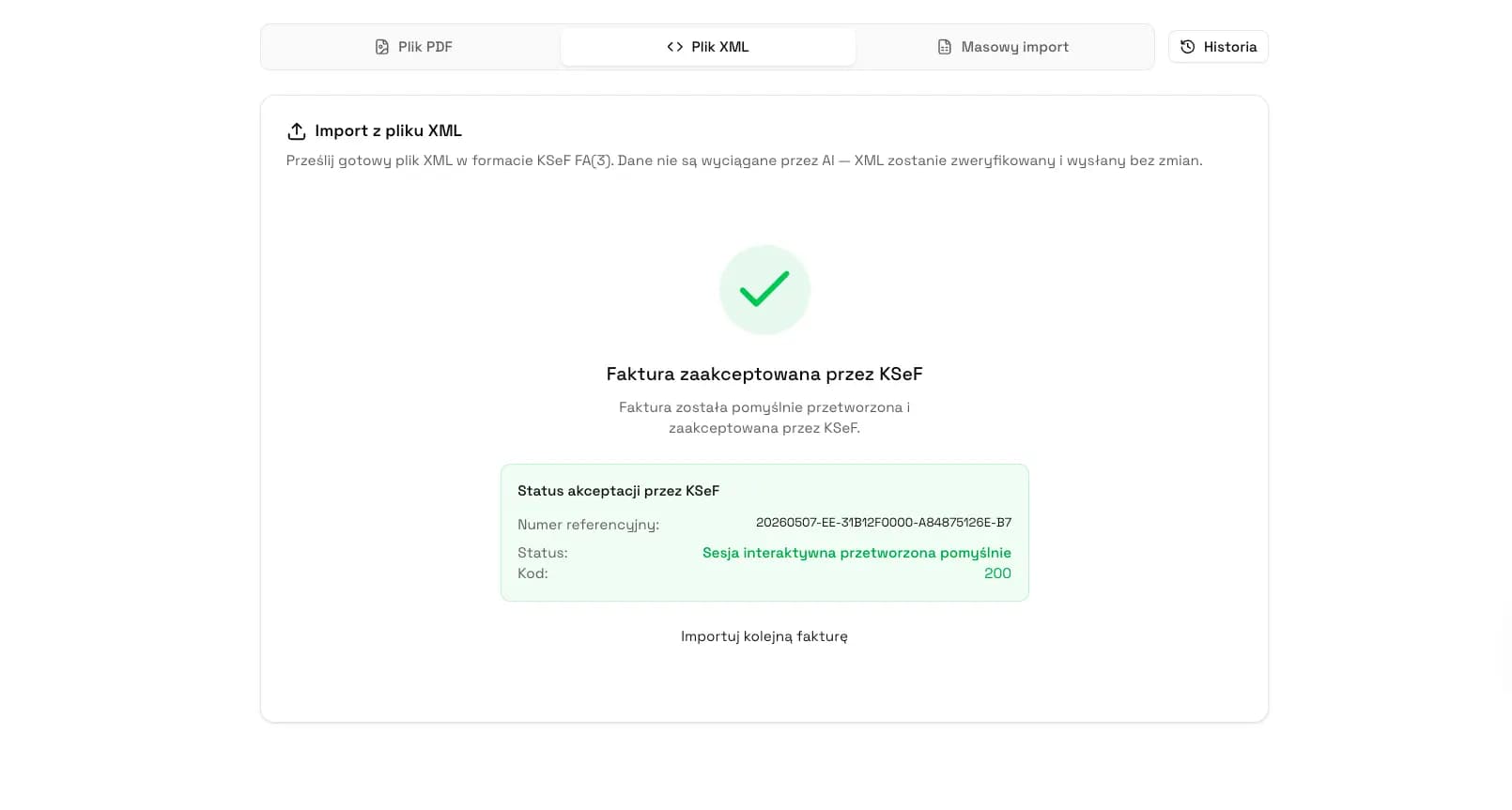
Control KSeF numbers, UPO and payment terms
In KSeFGPT you can handle invoices, submission statuses, UPO and settlement data in one process.
Go to the invoices moduleMost Common Mistakes When Counting Payment Terms
The first mistake is counting the term from the issue date even though the contract refers to receipt of the invoice. In KSeF these dates may differ, especially when the KSeF number is assigned after midnight or the invoice is submitted after offline work.
The second mistake is treating the PDF as the proper invoice. A PDF is a visualization and may help communication, but in the standard KSeF flow the key element is the XML accepted by the system and the KSeF number.
The third mistake is automatically applying one rule to all buyers. A domestic taxpayer with a NIP receiving invoices in KSeF is a different case from a consumer, an entity without a Polish NIP or a foreign counterparty to whom the invoice is made available outside KSeF.
| Mistake | Better practice |
|---|---|
| Counting from the issue date without checking the contract. | First check whether the term runs from issue, receipt or a specific date. |
| Waiting for the buyer to manually download the invoice. | In the standard flow, look at the KSeF number assignment date. |
| Treating an email with a PDF as a new receipt date. | Separate the visualization from receipt of the structured invoice in KSeF. |
| Ignoring exceptions for buyers outside KSeF. | Check the buyer type and how the invoice was actually made available. |
Frequently Asked Questions
From when should the payment term for a KSeF invoice be counted?
If the contract refers to a term counted from receipt of the invoice, in the standard KSeF flow for a domestic buyer with a NIP the practical reference point is the date when the KSeF number is assigned. The payment term itself still follows from the contract, the invoice and commercial transaction rules, not from KSeF alone.
Is the invoice issue date in KSeF the delivery date?
Not always. In KSeF you need to distinguish the issue date, the submission date and the receipt date. For a structured invoice received through KSeF, the receipt date is the day when the KSeF number is assigned.
Does the buyer have to download the invoice from KSeF for the payment term to start?
In the standard KSeF flow, the invoice is treated as received on the day the KSeF number is assigned. You do not wait for the buyer to manually download or open it, although in unusual cases you should check the issue mode and how the document was made available.
What if the invoice says 14 days from receipt?
If the starting point is receipt of the invoice in KSeF and the KSeF number was assigned on 2 February, the first day of a term counted in days is 3 February. This example does not replace analysis of the contract or special rules for a given transaction.
Does a PDF sent by email change the invoice receipt date?
For a standard structured invoice received in KSeF, a PDF or email is operationally useful, but should not be treated as a separate receipt date in KSeF. The answer may differ for buyers to whom the invoice is made available outside KSeF.
How should the term be counted for a foreign counterparty?
For counterparties covered by rules for making invoices available outside KSeF, you should check when the invoice was actually received in the agreed way. This is a different scenario from standard receipt by a domestic taxpayer with a NIP in KSeF.
Does the transfer title have to include the KSeF number?
From 1 January 2027, selected payments for structured invoices between active VAT taxpayers require the KSeF number or a collective identifier. This is a separate payment obligation, not a rule that determines the payment deadline itself.
Recommendation
If you want to go deeper without duplicating the whole submission process, start with these four articles:
How long to send an invoice to KSeF? - the difference between issue, submission, acceptance and deadlines for offline modes.
UPO in KSeF - what UPO confirms, when to download it and how to distinguish the KSeF number from the session number.
Sending invoices to KSeF - a broader guide to submission, statuses, authentication and error handling.
Can you send a PDF to KSeF? - why the PDF is a visualization and the actual document in KSeF is the FA(3) XML.
Keep KSeF statuses and payment terms in one place
KSeFGPT helps handle invoices, KSeF numbers, UPO, FA(3) XML, PDFs and settlement data without manually stitching information from several systems.
Go to KSeFGPTOfficial sources
This article was prepared based on official Ministry of Finance materials and current legal acts checked on 29 May 2026.
- KSeF - Issuing and receiving invoices
Ministry of Finance · accessed: 29 May 2026
Rules for treating an invoice as received and rules for online, offline24, unavailability and failure modes in KSeF.
- KSeF - KSeF number and collective identifier
Ministry of Finance · accessed: 29 May 2026
Difference between an invoice number and KSeF number, and obligations to provide the KSeF number or collective identifier from 2027.
- Polish VAT Act
ELI / Journal of Laws · accessed: 29 May 2026
Legal basis for structured invoices, in particular Articles 106na and 106gb.
- Act on Counteracting Excessive Delays in Commercial Transactions
ELI / Journal of Laws · accessed: 29 May 2026
Payment term limits and rules on delivery of invoices or bills in commercial transactions.
- Polish Civil Code
ELI / Journal of Laws · accessed: 29 May 2026
Rules for counting terms expressed in days, in particular Article 111.
Zweryfikowano merytorycznie: Bogdan Mazurek
Tax adviser · 29 May 2026
Content verified for the distinction between invoice issue date, receipt date in KSeF, rules for counting terms and limits resulting from commercial transactions.
Related articles
KSeF in Restaurants: How to Prepare Invoices, Receipts and Multiple Locations
A practical scenario for restaurants, catering and chains: B2B invoices, receipts with NIP, suppliers, corrections, UPO and document-flow control.
KSeF 2026: old-style invoicing without penalties, but with 2027 risk
Learn when an invoice outside KSeF is an exemption, when it is an offline mode and when it becomes a compliance risk.
How to issue an invoice with AI step by step
A practical guide for companies and accounting teams: how to prepare an invoice in KSeFGPT with AI chat, check Preview, PDF and FA(3) XML, and manually approve submission to KSeF.
Receipt with NIP after 1 January 2027 - the end of simplified invoices outside KSeF
See which 2026 transitional rules are expected to expire, when KSeF will cover the smallest taxpayers, and how to distinguish a receipt with NIP from a simplified invoice.