Receipt with NIP after 1 January 2027 - the end of simplified invoices outside KSeF
See which 2026 transitional rules are expected to expire, when KSeF will cover the smallest taxpayers, and how to distinguish a receipt with NIP from a simplified invoice.
Article Summary
Until 31 December 2026, a fiscal receipt with the buyer's NIP up to PLN 450 or EUR 100 is expected to continue being treated as a simplified invoice, if it meets the conditions of Article 106e(5)(3) of the Polish VAT Act, and it will not count towards the PLN 10,000 KSeF threshold.
From 1 January 2027, the transitional exclusion for the smallest taxpayers and the exception for receipts with NIP as simplified invoices outside KSeF are expected to expire.
For sellers and accountants, this means they need clear rules for distinguishing B2B documents, B2C documents, fiscal receipts and full invoices before the KSeF obligation fully applies.
Why 2027 Changes Receipts with NIP
KSeF is being introduced in stages. From 1 February 2026 the obligation applies to large taxpayers, and from 1 April 2026 to other taxpayers, with a deferral until 1 January 2027 for those whose monthly value of sales documented with invoices covered by mandatory KSeF does not exceed PLN 10,000 gross.
The transitional rules include, among other things, the ability to issue paper or PDF invoices outside KSeF when monthly gross sales from invoices covered by the obligation do not exceed PLN 10,000. In addition, until the end of 2026, a fiscal receipt treated as a simplified invoice - generally a receipt with the buyer's NIP up to PLN 450 or EUR 100 - does not have to be issued in KSeF.
From 1 January 2027, these transitional exceptions are expected to expire. The smallest taxpayers are expected to join the full KSeF obligation, and a receipt with NIP will no longer be a safe way to bypass the system.
Table of Contents
1. What remains in place until the end of 2026?
2. What changes from 1 January 2027?
3. How to distinguish a receipt with NIP, a simplified invoice and a full invoice?
4. Practical exceptions in 2027
5. Action plan for sellers and accountants
6. Common wrong assumptions
What Remains in Place Until the End of 2026?
Until the end of 2026, the obligation to issue invoices in KSeF is softened by several transitional solutions. They work as temporary relief for companies adapting to the new system.
The transitional PLN 10,000 threshold applies only to invoices that would normally be subject to mandatory KSeF. B2C invoices and fiscal receipts with the buyer's NIP treated as simplified invoices are not included in that threshold.
A fiscal receipt with the buyer's NIP up to PLN 450 or EUR 100 is expected to be treated as a simplified invoice until 31 December 2026, provided it meets the conditions of Article 106e(5)(3) of the Polish VAT Act. This means the seller does not have to issue it in KSeF, and the document can still serve as proof of sale.
What Changes From 1 January 2027?
From 1 January 2027, the transitional exclusion for the smallest taxpayers is expected to expire. This means that all companies covered by mandatory KSeF will have to issue structured invoices using KSeF in line with the system rules.
The PLN 10,000 threshold will stop working as a deferral in the KSeF context. When a B2B invoice is issued in 2027, it will have to go to KSeF unless it falls within a clear statutory exception.
A receipt with NIP, without an additional exception, will no longer automatically be a way to avoid KSeF. After 2026, such a document may in practice be issued only as fiscal proof under cash register rules, not as a simplified B2B invoice.
How to Distinguish a Receipt with NIP, a Simplified Invoice and a Full Invoice?
From 2027, accounting teams will need a clear distinction between a fiscal document and a structured invoice. The table below shows the key differences.
| Document | Who can issue it | KSeF? | Does it count towards the PLN 10,000 threshold? |
|---|---|---|---|
| Receipt with NIP up to PLN 450 or EUR 100 | Seller using a fiscal cash register | No until 31.12.2026 if it meets simplified invoice conditions; after 2026 not as a simplified invoice outside KSeF | No until 2026; after 2026 the B2B invoice threshold is no longer relevant |
| Simplified invoice | Seller documenting a sale with a simplified invoice | Outside KSeF as an exception until 2026; standardly in KSeF from 2027 | Yes for B2B invoices covered by the obligation |
| Full invoice | Any B2B seller | Yes, unless the transaction is excluded | Yes |
| B2C document | Individual not conducting business | No, it is excluded | No, because it is not covered by mandatory KSeF |
Practical Exceptions in 2027
Even though transitional KSeF reliefs are expected to expire, clear statutory exceptions will still exist in 2027. This will not mean freedom in documenting sales.
The most important exceptions are:
1. Invoices for individuals not conducting business (B2C). These documents remain outside mandatory KSeF.
2. Specific statutory and regulatory exclusions. Exports, intra-Community supplies and services for foreign taxpayers are not automatically excluded from KSeF simply because the buyer does not have a Polish NIP. Separate exclusions include, among others, self-billing cases specified in the regulation where the buyer or seller is not identified with a Polish NIP for the relevant transaction.
3. Fiscal receipts with the buyer's NIP treated as simplified invoices - this exception is expected to expire after 2026, so it should not be treated as a permanent solution in 2027.
Action Plan for Sellers and Accountants
For sellers and accountants, the important task now is to prepare procedures that separate documents actually covered by the obligation from those that are excluded. This reduces the risk of mistakes at the cash register and in the sales system.
The preparation process should include both sales staff and the accounting department. Both sides need to know when a receipt with NIP may remain fiscal proof and when a B2B invoice must be issued using KSeF.
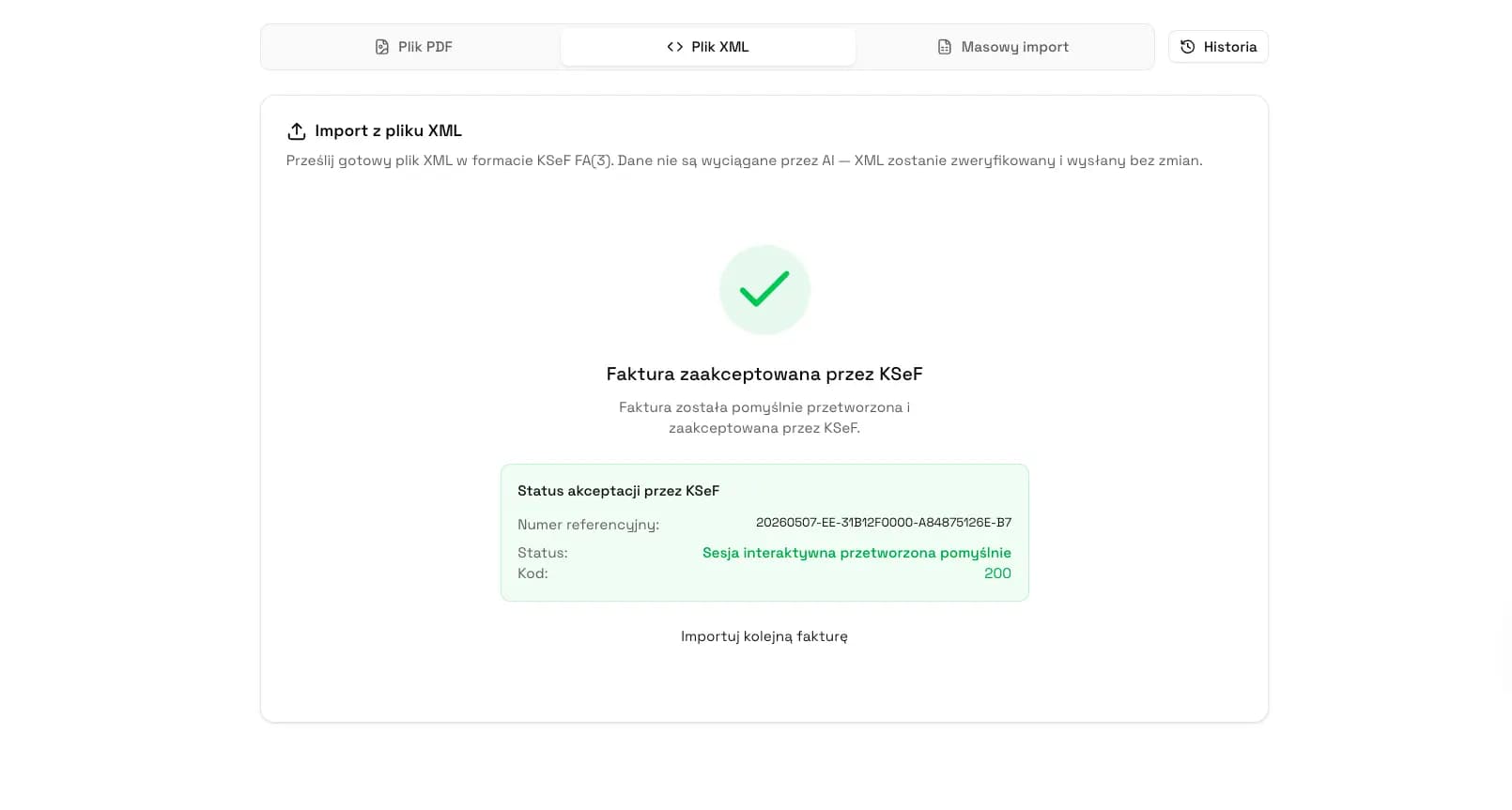
Use XML import, export and validation tools to check before submission whether the document meets the FA(3) standard.
Check KSeFGPT tools for preparing documents
KSeF documents are worth verifying before submission. KSeFGPT can help import, analyze and prepare structured invoices.
See toolsCommon Wrong Assumptions
Mistake 1: A receipt with NIP always means a B2B invoice. That is not true. A receipt with the buyer's NIP up to PLN 450 or EUR 100 functions as a simplified invoice only if it meets the VAT Act conditions, and the KSeF exclusion is transitional.
Mistake 2: A simplified invoice will still work outside KSeF after 2026. After 1 January 2027, the simplifying exceptions are expected to expire and most B2B invoices will go to KSeF.
Mistake 3: The PLN 10,000 threshold applies to all sales documents. The threshold applies only to invoices covered by mandatory KSeF, not to fiscal receipts or B2C invoices.
Mistake 4: The move to KSeF happens only after crossing the threshold. After 2026, crossing the threshold will not be the condition - the obligation becomes general, and the threshold remains only a temporary transitional rule.
Expert Explanation
The changes planned for 2027 do not mean that a receipt with NIP will suddenly become illegal. They mean that the transitional exception is expected to stop working and companies will have to apply the permanent KSeF rules.
For small sellers, the most important thing will be not to confuse B2C and B2B transactions. A private customer will still be able to receive a document outside KSeF, but an invoice for a business should be issued in the system.
In practice, it is worth deciding now which documents will be processed automatically as KSeF documents and which will be handled as regular fiscal receipts or B2C invoices. This separation will reduce the risk of incorrect postings and tax control problems.
Frequently Asked Questions
Can a receipt with NIP still be printed outside KSeF after 2026?
Yes, if it is a fiscal receipt issued from a cash register as a document for a private customer or under cash register rules. It will not, however, be an automatic simplified invoice for B2B transactions after 2026.
Is an invoice for a private individual always outside KSeF?
Yes. B2C invoices remain outside mandatory KSeF under Article 106ga(2) of the Polish VAT Act, even after 2026.
Does a B2C document count towards the PLN 10,000 threshold?
No. Until 31.12.2026 the threshold applies only to invoices covered by mandatory KSeF, not to B2C documents and not to fiscal receipts with the buyer's NIP treated as simplified invoices.
What should I do if a private customer requests an invoice?
Issue it traditionally outside KSeF or voluntarily in KSeF. If you choose KSeF, provide the consumer with the invoice in an agreed form, for example as a paper or electronic visualization with a QR code and KSeF number.
Will the smallest taxpayer have to send all invoices to KSeF from 2027?
Yes, from 1 January 2027 the smallest taxpayers are expected to join the full KSeF obligation, unless the transaction falls within a statutory exception.
Will a receipt with NIP up to PLN 450 or EUR 100 still be treated as a simplified invoice outside KSeF?
No, this exception is expected to expire after 31 December 2026. In 2027, a fiscal receipt with NIP will be a cash register document, not a substitute B2B invoice outside KSeF.
Related Articles
Can a PDF be sent to KSeF? - learn which document formats KSeF accepts and how to prepare files for submission.
XML validation and processing in KSeF - understand the verification process before submitting a structured invoice.
Can you avoid using KSeF in 2026? - review the exceptions and transitional rights in 2026.
KSeFGPT - app for import, export and AI analysis - tools that streamline work with KSeF documents.
Data Sources
National e-Invoicing System - implementation plan, Ministry of Finance - mandatory KSeF timeline and deferral for the smallest taxpayers until 1 January 2027.
Scope of mandatory KSeF, podatki.gov.pl - dates, exclusions, transitional provisions, the PLN 10,000 threshold and fiscal receipts with NIP up to PLN 450 or EUR 100.
KSeF 2.0 questions and answers, podatki.gov.pl - Ministry of Finance answers on receipts with NIP, simplified invoices and the end of the transitional exclusion after 31 December 2026.
KSeF rules and legal provisions, podatki.gov.pl - the PLN 10,000 threshold, effective dates and penalties from 1 January 2027.
Issuing and receiving invoices, podatki.gov.pl - rules for providing invoices to consumers, QR code, KSeF number and invoice receipt by taxpayers with NIP.
Ministry of Finance regulation of 7 December 2025 on cases where structured invoices are not mandatory - selected exclusions from mandatory KSeF, including self-billing cases without a Polish NIP for the relevant transaction.
KSeF 2.0 Handbook part II: issuing and receiving invoices in KSeF - practical rules for B2C invoices, simplified invoices and tax identifiers in the FA(3) structure.
Prepare for KSeF 2027 with KSeFGPT
Use tools for preparing, importing and verifying structured invoices before submission to KSeF.
Go to the appZweryfikowano merytorycznie: Bogdan Mazurek
Tax adviser · April 18, 2026
The article was verified against the legal status and Ministry of Finance materials available on May 21, 2026.
Related articles
How to send many invoices to KSeF from Excel
A practical guide: how to prepare an XLSX sheet, map columns to FA(3) fields, check errors and send valid invoices to KSeF in KSeFGPT.
UPO in KSeF - What the Official Receipt Means
Learn what UPO means in KSeF, what it contains, when it can be downloaded, how it differs from the KSeF number and why the Polish official term is Urzędowe Poświadczenie Odbioru.
Free Invoice Submission to KSeF - 5 Practical Paths
Free invoice submission to KSeF in 2026: Taxpayer Application KSeF 2.0, e-mikrofirma, KSeF mobile app, KSeFGPT public free tools and a hybrid workflow.
Corrective Invoice in KSeF - How to Issue and Submit a Correction
Correction to zero, manual line-item editing, correction from XML and correction from the KSeF invoice list. See how to prepare a corrective invoice in KSeFGPT.