Does a new payment due date require a corrective invoice in KSeF?
See when changing the payment date leads to a corrective invoice and why the tax interpretation of July 10, 2026 does not provide a completely unambiguous answer.
Article summary
In an individual tax interpretation dated July 10, 2026, the Director of National Tax Information found that a corrective invoice is the proper way to correct an incorrect payment due date and document a later change to a due date shown on a KSeF invoice.
The reasoning does not support the simple claim that a correction is always mandatory. The authority also wrote that correcting optional information is not the seller's obligation, but is expected when the additional information is material to the parties.
The safest approach is to separate three situations: a date that was already wrong when the invoice was issued, a date that was correct when issued but changed later, and a date that was never shown on the invoice. An individual interpretation concerns a particular applicant and the facts described, so it is an important interpretive signal for other businesses, not universal tax advice.
Short answer for businesses
The invoice already has a KSeF number, but the parties have postponed payment by 14 days. Is retaining the counterparty's email enough, or should a correction also be issued? According to the interpretation of July 10, 2026, reference 0114-KDIP1-1.4012.365.2026.1.MM, a corrective invoice is the proper method for changing a due date shown on the invoice.
This is a cautious answer, not an automatic rule for every case. A payment due date is optional invoice information, and the authority stated in the same reasoning that correcting it is not an unconditional obligation. At the same time, the authority described correction as expected when the information matters to the parties.
In practice, a business should first establish whether it is changing the content of an invoice accepted by KSeF or only contractual terms that were never recorded on the invoice. This distinction determines the next step.
Table of contents
What the Director of National Tax Information decided
Why the reasoning does not give a simple answer
The payment due date is optional information
The date on the invoice and arrangements outside the invoice
Why the stage at which the error is found matters
How to document the change in FA(3)
Does this correction change VAT?
Who is protected by the individual interpretation
Key takeaways
The interpretation should be read as a whole. Its formal conclusion, reasoning and two factual scenarios support a more cautious answer than a headline claiming that correction is always mandatory.
| Point | Details |
|---|---|
| Proper document | The Director of National Tax Information indicated a corrective invoice as the proper method for reflecting a changed due date shown on an invoice. |
| Scope of the case | The interpretation covered both an error existing when the invoice was issued and a later change to a previously correct due date. |
| No change in amounts | The taxable amount, VAT and gross amount did not change in either scenario. |
| Optional information | The payment due date is not a mandatory invoice item, but once entered it may be material to the parties. |
| Limit of protection | The interpretation generally protects the applicant in the described circumstances and is not a universal rule for all taxpayers. |
What the company asked
The application covered two different events. In the first, the due date on the invoice did not match the arrangements already in place when the invoice was issued. In the second, the invoice was correct when issued, but the parties agreed a new due date later.
In both cases, the invoice had been issued through KSeF and the change did not affect the taxable amount, VAT or gross receivable. The question concerned only how the new payment date should be documented.
| Scenario | Position when issued | What happened later | Effect on amounts |
|---|---|---|---|
| 1. Original error | The date conflicted with the parties' earlier arrangements. | The company discovered the error in the invoice. | No change to net, VAT or gross amounts. |
| 2. Later change | The date was correct when the invoice was issued. | The parties agreed to postpone payment. | No change to net, VAT or gross amounts. |
The applicant's position
The company believed that neither scenario required a corrective invoice. Its argument relied in part on the fact that the payment due date is not one of the mandatory invoice items listed in Article 106e(1) of the Polish VAT Act.
This was the applicant's position, not the authority's conclusion. The distinction is essential because the Director of National Tax Information formally found the company's position to be incorrect.
Why the reasoning does not give a simple answer
The most important nuance appears in the reasoning itself. On one hand, the authority rejected the company's position and indicated correction as the proper method. On the other, it wrote that the taxpayer may and should issue a corrective invoice, but is not obliged to do so.
The authority added that correcting optional invoice information is not the seller's obligation, although it is expected when the additional data is material to the parties. A payment due date will usually matter because it affects receivables, collection activity and the assessment of late payment.
The safe conclusion is therefore that correction is the method indicated by the authority for a due date shown on an invoice, but this one interpretation should not be turned into an unconditional obligation covering every commercial change.
| Part of the reasoning | Meaning | Safe conclusion |
|---|---|---|
| The company's position is incorrect | The authority rejected the claim that no correction was needed in either scenario. | Do not base the procedure solely on the optional nature of the date. |
| The taxpayer may and should issue a correction | Correction is the indicated way to put the document in order. | Treat correction as the primary method when the date appears on the invoice. |
| There is no such obligation | The authority did not formulate an unconditional duty to correct every item of optional information. | Do not extend the interpretation to facts it does not cover. |
| The data is material to the parties | The practical importance of the information strengthens the case for correcting it. | Document why the due date matters to the receivable. |
The payment due date is optional information
Article 106e(1) of the VAT Act lists the mandatory invoice items but does not include the payment due date. The FA(3) structure also treats the payment and due-date section as optional.
Optional means that omitting the information does not by itself make the invoice incomplete. It does not mean that information entered voluntarily may remain inconsistent with the parties' arrangements without any documentary consequence.
This distinction underpins the authority's reasoning. The date does not have to appear on the invoice, but if it is entered and matters to settlement, it should reflect the actual arrangements.
The date on the invoice and arrangements outside the invoice
An agreement, email or contract amendment exists outside KSeF. It can evidence a postponed payment date if the method of agreement complies with the contract, representation rules and any applicable form requirement. KSeF is not used to create such agreements.
A separate issue is whether the invoice remains consistent with the new arrangements. If the original invoice contains a specific due date, the interpretation indicates a correction as the way to update that information. The external agreement documents the basis of the change, while the corrective invoice puts the KSeF document in order.
If the due date never appeared on the invoice, the later agreement does not change an existing invoice item. The 2026 interpretation does not directly decide this scenario, so its conclusion about a date already shown should not be transferred automatically.
| Where the date was recorded | What changes | Documentation |
|---|---|---|
| On the invoice and in the parties' arrangements | Both the arrangement and the information shown on the invoice change. | Retain the agreement and consider correction in line with the interpretation. |
| Only in a contract or email | The arrangements outside the invoice change. | Retain evidence of the agreement and assess correction only if the invoice content changes. |
| Incorrect only on the invoice | The invoice does not reflect the earlier arrangement. | A correction removes the inconsistency between the document and the agreement. |
Why the stage at which the error is found matters
Start by checking the document's status. In a standard online submission, a draft, a rejected file and an invoice accepted with a KSeF number represent different stages of the process.
An invoice accepted by KSeF cannot be edited or deleted. If its due date needs to be corrected, the authority indicated a separate corrective invoice as the proper method. For a rejected file, first confirm the final status and exclude the possibility that an earlier submission of the same document was accepted. Only then correct the data and retry the standard online submission.
The standard online rule is not sufficient for offline24 because an invoice in that mode may already have been issued before it is sent to KSeF. If you are unsure whether KSeF accepted the document, do not create a correction or resubmit it based solely on an application message. Check the final status, KSeF number and UPO first. See How to check an invoice status in KSeF for the relevant control points.
| Document state | Does an issued invoice exist? | Next step |
|---|---|---|
| Unsubmitted draft | No | Correct the date before submission. |
| File rejected in an online submission | No, after the final status is confirmed | Exclude an earlier acceptance or duplicate, remove the reason for rejection and retry the submission. |
| Invoice accepted with a KSeF number | Yes | Do not edit the original. Under the interpretation, correction is the proper method for changing the entered due date. |
| Invoice issued in offline24 | It may exist before submission to KSeF | Check the mode and issue date. Do not automatically apply the rule for a rejected online submission. |
| No due date shown on the invoice | Yes, but without this information | Keep the external agreement and assess whether any invoice content changes at all. |
How to document the change in FA(3)
A correction to an ordinary sales invoice uses the KOR type in FA(3). In the scenario analysed, the correction should state the issuer's number and date of the corrected invoice as well as its KSeF number, because the original was accepted by the system. The correct content of the corrected information must then be provided.
The new date is entered in the FA(3) payment and payment-due-date section. The schema allows either a specific date or a description of the term. Stating the reason for correction is optional under Article 106j(2a), but a clear explanation helps accounting staff and the counterparty understand the document.
Do not mechanically treat a date-only change as a value correction. First confirm that the line items, taxable amount, VAT and gross receivable do not change. If the new term has another economic effect, the document may need a broader scope.
After preparing the document, validate it, send it to KSeF and verify its status and UPO. The general process is explained in Corrective invoice in KSeF.
| Correction element | What to check |
|---|---|
| Document type | Whether the correction type is appropriate for the original invoice. |
| Reference to the invoice | The issuer's number, date and KSeF number of the corrected document. |
| Correct due date | Whether it matches the agreement, contract or earlier arrangements. |
| Effect on values | Whether the changed term is connected with a discount, early-payment discount or another change in amounts. |
| Submission result | Whether KSeF accepted the correction, assigned a KSeF number and provided UPO. |
Does this correction change VAT?
In the circumstances described in the application, changing the due date did not affect the taxable amount, VAT or gross value. The correction put information relevant to receivables in order rather than changing output tax.
This neutrality should not be extended to every case. A postponed payment date may be linked to an early-payment discount, other discount, interest or another economic term. In that situation, assess separately whether the invoice values and the time at which the correction is recognised also change.
What the 2013 and 2019 interpretations show
The 2026 letter did not arise in isolation. Earlier interpretations reached different conclusions, but they concerned different law and facts. They should not be compared without those reservations.
In 2019, the authority treated the due date as additional information that the seller should not change through a corrective invoice and referred to a correction note issued by the buyer. That method is now only of historical importance. No new correction notes have been issued since February 1, 2026, while transitional rules apply to notes issued before that date.
The 2013 case concerned a date that was correct when the invoice was issued and was later extended by agreement in the context of bad debt relief. The authority did not see a mandatory correction at that time. The difference therefore primarily concerns mandatory correction and the context of the case, not an identical KSeF model.
| Year and reference | Facts | Authority's conclusion | Limit of comparison |
|---|---|---|---|
| 2013, ITPP1/443-176d/13/MN | Later extension of a correct due date in a bad debt relief case. | No mandatory correction, but the change could be documented. | The case predates KSeF and concerned a different tax context. |
| 2019, 0114-KDIP1-1.4012.440.2019.1.KBR | Change to additional due-date information. | The authority historically pointed to a buyer's correction note rather than a seller's correction. | No new notes have been issued since February 1, 2026; transitional rules cover earlier notes. |
| 2026, 0114-KDIP1-1.4012.365.2026.1.MM | An original error and a later change to a due date on a KSeF invoice. | A corrective invoice as the proper method, with a reservation that optional information is not subject to an unconditional correction obligation. | The interpretation protects the applicant in the described circumstances. |
Who is protected by the individual interpretation
An individual interpretation generally protects the applicant if the actual conduct corresponds to the facts or future event described in the application. It is neither a court judgment nor a source of generally applicable law.
For other taxpayers, the letter is a useful signal of the authority's current reasoning. If your circumstances differ materially, for example because no due date appeared on the invoice or postponement is connected with a discount, the case needs a separate assessment.
Checklist before issuing the correction
Before issuing a correction, answer eight questions: does the date appear on the invoice, was it wrong from the start, when did the parties agree the change, what evidence records the agreement, does the invoice have a KSeF number, do any amounts change, does the correction identify the original correctly, and did the submission result in the correct status and UPO?
If the answers point to an accepted invoice with a due date different from the agreed date, the interpretation of July 10, 2026 supports issuing a corrective invoice. If the change concerns only arrangements outside the invoice, do not extend that conclusion automatically.
| Control | Question | Evidence |
|---|---|---|
| Invoice content | Was the due date entered and how is it stated? | Source invoice. |
| Timing of the change | Did the error exist when issued, or was the date changed later? | Contract, order or correspondence. |
| KSeF status | Was the document accepted and assigned a KSeF number? | Document status and UPO. |
| Economic effect | Do amounts, a discount or an early-payment discount change? | Commercial agreement and calculation. |
| Correction reference | Does the correction identify the original unambiguously? | Details of the corrected invoice. |
| Process completion | Was the correction accepted by KSeF? | The correction's KSeF number and UPO. |
Expert perspective
The greatest risk is not the selection of the document type itself. It arises when a business fails to distinguish the effectiveness of an agreement between the parties from the accuracy of information shown on the invoice.
A sound procedure should preserve two audit trails. The first shows why the date was changed and who accepted the new terms. The second shows how the invoice content was put in order after KSeF accepted it.
The ambiguity in the reasoning supports a risk-based approach. When the date appears on the invoice and affects receivables, a correction is the cautious method and is consistent with the formal conclusion. When the date exists only outside the invoice, a separate assessment is needed instead of automatically creating another document.
For high-value cases or a dispute with a counterparty, agree the approach with accounting staff or a tax adviser. One individual interpretation does not remove every doubt created by its own reasoning.
How KSeFGPT helps organise the process
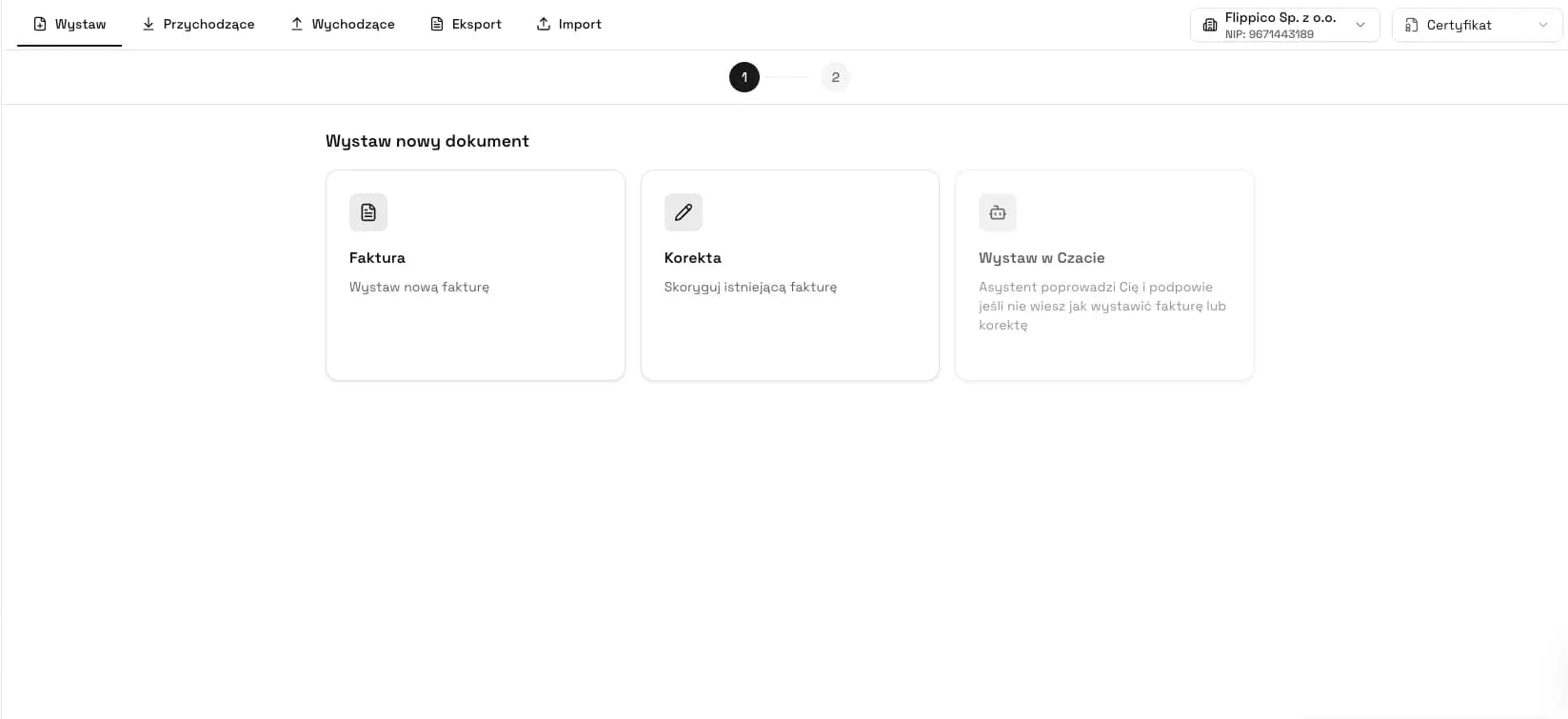
KSeFGPT does not replace a tax decision, but it helps complete the subsequent process in one place. You can work with the source invoice and correction, check data completeness, monitor submission status and retain the KSeF number and UPO.
First agree with accounting staff whether a correction should be issued in the specific case. Then ensure that the documents are linked correctly and verify the submission result. The KSeFGPT Invoices module helps prevent data from being scattered across email, spreadsheets and separate folders.
Keep the source invoice and correction together
Work with KSeF documents, check statuses and retain UPO in one process after the accounting decision has been made.
Explore the Invoices moduleFrequently asked questions
Does every change to a payment due date require a corrective invoice in KSeF?
According to the individual tax interpretation of July 10, 2026, a corrective invoice is the proper method when a due date shown on an invoice is changed. This does not automatically mean that every change to commercial arrangements creates an unconditional correction obligation. The authority also stated that correcting optional information is not an obligation, although it is expected when the information is material to the parties.
Is an email with the counterparty enough to change the payment due date?
An email, agreement or contract amendment can document the parties' new arrangements outside KSeF. If the due date appeared on an invoice accepted by KSeF, the interpretation indicates a corrective invoice as the proper way to align the invoice with the agreement.
What if the invoice did not show a payment due date at all?
A payment due date is not a mandatory invoice item. A literal analysis suggests that, if no date was entered, there is no invoice item being changed solely because of a new contractual arrangement. The interpretation of July 10, 2026 does not directly decide this scenario. Keep evidence of the agreement and consult accounting or a tax adviser in an unusual case.
Does correcting the payment due date change VAT?
In the two scenarios described in the application, the taxable amount, VAT and gross amount did not change. The date correction was therefore informational. If the new due date is connected with a discount, early-payment discount or another economic change, the consequences must be assessed separately.
Recommended reading
To explore payment terms, document types and the invoice structure further, read:
KSeF invoice payment term - explains how to distinguish the issue date, receipt date and payment due date.
Corrective invoice in KSeF - covers the general process for issuing and submitting corrections.
Invoice types in KSeF - organises the document types available in the FA(3) structure.
XML and the FA(3) format in KSeF - shows how invoice data is recorded in a structured document.
Manage invoices and corrections in one process
KSeFGPT helps you work with invoices, monitor their KSeF status and retain the KSeF number and UPO after submission.
Go to KSeFGPTSources and source notes
This analysis is based on the original individual interpretation of July 10, 2026, earlier letters concerning payment due dates, the Polish VAT Act and the official FA(3) structure. Sources were checked on August 13, 2026.
- Individual interpretation 0114-KDIP1-1.4012.365.2026.1.MM of July 10, 2026
Director of National Tax Information · accessed: August 13, 2026
The canonical record of the analysed case, including the company's question and position, the authority's formal conclusion and its reasoning on optional information.
- Individual interpretation 0114-KDIP1-1.4012.440.2019.1.KBR of October 9, 2019
Director of National Tax Information · accessed: August 13, 2026
Historical position on changing a due date as additional invoice information and the correction note available under the law then in force.
- Individual interpretation ITPP1/443-176d/13/MN of May 21, 2013
Director of the Tax Chamber in Bydgoszcz · accessed: August 13, 2026
Letter concerning a later extension of a payment due date in the context of bad debt relief and documentation of the change.
- Polish VAT Act, consolidated text, Journal of Laws 2025 item 775
Polish Journal of Laws / ELI · accessed: August 13, 2026
Consolidated text governing mandatory invoice items and corrective invoices, read together with subsequent amending acts.
- Act of August 5, 2025 amending the VAT Act, Journal of Laws 2025 item 1203
Polish Journal of Laws / ELI · accessed: August 13, 2026
Source of amendments applying in 2026, including the current rules for correcting a structured invoice and provisions connected with offline24.
- Act of June 16, 2023 amending the VAT Act, Journal of Laws 2023 item 1598
Polish Journal of Laws / ELI · accessed: August 13, 2026
Source of the repeal of correction-note provisions and transitional rules, read with later changes to commencement dates.
- FA(3) schema v1-0E
CIRF / Polish Ministry of Finance · accessed: August 13, 2026
Official structured-invoice schema, including optional payment and due-date information and elements identifying the corrected invoice.
- Invoice verification in KSeF
CIRF / Polish Ministry of Finance · accessed: August 13, 2026
Official documentation of the verification, acceptance and rejection process for an invoice submitted to KSeF.
- Offline modes in KSeF
CIRF / Polish Ministry of Finance · accessed: August 13, 2026
Official documentation of offline modes, including the time at which an invoice is issued before it is later submitted to KSeF.