KSeF penalty deferral through 2027? What the Ministry plans
Poland plans to defer KSeF error penalties through 2027. We explain the proposal's legal status, current deadlines and impact on businesses.

Summary
On September 16, 2026, Poland's Ministry of Finance announced plans to defer penalties for errors in using KSeF until December 31, 2027. The proposal would give additional time both to the smallest taxpayers and to businesses already using the national e-invoicing system.
The extension requires a legislative amendment. As of September 23, 2026, the existing statutory commencement date for the administrative penalty provisions remains January 1, 2027. The announcement is not yet a deferral in force.
The announcement does not postpone mandatory KSeF or extend transitional relief for the smallest businesses. Preparations for issuing invoices must follow the rules governing that obligation, independently of the proposed penalty timetable.
What did the Ministry of Finance announce on September 16?
The Ministry wants to extend the deferral of penalties for KSeF errors by another year. The smallest businesses would have more time to become familiar with the system after their transitional relief ends, while other taxpayers could improve their processes. The Ministry simultaneously maintains the obligation to use KSeF. Businesses therefore need to separate their implementation deadline from the date penalties begin to apply.
What the proposal means depends on the business. An issuer already covered by mandatory KSeF needs to improve everyday invoice handling. A business still using transitional relief needs to prepare its move into the system. A headline about the absence of penalties does not replace either decision.
Contents
Key takeaways
Record three dates separately when planning work: the start of your KSeF obligation, the expiry of any relief and the start of penalties. A proposed change to the last date does not automatically change the first two.
Is the extended deferral already in force?
As of September 23, 2026, the Ministry's announcement is a legislative proposal, not a published amendment. The Ministry expressly states that the proposal requires changes to legislation and that work on a bill is beginning. That distinction matters when deciding how to invoice in 2027.
The existing provisions schedule Article 106ni(1)-(3) and (5)-(7) of the Polish VAT Act to take effect on January 1, 2027. The date follows from Article 23, point 4 of the Act of June 16, 2023, as amended on August 5, 2025. These administrative penalty provisions do not yet apply in 2026.
The Ministry's plan aims to keep the deferral in place throughout 2027. It does not itself determine the wording of the future provisions or guarantee that penalties will start on January 1, 2028. The final scope and dates must be established by enacted legislation.
What would the proposal mean for two different businesses?
The examples below are illustrative, not customer case studies. They show two different legal positions. Being a microbusiness does not itself provide an exemption from KSeF. Under Article 145m, the relevant figure is gross sales documented by eligible invoices issued during the month, together with whether the business has already lost its entitlement to the relief.
The design practice should assign someone to check rejected or still-processing invoices and address recurring errors. The sole trader should prepare access, permissions and a way to issue the first invoices covered by the obligation. These are different tasks prompted by the same announcement.
The announcement also does not extend the separate Article 145n exclusion for cash-register invoices and receipts bearing a tax ID that qualify as simplified invoices. Nor does it remove statutory exclusions such as consumer invoices. The January deadline should therefore not be described as covering every invoice without exception.
| Illustrative business | What the law already requires | What the proposal could change |
|---|---|---|
| A design practice covered by KSeF since April 2026 | Ordinary domestic B2B invoices that do not qualify for an exclusion are already issued through KSeF. | More time to improve the process before penalties for errors apply. No permission to replace mandatory KSeF with a PDF alone. |
| A sole trader using Article 145m who has not previously exceeded PLN 10,000 gross per month in eligible invoices | The transitional relief allowing eligible invoices outside KSeF ends on December 31, 2026. | An additional penalty deferral period after mandatory use begins, if the amendment is enacted. No postponement of the obligation until 2028. |
Organise your invoice submission to KSeF
Issue an invoice in KSeFGPT, submit it and check its KSeF number and official receipt.
Sign in to KSeFGPTHow will the tax administration respond?
According to the announcement, Poland's National Revenue Administration, known as KAS, will primarily support taxpayers and remind them of their obligations. The Ministry also promises a response to invoices issued outside KSeF, allowing for statutory exclusions, and checks on whether failure to use the system is connected with inaccurate tax reporting.
Article 106ni(4) of the VAT Act is already in force and must also be considered. It prevents fiscal criminal or petty-offence proceedings from being initiated for the KSeF obligations specified in that provision. A deferred administrative penalty should therefore not automatically be replaced with the threat of fiscal criminal liability merely for bypassing the system.
This special rule is not a general exemption from liability for inaccurate declarations or fictitious invoices. Those are separate matters. Our guide to invoices issued outside KSeF explains the implications for issuers, buyers' VAT deduction and document handling in more detail.
What should you check in the bill and final law?
After the announcement, follow the actual wording of the amendment. Four points will matter for business decisions:
1. Scope. Exactly which penalty provisions and breaches will the deferral cover?
2. Dates. When will the law take effect, and what transitional period will it establish?
3. Other obligations. Does the amendment change only penalties or other rules too? The current announcement does not postpone mandatory KSeF.
4. Legislative stage. Has the law been passed and published in the Journal of Laws?
A bill will make it possible to assess the proposed solution, but the published law will establish its final form. Preparations for mandatory invoicing should not depend on predicting when work on penalties will finish.
How can you use the time to improve invoicing?
Decide who issues invoices, who checks submission and how the team handles a rejection. Distinguish a draft from a submitted document and an accepted invoice. For an accepted invoice, check the KSeF number and UPO, the official receipt.
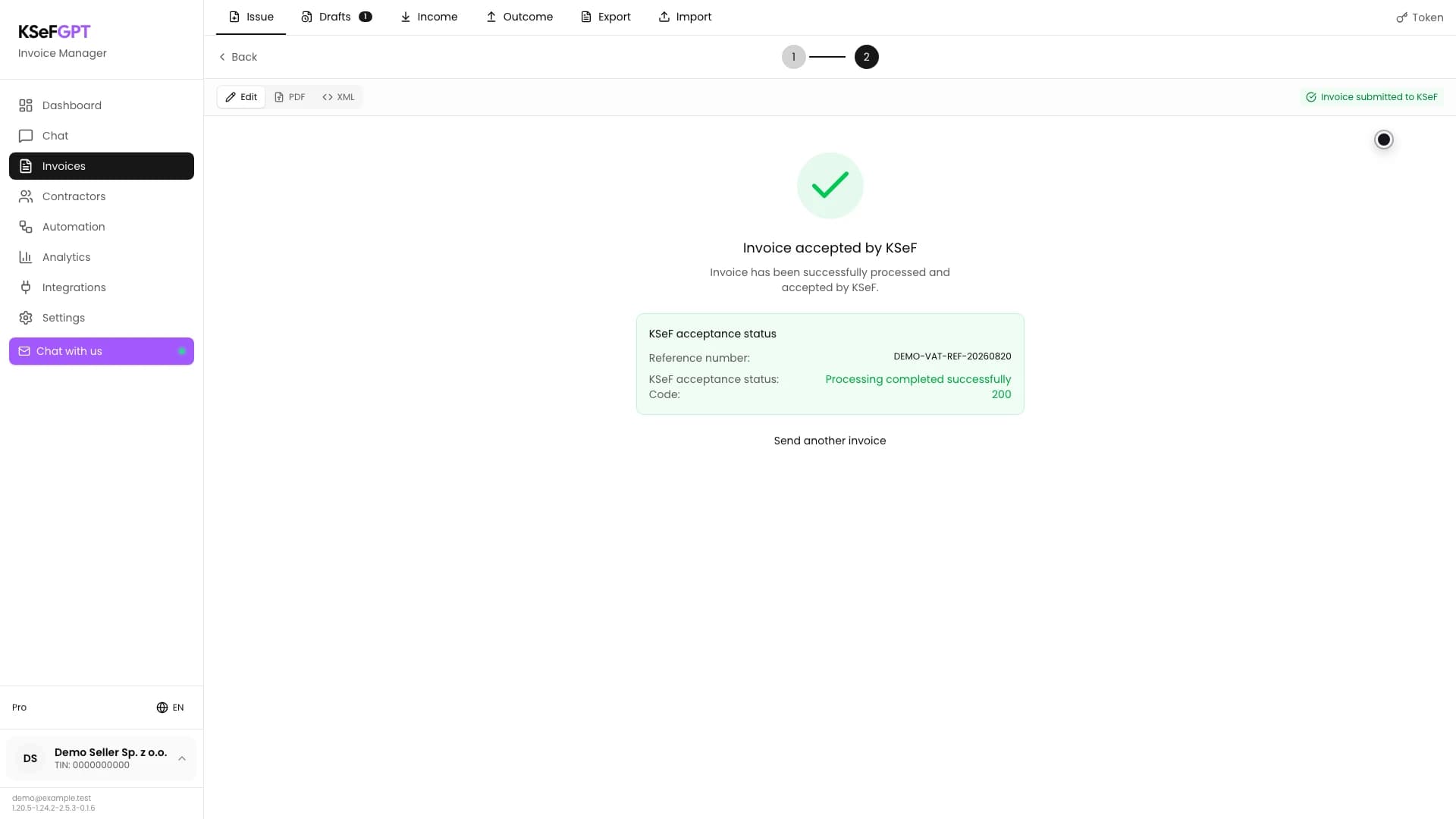
The KSeFGPT invoice module lets you prepare an invoice in the form or AI Chat, submit it to KSeF and download a readable visualization for your customer. The screenshot below shows the application's acceptance screen with demonstration data. It illustrates the final process message; technical acceptance does not replace checking the tax treatment.
Frequently asked questions
Have KSeF penalties already been deferred until the end of 2027?
As of September 23, 2026, the extension is a Ministry of Finance proposal announced on September 16 and requires legislation. The existing statutory commencement date for KSeF administrative penalties remains January 1, 2027. The announcement does not itself amend the law.
Can the smallest businesses wait until 2028 to use KSeF?
Not on the basis of this announcement. Relief under Article 145m of the Polish VAT Act for eligible invoices totalling up to PLN 10,000 gross per month ends on December 31, 2026. The Ministry confirms mandatory KSeF for the smallest taxpayers from January 1, 2027, subject to statutory exclusions. The penalty proposal does not move that date.
Does deferral mean no checks or liability?
No. The Ministry promises taxpayer support but also action by the National Revenue Administration on invoices outside KSeF and checks on tax reporting. Article 106ni(4) prevents fiscal criminal proceedings from being initiated for the KSeF obligations specified in it. It is not a general exemption from liability for inaccurate declarations or fictitious invoices.
What should a business do before the amendment is passed?
Establish when its KSeF obligation starts and which exclusions apply, prepare the people responsible for issuing and submitting invoices, and check processing results. Follow the proposed scope, effective date and publication of the final law in Poland's Journal of Laws.
Recommended reading
Base further decisions on your business's specific obligation and document process. These four guides cover the next steps:
Invoices outside KSeF and VAT deduction
Prepare your business for everyday KSeF invoicing
Use the form or AI Chat to issue an invoice, submit it to KSeF and download a readable visualization for your customer.
Open KSeFGPTSources
Position as of September 23, 2026. The Ministry's announcement describes a proposed further deferral; the legislation sets out the existing timetable and obligations. Sources are in Polish.
- Ministry announcement on extending the deferral of KSeF error penalties until the end of 2027
Polish Ministry of Finance · accessed: 2026-09-23
Announcement of September 16, 2026 explaining the proposal, the need to amend the law, the continuing KSeF obligation and the tax administration's response.
- Polish VAT Act, consolidated text
Chancellery of the Sejm · accessed: 2026-09-23
Article 106ga on the obligation and exclusions, Article 106ni on penalties and the specific fiscal criminal rule, and Articles 145m and 145n on transitional relief.
- Act of June 16, 2023, Journal of Laws item 1598
Chancellery of the Sejm · accessed: 2026-09-23
Current Article 23, point 4 sets January 1, 2027 as the commencement date for Article 106ni(1)-(3) and (5)-(7) of the VAT Act.
- Amendment of August 5, 2025, Journal of Laws item 1203
Journal of Laws · accessed: 2026-09-23
Article 2, point 5(b) established the existing commencement date for the KSeF administrative penalty provisions.
- Polish Fiscal Penal Code, consolidated text
Chancellery of the Sejm · accessed: 2026-09-23
Article 56 and Article 62(2) address separate issues involving inaccurate declarations and unreliable invoices, which should not be equated with merely bypassing KSeF.