What is ViDA and how does it affect Polish businesses?
Understand ViDA's three pillars, the timeline through 2035 and what a Polish business can do now without implementing unsettled rules.

Article summary
ViDA, or VAT in the Digital Age, is an EU package that modernises e-invoicing and digital transaction reporting, VAT rules for selected digital platforms, and VAT registration across Member States. It is neither a single IT system nor an EU version of Poland's KSeF. The package consists of three legal acts and is being introduced in stages through 2035.
ViDA has three pillars: digital reporting based on e-invoices, new rules for platforms facilitating short-term accommodation and passenger transport by road, and Single VAT Registration. The main implementation milestones fall on July 1, 2028, July 1, 2030 and January 1, 2035.
KSeF gives Polish businesses experience in working with structured invoice data, but it does not prove that the Polish system already meets the future EU model. Businesses should improve data quality and integrations now, while waiting for final implementing documents before coding detailed ViDA rules.
Why should a Polish business understand ViDA?
ViDA is increasingly discussed alongside KSeF because both concern the digitalisation of invoices and VAT data. Their scope is different. KSeF manages Poland's domestic flow of structured invoices, while ViDA changes common EU VAT rules, particularly for cross-border activity.
The topic matters even to a Polish business that does not currently sell abroad. ViDA can influence ERP data design, counterparty records, platform operations and the number of VAT registrations required in other Member States. Older proposal dates still circulate online, so this article uses the package adopted in March 2025 and the European Commission timeline current as of July 23, 2026.
Table of contents
Key conclusions
ViDA should be treated as a long-term VAT reform, not as one system that every EU business must start using on the same day.
| Point | Details |
|---|---|
| What ViDA is | A package of three EU legal acts covering digital reporting, platforms and VAT registration. |
| Why it was created | To address cross-border VAT fraud, simplify obligations and make better use of structured data. |
| Three pillars | Digital reporting and e-invoices, VAT in the platform economy, and Single VAT Registration. |
| Timeline | The package entered into force in 2025, with major stages scheduled for 2027, 2028, 2030 and 2035. |
| Business response | Improve data and integrations, monitor implementing documents and avoid building unconfirmed rules in advance. |
What is the ViDA package?
ViDA stands for VAT in the Digital Age. The Council of the European Union adopted the final package on March 11, 2025 after the European Parliament was consulted again. The acts were published on March 25, 2025 and the package entered into force on April 14, 2025.
Directive (EU) 2025/516: changes the common VAT rules, including e-invoicing, digital reporting and selected cross-border arrangements.
Regulation (EU) 2025/517: changes administrative cooperation and the exchange of information needed for the new model.
Implementing Regulation (EU) 2025/518: adjusts implementing rules for the practical application of the common VAT system.
An e-invoice is a structured document that a system can process automatically. Digital reporting means sending specified transaction data to a tax administration. A national e-invoicing system, such as KSeF in Poland, is a solution operated by one Member State. These concepts are connected, but they are not interchangeable.
ViDA does not mean one directive, one EU-wide IT system or a central database containing every European invoice. It also does not establish PEPPOL as a universal mandatory channel or justify applying one 48-hour deadline to every reporting obligation.
Once ViDA is understood as a package of rules rather than a ready-made application, the next question is why the reform was introduced.
| Concept | What it means | What it is not |
|---|---|---|
| ViDA package | Three EU legal acts that change VAT rules in stages through 2035. | One IT system or one directive. |
| E-invoice | A structured document that can be processed automatically. | A PDF visualisation alone. |
| Digital reporting | Transfer of specified transaction data to tax authorities. | Automatically a complete copy of every document in one EU database. |
| National e-invoicing system | A solution introduced by one country, such as KSeF in Poland. | The EU ViDA system. |
Why did the European Union introduce ViDA?
The single market is digital, but parts of the VAT framework still rely on later returns, recapitulative statements and obligations that vary between Member States. In cross-border trade, this makes irregularities harder to detect quickly and leaves businesses with separate registrations and processes.
Fiscal objective: tax administrations should receive comparable data sooner and identify cross-border VAT fraud more effectively.
Business objective: a company operating in several countries should need fewer local VAT registrations and repeat fewer similar obligations in different formats.
Technology objective: structured e-invoices should support more automated data exchange and reporting.
The European Commission estimates that e-invoicing-based reporting could reduce VAT fraud by up to EUR 11 billion per year and lower administrative and compliance costs for EU traders by more than EUR 4.1 billion per year over the next ten years. These are Commission estimates, not guaranteed outcomes.
The objectives address three distinct groups of problems. That is why ViDA has three pillars with different main audiences and implementation dates.
| Problem | ViDA response | Meaning for a business |
|---|---|---|
| Delayed and inconsistent cross-border transaction data | Digital reporting based on e-invoices | Greater importance of complete and consistent source data |
| Difficult VAT collection in selected platform services | Deemed supplier model in specified sectors | New obligations for selected platform operators and service providers |
| Multiple VAT registrations in different countries | Expansion of Single VAT Registration, OSS and IOSS | Fewer local registrations in selected cross-border scenarios |
| Different technical requirements between Member States | A common direction for reporting standards | Need for flexible mappings and integrations |
How do the three ViDA pillars work?
The first pillar covers Digital Reporting Requirements (DRR) based on e-invoicing. Its main impact is on reporting cross-border B2B transactions between businesses in different Member States.
Digital reporting and e-invoices: primarily businesses trading across EU borders and the finance systems that create and exchange invoice data.
Platform economy: platforms facilitating short-term accommodation and passenger transport by road, together with service providers using those platforms. The deemed supplier model does not automatically cover every digital platform.
Single VAT Registration: businesses selling goods and services in several countries that currently need local registrations in some scenarios. Expanded OSS and IOSS mechanisms and mandatory reverse charge are intended to reduce that number.
All three pillars digitalise VAT, but each solves a different problem. A date applying to platform rules is therefore not automatically the starting date for cross-border B2B reporting.
| Pillar | What changes | Main group | Key date |
|---|---|---|---|
| DRR and e-invoices | Digital reporting of cross-border B2B transaction data | EU traders, ERP systems and finance teams | July 1, 2030 |
| Digital platforms | Deemed supplier model for short-term accommodation and passenger transport by road | Selected platforms and service providers | July 1, 2028, with a possible delay to January 1, 2030 |
| Single VAT Registration | Expansion of OSS and IOSS and reduction of selected local registrations | Sellers operating in several Member States | July 1, 2028 |
When will the ViDA changes take effect?
ViDA is being introduced in stages. There is no single date on which every EU business moves to an identical invoicing and reporting process.
2028: this stage primarily covers elements of Single VAT Registration, mandatory reverse charge in specified cases and new rules for selected platforms. It is not the start date for all cross-border B2B digital reporting.
2030: Digital Reporting Requirements for cross-border B2B transactions are scheduled to apply from July 1. This is the main date for the e-invoicing-based reporting pillar.
2035: by January 1, domestic real-time digital transaction reporting systems based on legislation in force on January 1, 2024 must be aligned with the EU model and standards.
The timeline below reflects the official schedule as of July 23, 2026. These milestones should not be confused with short operational deadlines described in older proposals and industry commentary.
The staged timeline helps separate preparations that make sense today from changes that should wait for detailed requirements.
| Date | Change | Practical status |
|---|---|---|
| April 14, 2025 | ViDA entered into force and Member States could introduce mandatory e-invoicing under the package conditions | In force |
| January 1, 2027 | Minor clarifications affecting OSS and IOSS users | In preparation |
| July 1, 2028 | Single VAT Registration elements, mandatory reverse charge and rules for selected platforms | In preparation |
| July 1, 2030 | DRR for cross-border B2B transactions | Later stage |
| January 1, 2035 | Alignment of domestic transaction reporting systems based on legislation in force on January 1, 2024 | Later stage |
What does ViDA mean for a Polish business?
The best preparation is not to build a separate ViDA module today. It is to improve data quality and reduce dependence on one format, channel or manual re-entry.
Do now: standardise counterparty identifiers and countries, check invoice-data completeness, document mappings between ERP, KSeF and accounting systems, and keep source data separate from its visualisation.
Monitor: the scope of DRR, implementing standards, the future relationship between KSeF and the EU model, OSS and IOSS changes, and platform requirements if the business operates in short-term accommodation or passenger transport by road.
Do not implement in advance: rules based on a universal 48-hour deadline, an assumption that PEPPOL will be mandatory for every business, or an architecture built around one central EU invoice database.
Example: a Polish distributor selling to businesses in Germany and Czechia does not need a separate ViDA module today. It can standardise tax identifiers and counterparty countries, document mappings between ERP and KSeF, and keep reporting rules configurable. Later requirements will then be less likely to force the company to reconstruct logic hidden in code or spreadsheets.
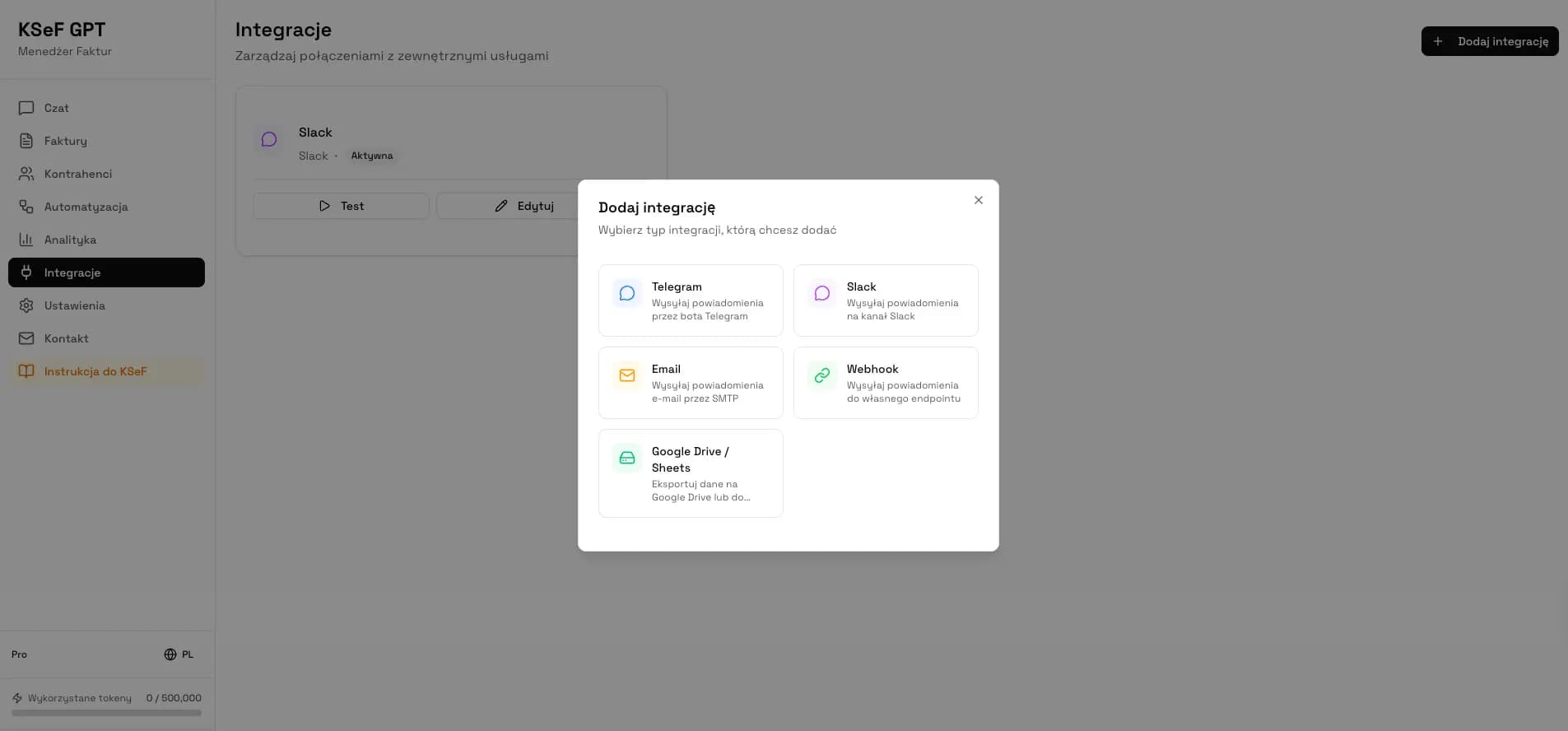
The screen below shows the current KSeFGPT integration layer. It illustrates how connections and data flows around KSeF can be organised today. It is not a view of a future ViDA or DRR system and does not claim future compliance.
This decision matrix reduces the risk of spending money on requirements that do not yet exist. The remaining question is which parts of Poland's KSeF experience can support the future EU model.
| Decision | Action | Why |
|---|---|---|
| Do now | Improve counterparty and invoice data quality | The same data will support KSeF, ERP and future cross-border processes |
| Do now | Document mappings and field ownership | A standard change should not require the business to reconstruct logic from code and spreadsheets |
| Do now | Design flexible integrations | Channels and technical details may change during implementing work |
| Monitor | Commission documents and Polish work on the relationship with KSeF | They will define the final scope and implementation dates |
| Monitor | OSS, IOSS and platform rule changes | The impact depends on the sales model and countries of operation |
| Do not implement in advance | Do not hard-code unconfirmed deadlines and channels | Older proposals are not a safe implementation specification |
What remains unclear about ViDA and KSeF?
Poland has practical e-invoicing experience. Businesses and software providers already work with structured invoices, validation, submission statuses and API integrations. These capabilities are useful for any further digitalisation of VAT.
That does not make today's KSeF an automatically ready component of DRR. The scope of reported data, mapping of the Polish FA(3) structure to EN 16931, data exchange channels and the role of the national system after 2030 still require separate decisions.
The European Commission published a ViDA implementation work programme for 2026 and early 2027 on May 13, 2026. This confirms that technical and implementing details are still being developed. Architecture decisions should therefore follow official documents rather than simplified diagrams circulating online.
The relationship between KSeF and ViDA deserves a separate analysis of legislation and standards. It will be covered in the next article in this series because combining both subjects too quickly creates promises that current law does not support.
How can a business organise its invoice process today?
Future ViDA requirements are not yet an implementation specification, but the current process can already be improved. A business can maintain one source of counterparty data, check invoice completeness, document mappings between systems and preserve a history of what was sent and received.
KSeFGPT currently helps users issue invoices in a form or through AI Chat, submit them to KSeF and download readable visualisations in Polish, English, German or Ukrainian. These are tools for today's KSeF process, not a claim of future ViDA DRR compliance.
Frequently asked questions
Is ViDA the EU equivalent of KSeF?
No. ViDA is a package of changes to EU VAT rules, while KSeF is Poland's national system for issuing and receiving structured invoices. KSeF gives Polish businesses practical experience with e-invoicing, but its future alignment with EU digital reporting will depend on separate legislation and technical specifications.
When will ViDA become mandatory?
ViDA does not have a single start date. The package entered into force on April 14, 2025. OSS and IOSS clarifications are scheduled for January 1, 2027, selected platform and Single VAT Registration measures for July 1, 2028, and digital reporting for cross-border B2B transactions for July 1, 2030. By January 1, 2035, domestic real-time transaction reporting systems based on legislation in force on January 1, 2024 must be aligned with the EU model.
Does ViDA mean the end of PDF invoices?
That conclusion is too broad. ViDA strengthens the role of structured e-invoices as the basis for digital reporting of specified transactions, but a PDF may still serve as a readable visualisation. The exact obligation depends on the transaction type, implementation stage and national rules.
Does a Polish business need to implement new ViDA solutions now?
There is no reason to implement unsettled ViDA rules in advance. A business can already improve counterparty and invoice data, document mappings between systems, reduce manual re-entry and build flexible integrations. Specific changes should be implemented only when final legislation and technical documentation are available.
Recommended reading
What is KSeF AI and when is it useful? - see where automation helps with invoices and where human control remains necessary.
KSeF and JPK - learn why similar data sets do not mean the same system or obligation.
XML and the FA(3) format in KSeF - understand the structure of a Polish structured invoice and its role in integrations.
KSeF invoices in English, German and Ukrainian - see how source invoice data differs from a readable visualisation for a foreign counterparty.
Organise your invoice process today
Use KSeFGPT to issue an invoice in a form or AI Chat, submit it to KSeF and download a readable visualisation in the recipient's language.
Open KSeFGPTSources
This article is based on final EU legal acts and official European Commission materials checked on July 23, 2026.
- VAT in the Digital Age
European Commission · accessed: July 23, 2026
Official description of the three ViDA pillars, adoption and entry-into-force dates, and the implementation timeline through 2035.
- Directive (EU) 2025/516
EUR-Lex · accessed: July 23, 2026
Final directive amending the common VAT system for the requirements of the digital age.
- Regulation (EU) 2025/517
EUR-Lex · accessed: July 23, 2026
Regulation amending administrative cooperation in the field of VAT.
- Implementing Regulation (EU) 2025/518
EUR-Lex · accessed: July 23, 2026
Implementing act adapting practical VAT rules to the ViDA package.
- ViDA implementation work programme
European Commission · accessed: July 23, 2026
Implementation work programme for 2026 and early 2027, published on May 13, 2026.
Expert reviewed: Bogdan Mazurek
Tax adviser · July 23, 2026
The article was reviewed against official EU materials current on July 23, 2026, including the three ViDA pillars, implementation timeline and practical conclusions.