KSeF and JPK: how the invoice system works with the JPK family of structures
KSeF does not replace JPK_VAT. Learn the differences between FA(3), JPK_V7M, JPK_V7K and JPK_FA, and the rules for KSeF numbers, corrections and offline modes.
Article summary
JPK is a family of XML structures comprising three groups: recurring JPK_VAT with the VAT return, mandatory annual JPK_PD income-tax files, and seven structures supplied on request. JPK_PD is being introduced in stages and does not cover every taxpayer in the same year.
KSeF does not replace JPK_VAT. KSeF stores and handles individual structured invoices, whereas JPK_V7 reports sales and purchase records and the VAT settlement for a given period, including on the basis of evidence originating outside KSeF.
JPK_V7M(3) and JPK_V7K(3) apply from the February 2026 settlement. If an invoice has a KSeF number, it is entered in the NrKSeF field. If there is no number, the appropriate OFF, BFK or DI marker is used instead.
Why the number of documents in KSeF may differ from the number of JPK records
A business may see 120 documents for May in KSeF but a different number of entries in its JPK records for May. The difference alone does not prove that there is an error. Some invoices may belong to another VAT period, some purchase VAT may not yet have been deducted, and some JPK entries may arise from aggregate evidence, internal documents or invoices issued outside KSeF.
The key is to distinguish four levels: the FA(3) invoice file, the event and number in KSeF, the VAT ledger entry, and the periodic JPK file. The data may be linked, but the levels are not identical and do not arise at the same time.
This guide presents the legal and technical position as at June 6, 2026. It does not describe a field-by-field mapping from FA(3) to JPK because there is no simple one-to-one mapping between these structures.
Table of contents
1. JPK is a family of structures, not a single file
2. What JPK_VAT with the VAT return is
3. What KSeF stores and what JPK reports
4. GTU in FA(3) and JPK_V7 does not map one-to-one
5. Where KSeF and JPK data come from
6. The issue and receipt dates do not always determine the JPK month
7. The supplier's invoice number and the KSeF number are two different identifiers
8. How to report an invoice in JPK_V7 from February 2026
9. Offline modes, system failure and total failure
10. Invoices outside KSeF and aggregate evidence
11. Correcting invoices and JPK corrections
12. JPK_FA and other structures supplied on request
13. Transitional periods in 2026
14. KSeF-to-JPK reconciliation matrix
15. Month-end procedure
16. Frequently asked questions
Key Takeaways
The table below summarises the most important distinctions needed when reconciling KSeF with the VAT settlement.
| Point | Details |
|---|---|
| JPK is a family of structures | It includes recurring JPK_VAT, annual JPK_PD introduced in stages, and seven structures supplied on request. |
| KSeF does not replace JPK_VAT | FA(3) describes an invoice, while JPK_V7 describes a ledger entry and the settlement for a period. |
| There is no one-to-one mapping | Invoice data may feed the accounting entry, but the VAT period, the right to deduct and evidence outside KSeF require additional rules. |
| The field and the markers are not interchangeable | NrKSeF is the field for the number of an invoice in KSeF, while OFF, BFK and DI are alternative markers used without that number. |
| Reconciliation requires exceptions to be explained | A difference in document counts may be correct if it results from the VAT period, deduction timing, corrections or aggregate evidence. |
JPK is a family of structures, not a single file
The Polish Standard Audit File for Tax, known as JPK, is a data set generated by direct export from a taxpayer's IT systems in a prescribed XML layout. The abbreviation JPK does not denote a single form. It covers structures intended for different books, records and document types.
The full picture comprises three groups. The first is recurring JPK_VAT with the VAT return. The second consists of the annual JPK_PD structures: JPK_KR_PD, JPK_ST_KR, JPK_PKPIR, JPK_EWP and JPK_ST, whose application depends on the implementation stage and the type of records maintained. The third group consists of seven structures supplied on request: JPK_KR, JPK_WB, JPK_MAG, JPK_FA, JPK_FA_RR, JPK_PKPIR and JPK_EWP.
The JPK_PD obligation is phased. The first JPK_KR_PD files are submitted in 2026 for a year beginning after December 31, 2024 by the largest CIT taxpayers and tax capital groups, with JPK_ST_KR optional for that group for its first reported year. For years beginning after December 31, 2025, the obligation also covers the remaining CIT taxpayers and PIT taxpayers filing JPK_V7M. For years beginning after December 31, 2026, it extends to the remaining taxpayers, including those filing JPK_V7K. The specific obligations must therefore be checked by reference to the type of records, tax and tax year.
The detailed scope and timetable are published by the Ministry of Finance on the JPK for income taxes page. The authority may obtain structures supplied on request during verification activities, tax proceedings, a tax audit or a customs and tax audit. The deadline specified in the request may not be shorter than three days.
In practice, asking whether a business should use KSeF or JPK sets up a false choice. KSeF is an invoice circulation system, while the individual JPK structures are used to report tax data or provide books and records on request.
| Group and structures | Scope | Submission method | Relationship with KSeF |
|---|---|---|---|
| Recurring JPK_VAT: JPK_V7M and JPK_V7K | VAT records and the declaration section | Monthly, without a request, with the quarterly return in JPK_V7K | NrKSeF links the record to the invoice; without the number, OFF, BFK or DI is used. |
| Annual JPK_PD: JPK_KR_PD and JPK_ST_KR | Accounting books and fixed-asset records of taxpayers keeping accounting books | In stages after year-end; JPK_ST_KR is optional for the first group for its first reported year | KSeF may be a source of documents but does not replace the accounting books or fixed-asset records. |
| Annual JPK_PD: JPK_PKPIR, JPK_EWP and JPK_ST | Tax revenue and expense ledger, revenue records and fixed assets of taxpayers keeping those records | Mandatory after year-end, introduced in stages by taxpayer group | KSeF invoices are only part of the data needed to calculate taxable income. |
| On request: JPK_KR, JPK_WB and JPK_MAG | Accounting books, bank statements and warehouse movements | Following a request from the authority | They concern areas other than the storage of invoices in KSeF. |
| On request: JPK_FA and JPK_FA_RR | Sales invoices and VAT RR invoices | Following a request from the authority | JPK_FA may cover invoices outside KSeF; data from invoices issued in KSeF is available to the authority in the system. |
| On request: JPK_PKPIR and JPK_EWP | Tax revenue and expense ledger and revenue records in structures requested for the relevant period | Following a request from the authority | They should not be confused with the mandatory annual JPK_PD versions. |
What JPK_VAT with the VAT return is
JPK_VAT with the VAT return is a single electronic document consisting of two parts. The records section contains the data needed to calculate output and input VAT correctly. The declaration section contains the items needed to calculate VAT payable, an excess or a refund.
Since October 1, 2020, active VAT taxpayers have not filed a separate VAT-7 or VAT-7K return and the former JPK_VAT file. These data have been combined in the JPK_V7M and JPK_V7K structures.
JPK_V7M is used by a taxpayer settling VAT monthly. JPK_V7K applies to a taxpayer settling VAT quarterly, but its records section is still submitted for each month. The declaration section for the entire quarter is included in the file for the third month of the quarter.
Versions JPK_V7M(3) and JPK_V7K(3) apply from the February 2026 settlement. They were designed to report either the number in the NrKSeF field or an alternative marker for a document without that number. Details are provided in the JPK_VAT with the VAT return guide applicable from February 1, 2026.
| Element | JPK_V7M | JPK_V7K |
|---|---|---|
| Settlement method | Monthly | Quarterly |
| Records section | For each month | For each month |
| Declaration section | For each month | For the quarter, in the file for the third month |
| Version from February 2026 | JPK_V7M(3) | JPK_V7K(3) |
| Link with KSeF | NrKSeF or alternatively OFF, BFK or DI | NrKSeF or alternatively OFF, BFK or DI |
KSeF does not replace JPK_VAT
KSeF is primarily responsible for issuing, receiving and storing structured invoices. JPK_VAT with the VAT return is responsible for periodic VAT records and settlement. These are two separate obligations, even if invoice data from KSeF feeds the accounting system.
KSeF does not know all of the taxpayer's accounting decisions. It does not automatically determine the period in which a particular purchase should be deducted, how internal evidence should be recorded, how imports, intra-Community acquisitions or cash-register sales should be settled, or whether a particular correction changes an already submitted JPK.
The KSeF number makes it easier to link a ledger entry to an invoice. This does not mean, however, that the National Revenue Administration performs a publicly documented, complete and automatic reconciliation of every JPK record with every KSeF invoice.
What KSeF stores and what JPK reports
FA(3) is the structure of an individual structured invoice. It contains the parties' data, line items, amounts, rates, payment information and other details that are mandatory or voluntarily provided by the supplier. Once the document is accepted, KSeF assigns a number to it and stores it in the system.
JPK_V7 describes sales and purchase ledger entries for a period and the declaration section. JPK_FA, by contrast, is an invoice structure supplied on request for documents covered by that request.
The comparison is based on the official description of the structured invoice and FA(3) and the JPK_VAT with the VAT return guide. A shared XML format does not mean a shared schema. FA(3), JPK_V7 and JPK_FA have different purposes, nodes and scopes. It should not be assumed that every FA(3) field has an exact JPK equivalent or that every JPK row is created from a single invoice field. For a broader discussion of the invoice structure, see XML and the FA(3) format in KSeF.
| Feature | KSeF / FA(3) | JPK_V7 | JPK_FA |
|---|---|---|---|
| Unit of data | Individual invoice | Ledger entries and the declaration for a period | Data from invoices covered by the request |
| When it arises | When the invoice is issued and accepted | When records are kept and the period is closed | After a request from the authority |
| Main source | Invoicing system and supplier data | VAT records and the financial and accounting system | The taxpayer's invoicing system |
| Recipient | KSeF and the buyer | Tax administration | The authority conducting verification or an audit |
| Frequency | For every invoice submitted | Monthly, subject to the rules for quarterly settlement | On request |
| KSeF number | Assigned after acceptance | Reported to link the record when available | Does not replace the scope of the structure for invoices outside KSeF |
| Tax purpose | Documenting a transaction with an invoice | Settling VAT for a period | Providing invoice data for verification |
GTU in FA(3) and JPK_V7 does not map one-to-one
GTU designations illustrate why the technical mapping of FA(3) to JPK_V7 is not a simple matter of copying fields. The official FA(3) structure guide describes GTU designations in the FaWiersz element as optional fields relating to a specific invoice line.
In JPK_V7, a GTU designation applies to the record or document in the sales ledger. If even one invoice line falls within a particular GTU, the accounting system must determine the correct designation for the entire record. A single XML node therefore cannot simply be copied without an aggregation rule.
FA(3) may contain GTU information as an aid, but the optional nature of that field does not release the taxpayer from correctly designating JPK_V7 if the record-keeping rules require a GTU. Conversely, the absence of GTU in FA(3) does not determine that the JPK entry should have no designation.
| Feature | FA(3) | JPK_V7 | Mapping conclusion |
|---|---|---|---|
| Data level | FaWiersz, meaning a specific invoice line | A record or document in the sales ledger | Invoice lines must be aggregated to record level. |
| Nature of the field | Optional invoice element | Designation required when the transaction meets the GTU conditions | The absence of the field in FA(3) does not determine JPK treatment. |
| Multiple GTUs | Different lines may have different designations | One record may receive more than one GTU | The system must collect designations from all relevant lines. |
| Correction | GTU may relate to a corrected line | The designation depends on the scope of the correction recorded in the ledger | Designations must not be copied without analysing the correcting document. |
Where KSeF and JPK data come from
KSeF receives an invoice file conforming to the FA(3) structure. JPK is generated from VAT records and data held in the financial and accounting system. Invoices downloaded from KSeF may reduce manual data entry, but they do not independently create a complete JPK file.
JPK requires additional tax context: the correct tax-point period, the date on which the invoice was received, the right to deduct, document designations, corrections, aggregate evidence, internal documents and events such as imports of services, intra-Community acquisitions or other transactions settled without a KSeF invoice.
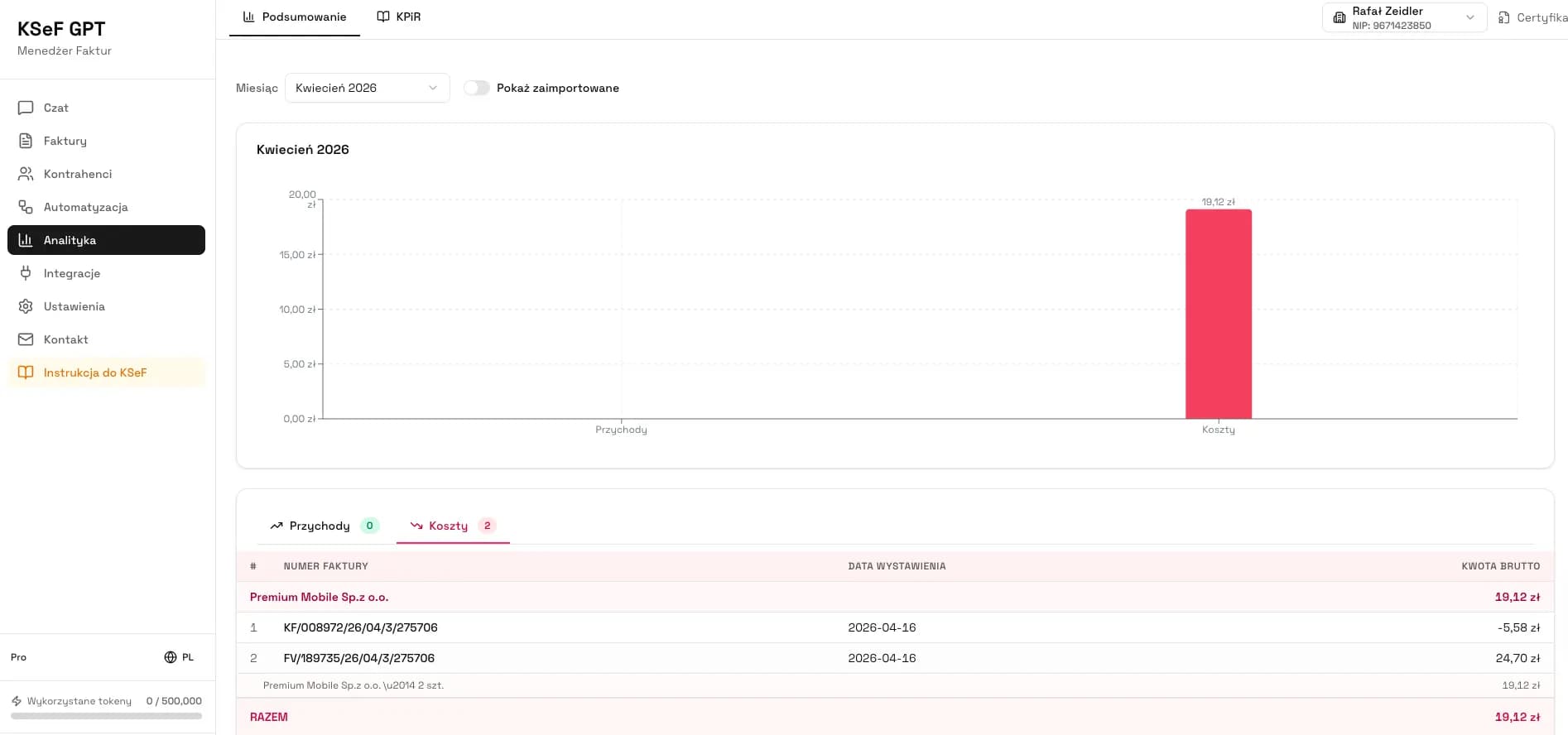
The KSeFGPT invoice analytics view can help organise incoming and outgoing data before it is passed to accounting. The screenshot below shows invoice-data analytics, not a module for creating or submitting JPK.
The scope of the records and declaration data is described on the official JPK_VAT with the VAT return page.
| Data source | What it contributes to the settlement | What it does not determine by itself |
|---|---|---|
| FA(3) invoice from KSeF | Document, party, line and amount data, and the KSeF number | Deduction period, legitimacy of the expense and completeness of the records |
| VAT records | How sales and purchases are recorded | The contents of all accounting books |
| Financial and accounting system | Posting, accounts, settlements and reporting data | Whether the source invoice is correct without verification |
| Evidence outside KSeF | VAT events that are not present in the invoice system | Automatic assignment of the correct marker |
The issue and receipt dates do not always determine the JPK month
In standard online mode, a structured invoice is generally regarded as issued on the date it is sent to KSeF, provided that the transmission date is consistent with the date entered in field P_1. For a domestic buyer with a NIP, the date of receipt of an online or offline24 invoice, or an invoice issued during unavailability, is generally the date on which the KSeF number is assigned. The precise receipt process is described in How to receive an invoice from KSeF step by step.
In the system-failure mode, the invoice is supplied to the buyer outside KSeF. The receipt date is the earlier of actual receipt and assignment of the KSeF number. For buyers referred to in Article 106gb(4), the date of actual receipt continues to apply. During a total failure, invoices are not subsequently sent to the system, so actual receipt is decisive.
These dates do not replace VAT rules. Sales are recorded according to the applicable tax point. Purchase VAT may be deducted no earlier than when the right to deduct has arisen and the invoice has been received, with the possibility of exercising that right in the subsequent periods permitted by law.
Sales example: a service was performed on May 29 and the invoice was sent to KSeF on June 2. If the tax point for the service arose in May, the sales record may belong to May despite the June invoice issue date.
Purchase example: KSeF assigned a number to an invoice on May 31, but the taxpayer did not deduct VAT in May and exercised the right in one of the subsequent periods permitted by law. The invoice has been in KSeF since May, but the deduction record may appear later.
The dates for the individual modes are compared in the official Ministry of Finance comparison table.
| Event | System date | Question that determines JPK treatment |
|---|---|---|
| Online sale | Date of transmission consistent with P_1 | When did the tax point arise for the particular transaction? |
| Online, offline24 and unavailability for a domestic buyer with a NIP | Generally, the date on which the KSeF number is assigned | Has the right to deduct arisen, and in which permitted period is it exercised? |
| System-failure mode | The earlier of actual receipt and the KSeF number; exception for Article 106gb(4) | When did the buyer actually receive the document, and when was the number assigned? |
| Total failure | Actual receipt outside KSeF | Were the document and its receipt properly evidenced? |
| Aggregate evidence | Date of the last event covered by the evidence | What period does the evidence cover, and which record-keeping rules apply? |
The supplier's invoice number and the KSeF number are two different identifiers
The supplier assigns the invoice's own number. In the FA(3) structure, it appears in field P_2 and identifies the document within the taxpayer's numbering system.
KSeF assigns its number only after accepting the invoice. It is not a number entered by the supplier in field P_2 of the invoice being issued. The KSeF number is returned in the system confirmation, including the UPO.
In JPK_V7(3), the KSeF number has a different role: it links the ledger entry to the document accepted by KSeF. Accounting data should therefore retain both identifiers rather than replacing one with the other.
This distinction is confirmed by the official description of the KSeF number and aggregate identifier.
| Identifier | Assigned by | When it arises | Where it is used |
|---|---|---|---|
| Invoice number P_2 | Supplier | When the document is issued | On the invoice, in accounting and in dealings with the counterparty |
| KSeF number | KSeF | After the document is accepted | In KSeF, the UPO, JPK records and reconciliations |
| UPO | KSeF | After the relevant processing has been completed | As the official acknowledgement of acceptance |
How to report an invoice in JPK_V7 from February 2026
The starting point is the document's status on the date the records are submitted. If the invoice already has a KSeF number, that number is entered in the NrKSeF field for sales or purchases. If there is no number, NrKSeF is left blank and the appropriate alternative marker must be used.
OFF, BFK and DI are not values of the NrKSeF field or three names for the same absence of a number. OFF applies to an invoice issued in the system-failure mode specified in Article 106nf(1). BFK applies to an electronic or paper invoice issued outside KSeF. DI covers evidence other than an invoice and, in specified cases, an offline24 invoice or an invoice issued during unavailability that does not yet have a KSeF number.
The rules in the table follow the official JPK_VAT marker matrix. A JPK file marked OFF is not corrected solely because a number is assigned later. For sales, a DI record concerning an offline24 invoice or an invoice issued during unavailability must be corrected after the number is obtained by completing NrKSeF. The purchase section of the Ministry of Finance matrix does not impose an equivalent correction solely because of the later number.
| Side and document status | NrKSeF field | Alternative marker | Subsequent JPK correction |
|---|---|---|---|
| Sale or purchase: invoice has a KSeF number | Enter the KSeF number | None | Not because of the number alone. Correct only if the record is wrong or the settlement changes. |
| Sale or purchase: system-failure invoice has no number | Blank | OFF | No correction is required solely because a KSeF number is assigned later. |
| Sale or purchase: paper or electronic invoice outside KSeF | Blank | BFK | Correct only if the record or settlement is wrong. BFK does not legalise a breach of the obligation. |
| Sale or purchase: evidence other than an invoice | Blank | DI | It does not change to NrKSeF if the document is not an invoice submitted to KSeF. |
| Sale: offline24 invoice without a number | Blank | DI | After obtaining the number, correct the record and complete NrKSeF. |
| Sale: invoice issued during unavailability without a number | Blank | DI | After obtaining the number, correct the record and complete NrKSeF. |
| Purchase: offline24 or unavailability invoice without a number | Blank | DI | The Ministry of Finance matrix does not require an equivalent correction solely because a number is assigned later. |
Offline modes, system failure and total failure
The informal term offline invoice may refer to several distinct legal procedures. Offline24 is chosen by the taxpayer. Unavailability and system failure concern events announced for the system, while total failure has separate consequences.
The differences cover the document format, submission deadline, method of determining the issue and receipt dates, and the JPK marker. OFF therefore cannot be used as a universal marker for every invoice issued without a current connection to KSeF.
The table is based on the official comparison of invoice issue modes. For a domestic buyer with a NIP, online, offline24 and unavailability generally result in receipt when the KSeF number is assigned. During a system failure, the earlier of actual receipt and the KSeF number applies, while during a total failure only actual receipt applies.
| Mode | Format | Deadline for submission to KSeF | Issue and receipt dates | JPK marker without a number |
|---|---|---|---|---|
| Online | FA(3) | Current submission | Issue upon transmission consistent with P_1; a domestic buyer with a NIP receives it when the KSeF number is assigned | After acceptance, NrKSeF is completed |
| Offline24 | FA(3) | Without delay, no later than the next business day | Issue according to P_1; a domestic buyer with a NIP receives it when the KSeF number is assigned | DI without a number; subsequent completion of NrKSeF applies to a sales correction |
| KSeF unavailability | FA(3) | No later than the day after unavailability ends | Issue according to P_1; a domestic buyer with a NIP receives it when the KSeF number is assigned | DI without a number; subsequent completion of NrKSeF applies to a sales correction |
| KSeF system failure | FA(3) | Within seven business days after the failure ends | Receipt on the earlier of actual receipt and the KSeF number; actual receipt for Article 106gb(4) | OFF without a number; the later number alone does not require correction |
| Total failure | FA(3) not mandatory | The invoice is not subsequently sent to KSeF | Actual issue date and actual receipt outside KSeF | BFK as an invoice issued outside KSeF |
Invoices outside KSeF still enter tax settlements
JPK_V7 is not limited to structured invoices. The records may still include consumer invoices, documents covered by a statutory exclusion, invoices from transitional periods and other documents issued outside KSeF.
Mandatory issuing in KSeF began on February 1, 2026 for the largest taxpayers and on April 1, 2026 for the remaining taxpayers. Only invoices that would be subject to mandatory KSeF without the preference count towards the PLN 10,000 gross threshold. The threshold excludes, among other things, B2C invoices, sales recorded on a cash register, receipts with a NIP up to PLN 450 and invoices covered by another exclusion.
If the total of the relevant invoices exceeds the threshold, the invoice that crosses the threshold and all subsequent invoices must be issued in KSeF. Once the threshold has been exceeded, the taxpayer cannot return to the preference in subsequent months. The Ministry of Finance publishes rules and examples on the Below PLN 10,000 page. For broader context on the exceptions, see Who must use KSeF in 2026 and who is exempt?.
An invoice issued outside KSeF in breach of the obligation does not disappear from business circulation or the records. The Ministry of Finance states that, in principle, it may support the buyer's deduction if the conditions under Article 86 of the VAT Act are met. The authority may, however, examine due diligence in the particular circumstances.
| Type of document outside KSeF | Why it may occur | Typical identification treatment |
|---|---|---|
| Consumer invoice | KSeF is optional for it | BFK if the document is recorded as an invoice outside KSeF |
| Invoice covered by a statutory exclusion | The law does not require it to be issued in KSeF | BFK |
| Invoice of a taxpayer using the preference until the end of 2026 | The threshold covers only invoices that would otherwise be subject to KSeF | BFK up to the invoice preceding the threshold crossing |
| Invoice crossing PLN 10,000 and subsequent invoices | The preference ceases to apply from that invoice | NrKSeF after issue in the system |
| Receipt with a NIP treated as a simplified invoice | Transitional rule until December 31, 2026 | Sales generally in RO, without a separate FP; purchase as BFK |
| Separate invoice to a receipt or cash-register invoice | Transitional rule until December 31, 2026 | Sales as FP and BFK where the invoice is outside KSeF; purchase as BFK |
| Invoice issued outside KSeF in breach of the obligation | Error or failure by the supplier to comply | BFK does not remove the supplier's risk |
Aggregate evidence and document markers still matter
JPK_V7 is not merely a list of invoices. It also includes specified aggregate evidence and internal documents. RO identifies aggregate evidence of sales from cash registers, WEW identifies internal evidence, and FP identifies invoices connected with cash-register sales to the extent required by the rules.
The official JPK_VAT questions and answers distinguish three situations. On the sales side, a receipt with a NIP up to PLN 450 treated as a simplified invoice is generally covered by the RO report and does not receive a separate FP. A separate invoice issued to a receipt or an invoice generated by a cash register is marked FP. If such an invoice remains outside KSeF, BFK is also used. On the purchase side, an invoice outside KSeF, including a simplified invoice, receives BFK.
NrKSeF links a record to a specific invoice, but it does not support the assertion that every KSeF invoice must, without exception, be a separate row in every possible case. Aggregation applies to the types of evidence specified in the rules, so the nature of the record must always be checked.
| Designation | Meaning | Does it require a KSeF invoice? |
|---|---|---|
| RO | Aggregate evidence of sales from cash registers | No |
| WEW | Internal evidence | No |
| Receipt with a NIP up to PLN 450 as a simplified invoice, sales | Generally in the RO report, without a separate FP | No |
| Separate invoice to a receipt or cash-register invoice, sales | FP; additionally BFK if issued outside KSeF | No, if it uses the transitional arrangement |
| Cash-register or simplified invoice, purchase | BFK as an invoice received outside KSeF | No |
| NrKSeF field | Links the ledger entry to the invoice in KSeF | Yes |
Correcting invoices and JPK corrections are two different processes
A correcting invoice changes the data of the original document. A correction to a structured invoice is generally also issued as a structured invoice and should contain the KSeF number of the corrected invoice if that number was assigned. Once accepted, the correction receives its own KSeF number. The practical process is described in Corrective invoices in KSeF.
A JPK correction means resubmitting the complete file with corrected data. Under the JPK_V7M(3) and JPK_V7K(3) guide, a file containing only the corrected items is not submitted. The mere fact that a correcting invoice has been issued does not prove that the earlier JPK was incorrect.
For VAT corrections, the supplier and buyer, the direction of the correction, its reason, the issue mode and the method of receipt must be analysed separately. The VAT Act and the amending Act of August 5, 2025 provide special rules for downward corrections submitted to KSeF after being issued in special modes.
Upward corrections also do not have a single universal date. If the reason already existed at the time of sale, the period may require a retrospective correction. If the reason arose later, settlement may fall in the current period. The date on which the correcting invoice receives its KSeF number therefore cannot be the sole criterion.
| Side and type of correction | General rule | What to check before recording it in JPK |
|---|---|---|
| Supplier, downward, standard KSeF process | Reduction in the period in which the correcting invoice is issued in KSeF under Article 29a(13) of the VAT Act | Whether the correction was effectively issued in KSeF and which period is covered by its issue date |
| Supplier, downward, offline24, unavailability or system failure | Apply the special rules in Article 29a(13b)-(13c); the reduction period is linked to submission of the correction to KSeF | The issue mode and method of making it available indicate the applicable paragraph, while the submission date to KSeF determines the reduction period |
| Buyer, downward | As a rule, reduce input VAT for the period in which the correction was received | Whether VAT from the original invoice has already been deducted; if not, the further statutory rules apply |
| Supplier, upward | The period depends on the reason for the correction, not merely the date of the correcting invoice | Whether the reason existed originally or arose after the sale |
| Buyer, upward | Deduction requires the general conditions to be met and the document to be properly received | When the right to deduct arose, receipt of the correction and the link between the purchase and taxable activities |
| Incorrect entry in a submitted JPK | Submit a new, complete file containing the correct data | Whether the error concerns tax amounts, identification data or a designation |
| DI sale after offline24 or unavailability | After the KSeF number is assigned, correct the record by completing NrKSeF | Do not automatically transfer this rule to purchase records |
Does KSeF replace JPK_FA and other structures supplied on request?
For invoices issued in KSeF, the authority has access to the data and therefore does not request it again in JPK_FA. This does not mean that JPK_FA has been abolished.
The authority may still request JPK_FA for invoices issued outside KSeF, such as documents covered by an exclusion or a transitional period. The scope of the request depends on the activities being conducted and the data that remains outside KSeF.
The remaining structures supplied on request concern accounting books, bank accounts, warehouses, the tax revenue and expense ledger or revenue records. KSeF stores invoices, so it does not replace those areas.
The scope of this exclusion is described in the official KSeF 2.0 questions and answers and the information on JPK supplied on request.
| Question | Answer |
|---|---|
| Does the authority request JPK_FA for invoices issued in KSeF? | No, because it has access to the data of those invoices in the system. |
| Can the authority request JPK_FA for invoices outside KSeF? | Yes, if the documents fall within the scope of the request. |
| Does KSeF replace JPK_KR or JPK_WB? | No. These structures concern data other than invoices. |
| Can the authority still issue a JPK request? | Yes. KSeF does not remove the authority's power to request the relevant structures. |
Transitional periods in 2026
The year 2026 combines the launch of mandatory KSeF, new JPK_V7 versions and several transitional preferences. When reconciling a month, it is therefore necessary to check not only the document date but also the supplier's status and the invoice type.
A Ministry of Finance announcement dated July 4, 2024 can still be found online. It stated that the KSeF number would not have to be reported in sales records from February 1 to July 31, 2026. This is historical information based on the timetable then in force. The later regulation of December 12, 2025, the JPK_V7(3) schemas, the guide and the Ministry of Finance matrix provide for NrKSeF or an alternative marker in the structures used from the February 2026 settlement.
Accounting instructions should therefore not be based on the older announcement without checking the later legislation and technical documentation.
| Date | Change | Significance for KSeF and JPK |
|---|---|---|
| February 1, 2026 | FA(3), mandatory issuing for the largest taxpayers and mandatory receipt | Current invoices begin to be linked with KSeF numbers on a broad scale. |
| February 2026 settlement | JPK_V7M(3) and JPK_V7K(3) | NrKSeF is completed or the alternative OFF, BFK or DI marker is used. |
| April 1, 2026 | Second stage of mandatory issuing | The obligation covers the remaining taxpayers, subject to statutory exceptions and preferences. |
| Until December 31, 2026 | PLN 10,000 gross preference for invoices that would otherwise be subject to KSeF | The invoice crossing the threshold and all subsequent invoices go to KSeF. |
| Until December 31, 2026 | Cash-register invoices and receipts treated as simplified invoices | Simplified receipt: sales generally as RO without FP; separate invoice: FP and, outside KSeF, BFK. |
| January 1, 2027 | End of the specified transitional preferences | Procedures based on the 2026 exceptions require updating. |
How to reconcile KSeF with JPK without false alarms
Reconciliation should not consist solely of comparing invoice counts and gross totals. First classify the difference as timing-related, document-related, technical or tax-related. Only then can it be assessed as correct or incorrect.
The matrix below is an original operating procedure based, among other things, on the Ministry of Finance marker matrix and the JPK_V7(3) guide. It is not a statutory catalogue or a substitute for analysing the particular case.
| Difference | Possible valid reason | Data to check | Error requiring action |
|---|---|---|---|
| Invoice is in KSeF but not in the JPK sales records for that month | The tax point arose in another period | Transaction date, tax-point rule, P_1 and KSeF number | Missing record in the correct period or incorrect tax-point date |
| Purchase invoice is in KSeF but VAT has not been deducted | The taxpayer has not yet exercised the right to deduct or the document is awaiting approval | Receipt date, right to deduct, expense status and recording period | Omission after the permitted periods have expired or deduction without entitlement |
| JPK contains BFK with no counterpart in KSeF | The invoice was correctly issued outside KSeF | Basis for the exclusion, transitional period and document form | BFK used for a document that should have NrKSeF |
| Sales contain DI awaiting a number | The offline24 or unavailability invoice had no number on the filing date | Issue mode, submission date to KSeF and subsequent status | Failure to correct the sales record by completing NrKSeF after the number is assigned |
| DI remains in purchases after a number is assigned later | The Ministry of Finance matrix does not require a correction solely for that reason | Whether the record was correct on the filing date and whether there is another error | Automatic transfer of the sales rule or an unjustified correction |
| OFF remains in JPK despite a later KSeF number | The rules do not require a correction solely because a number was assigned later | Whether the document was actually issued in the system-failure mode under Article 106nf | OFF used for offline24, unavailability or an ordinary absence of a number |
| Correction is in KSeF but appears in another JPK period | The recording period follows the VAT correction rules, not only the date of the KSeF number | Correction type, transaction side, reason, receipt date and mode | Correction recorded under one automatic rule without analysis |
| JPK contains RO or WEW without a KSeF invoice | The entry arises from aggregate or internal evidence | Cash-register report, scope of the evidence and basis of the internal document | Missing source documentation or incorrect aggregation |
| XML was submitted but there is no KSeF number or invoice record | The document was rejected and did not become a structured invoice | Session status, error message, UPO and resubmission | Treating rejected XML as an accepted invoice or failing to submit a correct document |
| Invoice outside KSeF comes from a small taxpayer | The supplier is using the preference until the end of 2026 | Value of only the invoices subject to KSeF and the sequence of documents | The threshold-crossing or a subsequent invoice was issued outside KSeF |
Month-end procedure
The following list is an original operating procedure for a business or accounting firm. It is not an exhaustive catalogue of activities required by law. Its purpose is to identify exceptions before JPK is submitted.
1. Download the list of sales and purchase invoices available in KSeF, including their own invoice numbers, KSeF numbers, dates and statuses.
2. Isolate documents without a KSeF number. Determine whether they were rejected, await submission, arose in offline24, during unavailability, system failure or total failure, or were issued outside KSeF.
3. For an invoice with a number, complete NrKSeF. For a document without a number, use OFF, BFK or DI as appropriate to the document type and mode.
4. Check the tax-point period for sales and the period in which the right to deduct is exercised for purchases. Distinguish the invoice date from the date of VAT recognition.
5. Identify correcting invoices. Check the original document number, KSeF number, reason for the correction and the correct period for the supplier or buyer.
6. Separate RO, WEW and FP from ordinary invoice records. As a rule, leave a simplified receipt in RO without FP, and mark a separate invoice to a receipt as FP.
7. Review invoices outside KSeF, including exclusions, the PLN 10,000 threshold calculated only for invoices subject to KSeF, the invoice crossing the threshold, consumer documents and cash-register invoices.
8. Compare net and VAT totals, the number of entries and the number of exceptions. Do not require the number of KSeF documents and JPK records to be identical without analysing the reasons.
9. Check DI sales records awaiting a KSeF number and rejected documents. Do not automatically correct purchase records marked DI solely because a number was assigned later.
10. Retain an explanation trail: the source document, basis for the marker, note on the VAT period, correction status and approving person.
| Stage | Control result |
|---|---|
| Completeness | List of KSeF invoices and documents outside KSeF for the period under review |
| Identification | Each record has NrKSeF or a justified alternative OFF, BFK or DI marker |
| VAT period | Sales and purchases have been assigned according to tax rules, not merely the document date |
| Corrections | New correcting invoices have been distinguished from corrections of a previously submitted JPK |
| Exceptions | Each difference has an owner, deadline and recorded explanation |
Organise incoming invoices before month-end
KSeFGPT helps you review and organise invoices received from KSeF. You can pass the data prepared in this way for further accounting verification without any promise of automatic JPK generation.
View incoming invoicesFrequently asked questions
Does KSeF replace JPK_VAT?
No. KSeF handles structured invoices, while JPK_VAT reports VAT records and the VAT settlement for a period.
Does every KSeF invoice appear in JPK in the same month?
No. The period is determined by the tax-point and deduction-right rules.
Is the KSeF number the invoice number?
No. The supplier assigns the invoice number in P_2, while KSeF assigns its number after accepting the document.
What should be entered in JPK if an invoice does not yet have a KSeF number?
NrKSeF remains blank and, depending on the document and mode, OFF, BFK or DI is used.
Can the tax authority still request JPK_FA?
Yes, for invoices issued outside KSeF and falling within the scope of the request.
Can an invoice outside KSeF give the right to deduct VAT?
It may do so if the general conditions are met, despite a breach by the supplier, subject to a possible due-diligence review.
Must JPK always be corrected after a KSeF number is assigned?
No. OFF remains unchanged for that reason alone. Correcting DI by completing NrKSeF applies to the specified sales records and is not an automatic rule for purchases.
What is the difference between a correcting invoice and a JPK correction?
A correcting invoice is a new document, while a JPK correction is a resubmission of the complete file with corrected data.
Recommendation
To explore the subject further, read these four materials in detail: XML and the FA(3) format in KSeF, Corrective invoices in KSeF, How to receive an invoice from KSeF step by step, and Who must use KSeF in 2026 and who is exempt?.
Organise KSeF invoices before passing them to accounting
KSeFGPT helps you work with incoming and outgoing invoices, review document data and prepare an organised set for further settlement. The application is not presented as a JPK generator.
Go to the invoice moduleSources
This article was prepared on the basis of official legislation, Ministry of Finance documentation and KSeF materials current as at June 6, 2026.
- JPK supplied on request
Polish Ministry of Finance · accessed: June 6, 2026
Definition of JPK, the list of structures supplied on request, the request procedures and the minimum deadline specified in a request.
- JPK for income taxes
Polish Ministry of Finance · accessed: June 6, 2026
Official description of the five JPK_PD structures, annual submission and phased introduction of the obligation by taxpayer group.
- JPK_VAT with the VAT return
Polish Ministry of Finance · accessed: June 6, 2026
Official explanation of the records and declaration sections and the combination of JPK_VAT with VAT-7 and VAT-7K returns.
- JPK_VAT with the VAT return guide applicable from February 1, 2026
Polish Ministry of Finance · accessed: June 6, 2026
Detailed rules for JPK_V7M(3), JPK_V7K(3), the records section, the declaration section and file corrections.
- New JPK_VAT structure templates available on ePUAP
Polish Ministry of Finance · accessed: June 6, 2026
Announcement of the publication of JPK_V7M(3) and JPK_V7K(3) structures incorporating integration with KSeF.
- Regulation on the detailed scope of data contained in tax returns and VAT records, Journal of Laws 2025 item 1800
Polish Journal of Laws · accessed: June 6, 2026
Legal basis for NrKSeF, the alternative OFF, BFK and DI markers, and the RO, WEW and FP document designations.
- JPK_VAT with the VAT return: use of markers
Polish Ministry of Finance · accessed: June 6, 2026
Official matrix for the use of NrKSeF and the alternative OFF, BFK and DI markers, separately for sales and purchases.
- Information guide to the FA(3) e-Invoice logical structure
Polish Ministry of Finance · accessed: June 6, 2026
Documentation of FA(3) fields, including optional GTU designations at FaWiersz element level.
- Structured invoice and the FA logical structure
Polish Ministry of Finance · accessed: June 6, 2026
Definition of a structured invoice, the scope of FA(3), and the rules governing issue and receipt dates.
- KSeF number and aggregate identifier
Polish Ministry of Finance · accessed: June 6, 2026
Explanation of the difference between the invoice number assigned by the supplier and the KSeF number.
- KSeF 2.0 Manual, Part II: Issuing and receiving invoices in KSeF
Polish Ministry of Finance · accessed: June 6, 2026
Description of invoice acceptance, assignment of the KSeF number, the UPO and the operational document flow.
- Issuing and receiving invoices
Polish Ministry of Finance · accessed: June 6, 2026
Explanations concerning receipt dates, VAT deductions, corrections and invoices issued before and after the KSeF obligation applies.
- Offline24 mode
Polish Ministry of Finance · accessed: June 6, 2026
Rules for the voluntary offline24 mode and the deadline for submitting an invoice to KSeF.
- Invoice issue modes: comparison table
Polish Ministry of Finance · accessed: June 6, 2026
Comparison of online, offline24, unavailability, system failure and total failure, including invoice receipt dates.
- What to know before the start of stage II of KSeF implementation
Polish Ministry of Finance · accessed: June 6, 2026
Deadlines for submitting invoices after KSeF unavailability and system failure.
- Total failure
Polish Ministry of Finance · accessed: June 6, 2026
Rules for issuing and supplying invoices during a total failure and for not submitting them after the failure.
- Scope of mandatory KSeF
Polish Ministry of Finance · accessed: June 6, 2026
Stages of mandatory issuing, mandatory receipt and the preference for monthly sales of up to PLN 10,000 gross.
- Below PLN 10,000
Polish Ministry of Finance · accessed: June 6, 2026
Rules for calculating the threshold only for invoices subject to KSeF and the obligation to submit the threshold-crossing invoice and subsequent invoices.
- Questions and answers on JPK_VAT with the VAT return
Polish Ministry of Finance · accessed: June 6, 2026
Explanations of RO and FP, including the separate treatment of receipts with a NIP regarded as simplified invoices.
- Rules governing KSeF and the legal provisions
Polish Ministry of Finance · accessed: June 6, 2026
Ministry of Finance position on the right to deduct from an invoice issued outside KSeF and the assessment of due diligence.
- KSeF 2.0 questions and answers
Polish Ministry of Finance · accessed: June 6, 2026
Explanation of the relationship between KSeF and JPK_FA for invoices issued inside and outside the system.
- Act on tax on goods and services, consolidated text
Electronic Journal of Laws · accessed: June 6, 2026
Current consolidated text of the VAT Act provisions on structured invoices, corrections, tax points and the right to deduct.
- Act of August 5, 2025 amending the VAT Act and the KSeF Act, Journal of Laws 2025 item 1203
Electronic Journal of Laws · accessed: June 6, 2026
Transitional provisions and rules concerning, among other matters, downward corrections in the new KSeF modes.
- Change to the deadline for adapting JPK_VAT with the VAT return to KSeF
Polish National Revenue Administration · accessed: June 6, 2026
Historical announcement of July 4, 2024, which must be read together with the later regulation and JPK_V7(3) structures.