How Much Does KSeF Implementation Cost in Manufacturing?
See what really shapes a manufacturing company's KSeF budget: data, ERP, APIs, testing, maintenance and internal team time.

Summary
There is no single reliable price for implementing Poland's National e-Invoice System, KSeF, in a manufacturing company. The first-year cost is the sum of one-off work, internal team time, recurring charges, maintenance and contingency, and each component depends on the company's actual scope.
A first-year budget should cover process analysis, data clean-up, mapping to the FA(3) structured e-invoice schema, configuration or development, testing, training, go-live, subscription or API charges, monitoring, support and employee time.
Free tools provided by the Polish Ministry of Finance do not make an implementation cost-free. They remove the purchase price of an application, but not the work required to prepare documents, handle errors, manage permissions and official acknowledgements, or change procedures across accounting, sales and IT.
KSeFGPT also develops custom integrations for companies that want to send invoices from their ERP or sales system to KSeF through the ksefgpt-api layer. The integration is priced after the input data, responsibilities and full process scope have been agreed.
Why there is no single KSeF implementation price
A cost discussion often begins with the price of software. In a manufacturing company, however, the budget is more often determined by where invoice data comes from, how many systems take part in the process and what must happen after a document is sent.
An invoice may originate in an ERP or sales system, use customer and product master data, refer to orders and require the KSeF number and the UPO, Poland's official acknowledgement of invoice acceptance, to be written back. If several legal entities, plants or different system configurations are involved, each additional mapping and alignment step increases the scope of work.
A responsible answer is therefore not that implementation costs a predetermined amount. The cost must be calculated for a specific architecture, set of documents, data, division of responsibility and service level. This article explains how to do that without overlooking costs that become visible only after go-live.
Table of contents
1. How much does KSeF implementation cost in manufacturing?
2. What makes up the cost of KSeF implementation?
3. Why can implementation cost more in manufacturing?
4. How should you calculate costs over 12 and 36 months?
5. A standard ERP module or an API integration?
6. How does KSeFGPT connect a customer's system to KSeF?
7. What information is needed for a reliable estimate?
Key takeaways
The table below summarises the points that should be agreed before a manufacturing company approves its KSeF implementation budget.
| Point | Details |
|---|---|
| No single price | The amount depends on the architecture, number of systems, documents, data quality, testing and maintenance. |
| Architecture defines the scope | Manual handling, a standard ERP module, a proprietary integration and a shared layer for several systems require different work. |
| Internal time is a cost | Accounting, sales, IT, logistics, security and process owners usually need to take part in the project. |
| Maintenance starts at go-live | Monitoring, errors, retries, certificates, API updates and process changes create recurring costs. |
| An estimate requires data | Without volume, invoice types, a system list and a defined division of responsibility, any amount is only a guess. |
How much does KSeF implementation cost in manufacturing?
The cost of KSeF implementation in a manufacturing company is specific to that business. It is the sum of one-off work, recurring costs and internal team time. Until the company establishes how many systems provide data, which documents are in scope and who is responsible for errors, a credible price cannot be given.
The first decision is the operating model. Free Ministry of Finance tools may be sufficient for a small, straightforward process handled manually. A standard ERP vendor module reduces development if it supports every required invoice variant. An API integration becomes justified when invoices need to leave the company's own system and statuses and acknowledgements need to return to the business process.
External cost: licences, configuration, development, infrastructure, monitoring and vendor support. Internal cost: time spent by accounting, sales, IT, logistics, security and process approvers. Risk cost: a contingency for incomplete data, additional invoice variants, corrections after testing and changes in scope.
The table below is not a price list. It shows what a company pays for in each operating model and where work arises that is not visible in the price of the tool itself.
| Implementation model | One-off work | Recurring costs | Company's internal work | Main limitation |
|---|---|---|---|---|
| Ministry tools and manual handling | Permissions setup, procedure design, data preparation and testing. | Operational handling, training and procedure updates. | High, because users must handle documents and statuses. | Scaling the process as volume and exceptions increase. |
| Standard ERP vendor module | Activation, configuration, field mapping, testing and training. | Licence, service, and updates to the module and ERP. | Moderate if the process fits the module's standard workflow. | Dependence on the ERP vendor's features and release schedule. |
| One-system integration through the KSeFGPT API | Data analysis, input contract, mapping, validation, testing and go-live. | Agreed access, monitoring, maintenance and support. | Requires the system owner, accounting and IT to participate. | The quality and completeness of data provided by the customer's system. |
| Custom integration | Additional rules, document types, exception handling and return integrations. | Monitoring, development, support and changes to business rules. | High during analysis, user acceptance testing and go-live. | The number of exceptions and boundaries of responsibility between systems. |
| Shared layer for multiple systems | Architecture, multiple mappings, data alignment and tests for each source. | Maintenance of the integration layer, monitoring and connection development. | The greatest coordination effort across legal entities, plants and vendors. | Consistency of data and processes across the organisation. |
What makes up the cost of KSeF implementation?
The full budget begins before the first API call. The company needs to document its current invoice flow, identify data sources, assign field ownership and decide where a user corrects an error. Only then can configuration or development be estimated credibly.
Process analysis: identifies the source system, roles, exceptions and the point at which an invoice is considered complete. Master data: includes customers, products, units, tax rates, bank accounts and identifiers. Integration: includes mapping, validation, sending and agreed return operations. Go-live: includes tests, instructions, training and an incident response plan.
| Component | What it covers | What increases the scope | Roles involved |
|---|---|---|---|
| Process analysis | Invoice flow, responsibility, exceptions and completion criteria. | Multiple legal entities, plants, systems and different procedures. | Finance, sales, IT, logistics and process owners. |
| Data clean-up | Customer and product records, units, tax rates and bank accounts. | Gaps, duplicates, inconsistent identifiers and manual fields. | Accounting, sales and ERP administrators. |
| FA(3) mapping | Assignment of source-system data to the structured invoice schema. | Custom fields, multiple invoice types and conditional rules. | Analyst, accounting, integrator and ERP vendor. |
| Configuration or development | System connectivity, validation, sending and return operations. | Multiple interfaces, source-system limitations and exceptions. | IT, integrator and system vendors. |
| Authentication and permissions | Certificates, entity access, roles and secure handling of secrets. | Multiple entities, distributed teams and security policies. | IT, security, administration and the entity owner. |
| User acceptance testing | Invoice variants, errors, statuses, UPOs, retries and contingency procedures. | Many scenarios, edge cases and correction rounds. | Accounting, business users, IT and the integrator. |
| Training and procedures | User instructions, responsibility and escalation paths. | Multiple roles, locations, shifts and document approval methods. | Process owner, finance and management. |
| Maintenance | Monitoring, incidents, API updates, certificates and process development. | High volume, availability requirements and frequent business changes. | IT, support, integrator and accounting. |
Why can implementation cost more in manufacturing?
Manufacturing does not always mean a complex implementation, but it is more likely than a simple service business to use several data sources and document relationships. An ERP may manage sales, a warehouse management system (WMS) the warehouse, a manufacturing execution system (MES) production work, and electronic data interchange (EDI) data exchange with customers. Not all of these systems need to connect to KSeF, but the company must identify which system owns each piece of information on an invoice.
Source systems: check where the invoice number, buyer, line items, tax rates, payment data and order link originate. Document variants: include advance invoices, final invoices, corrections, currencies, exports and self-billing where relevant. Return flow: decide where the KSeF number, status and UPO are stored and who responds to a rejection.
| Source of complexity | Question for the company | Impact on scope |
|---|---|---|
| Several systems | Which system is the source of each field and status? | More interfaces, alignment work and responsibility tests. |
| Multiple plants or legal entities | Are processes, numbering series and data shared? | Separate configurations, permissions and acceptance scenarios. |
| Different invoice types | Which variants actually occur and how often? | Additional mappings, rules, test data and error handling. |
| High volume | Are batch sending and automated retries required? | Monitoring, queues, limit control and operational procedures. |
| Incomplete master data | Who fills the gap and in which system? | Data cleansing, validation rules and an exception queue. |
| Business continuity requirement | How does the company operate when KSeF or the integration is unavailable? | Contingency procedures, monitoring, responsibility and recovery tests. |
How should you calculate costs over 12 and 36 months?
The most useful measure is total cost of ownership, or TCO. For the first 12 months, add process analysis, data work, configuration or development, testing, training, go-live, internal work, recurring charges, monitoring, support and a contingency for changes. For 36 months, also include renewals, integration development, updates, and the rotation of certificates and responsible staff.
One-off costs: analysis, data, mapping, configuration, development, tests and go-live. Recurring costs: subscription, infrastructure, monitoring, support and updates. Internal costs: employee time spent on the project and subsequent operations. Contingency: corrections caused by new variants, data gaps and process changes.
A company does not need universal rates to compare options. It should complete the calculations below with its own financial data and document volume, then price the same scope for every architecture under consideration.
| Measure | How to calculate it | What it is used for |
|---|---|---|
| 12-month TCO | One-off costs + internal work + one year of recurring costs + contingency. | Shows the go-live and first-year operating budget. |
| 36-month TCO | First-year TCO + two years of maintenance, updates and planned development. | Helps compare solutions with different start-up and maintenance costs. |
| Cost per invoice | TCO for the period divided by the number of invoices processed. | Makes it easier to compare manual handling and automation at a given volume. |
| Labour savings | Hours saved multiplied by the team's full hourly cost. | Shows the value of reducing manual tasks and corrections. |
| Payback period | Go-live cost divided by the monthly operating benefit. | Helps determine when greater automation begins to pay off. |
A standard ERP module or an API integration?
A standard ERP module makes sense when the company uses one supported system, the invoice process is standard and the vendor handles the required document types, statuses and acknowledgements. Before purchasing it, however, the company must verify the entire flow, not just the ability to send XML.
A direct integration with the Ministry of Finance API provides the greatest control, but makes the company or its contractor responsible for authentication, sessions, validation, sending, statuses, UPOs, monitoring and updates. An integration through the KSeFGPT API can separate the company's system from part of KSeF's complexity, but the exact division of responsibility must be documented in the project scope.
Data ownership: the customer's system should identify the source of every field. Error ownership: the company must decide where a user corrects data. Status ownership: the company must know which system stores the KSeF number, UPO and attempt history. Change ownership: the agreement should state who updates the mapping and integration.
| Criterion | Standard ERP module | Direct Ministry API | KSeFGPT API | Multi-system model |
|---|---|---|---|---|
| Data mapping | Depends on the module's standard model. | Designed and maintained by the company or its contractor. | Agreed for data sent by the customer's system. | Separate for each source or based on a shared data model. |
| Authentication | Handled within the ERP's feature scope. | Full responsibility of the company's integration. | The division of responsibility is agreed in the project. | Requires a consistent policy for multiple entities and systems. |
| Statuses and UPOs | Storage and visibility in the ERP must be confirmed. | Retrieval and storage must be designed independently. | They can be included in the agreed integration flow. | One system must be assigned responsibility for document state. |
| Updates | Depend on the ERP vendor. | Handled by the integration owner. | Shared according to the service scope. | Coordinated across several vendors. |
| Best fit | A standard process in one ERP. | An organisation with its own team and full technical control. | A proprietary system requiring a custom connection to KSeF. | Several systems, plants or entities operating under shared rules. |
How does KSeFGPT connect a customer's system to KSeF?
KSeFGPT develops custom integrations for companies that want to keep issuing invoices in their ERP, sales system or another tool while sending them to KSeF through the ksefgpt-api layer. This is not a universal connector switched on without analysis. The scope is based on the data, document types and responsibilities agreed with the customer.
Stage 1: inventory of processes and systems. Stage 2: data contract and mapping of fields to FA(3). Stage 3: validation and handling of incomplete data. Stage 4: integration and pre-production testing. Stage 5: pilot and go-live. Stage 6: agreed monitoring, support and development.
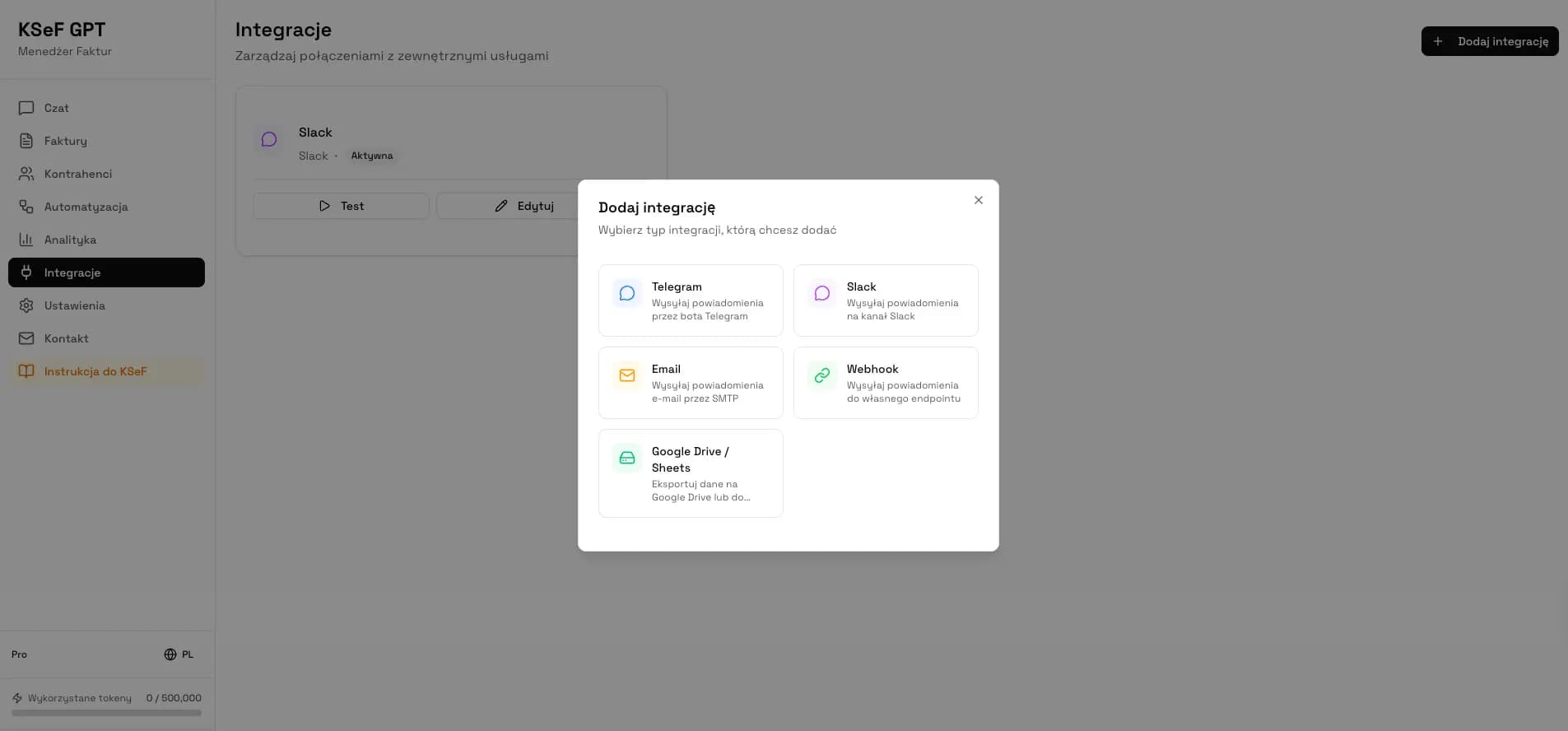
The scope may cover only preparing and sending an invoice, or a broader flow with statuses, the KSeF number, UPOs, retries and outbound events. Each element must be confirmed explicitly before pricing. The public KSeFGPT Integrations module shows the available ways to connect an invoicing process, while outbound webhooks can send events to the customer's system.
| Stage | What must be agreed | Why it affects the estimate |
|---|---|---|
| Analysis | Systems, entities, data owners, invoice types and exceptions. | Defines the number of flows, mappings and project participants. |
| Data contract | Input format, required fields, identifiers and quality rules. | Reduces misunderstandings and rework during integration. |
| Mapping and validation | FA(3) mapping, conditional rules and where errors are corrected. | Each document variant requires appropriate rules and tests. |
| Return flow | Statuses, KSeF number, UPOs, retries and events for the customer's system. | Extends the integration beyond one-way invoice transmission. |
| Testing and go-live | Test data, acceptance criteria, pilot and operational responsibility. | The number of scenarios and correction rounds affects both teams' work. |
| Maintenance | Monitoring, incident handling, updates and level of support. | Defines the recurring operating cost after the project ends. |
Do you want to connect your own system to KSeF?
Prepare information about your systems, invoice types, volume and expected flow. This makes it possible to define the scope of a custom KSeFGPT integration.
Explore KSeFGPT integrationsWhat information is needed for a reliable estimate?
A sound estimate does not begin with the number of screens or endpoints. It begins with complete information about the process. The earlier a company identifies its systems, documents, exceptions and owners of responsibility, the fewer assumptions a supplier has to turn into project contingency.
At KSeFGPT, we organise this information into an implementation qualification model. Systems and entities define the architecture, document types determine the mapping and testing scope, data quality indicates preparatory work, the post-submission flow determines integration directions, and operational requirements define the maintenance model. Only after these five areas have been covered is the scope ready to be priced.
Systems: how many sources produce invoices, and where should statuses return? Entities: how many legal entities, plants and configurations are in scope? Documents: which invoice types actually occur? Data: which fields are complete, and which need to be supplemented? Operations: does the scope include sending, receiving, statuses, UPOs and retries? Maintenance: who monitors the process and responds to errors after go-live?
If data comes from spreadsheets or needs to be cleaned up first, see the guide to bulk invoice submission to KSeF from Excel. If master data is the issue, begin by planning customer database migration during KSeF implementation.
| Area | Information to collect | Decision resulting from the answer |
|---|---|---|
| Systems and entities | ERPs, sales systems, legal entities, plants and technical owners. | Number of integrations, configurations, permissions and teams. |
| Volume and operating pattern | Invoice count, peak periods, batches and required processing time. | Sending mode, monitoring, queues and operational requirements. |
| Document types | Standard invoices, advance invoices, corrections, currencies and self-billing. | Scope of mapping, validation and user acceptance testing. |
| Data quality | Gaps, duplicates, custom fields, units, rates and identifiers. | Clean-up work and where data is corrected. |
| Post-submission flow | Statuses, KSeF number, UPOs, rejections, retries and invoice receiving. | Integration directions and responsibility for document state. |
| Security and maintenance | Permissions, certificates, monitoring, escalation and expected support. | Operating model and recurring service scope after go-live. |
How does integration experience help control costs?
Most unnecessary work arises when development starts before the company agrees on data ownership and the boundaries of responsibility. An integration can work technically and still stop invoices if no one knows who should correct a missing customer, an incorrect tax rate or an inconsistent product identifier.
A well-prepared data contract reduces the number of such disputes. It should specify required fields, document identification, permitted values, the error response and retry rules. This prevents the customer's system and the integration layer from trying to correct the same information at the same time.
A test plan works in the same way. Instead of checking only a straightforward invoice, the team covers actual document types, validation errors, rejections, statuses, UPOs and procedures for periods of unavailability. Identifying a gap before go-live costs less organisationally than changing a process after production launch.
The final element is responsibility after go-live. The company should know who watches monitoring, who receives an alert, who resolves a business error and who updates the integration after an API or process change. This division does not create an impressive screen, but it has a direct effect on total cost and implementation stability.
Frequently asked questions
Can KSeF be implemented at no cost?
The Polish Ministry of Finance provides free tools for using KSeF, but a company still incurs the cost of preparing data, procedures, permissions, tests, training and employee time. An integration with an ERP or a proprietary system also adds configuration, development, monitoring and maintenance costs.
How much does a KSeF integration with an ERP cost?
There is no single reliable price for integrating KSeF with an ERP. The estimate depends on factors such as the number of systems and legal entities, invoice types, data quality, the scope of invoice sending and receiving, status and UPO handling, testing, and the support required after go-live. A credible amount can be determined only after these elements have been analysed.
What increases the cost of KSeF implementation in manufacturing the most?
The main cost drivers are multiple source systems, different processes across plants or legal entities, incomplete master data, numerous invoice types, custom mapping rules, high volume, error handling and retries, and demanding requirements for monitoring, security and business continuity.
Can invoices be sent from a proprietary system through the KSeFGPT API?
Yes. KSeFGPT develops custom integrations in which the customer's system sends an agreed invoice data set through the ksefgpt-api layer, while KSeFGPT provides the agreed scope of connectivity with Poland's National e-Invoice System, KSeF. The exact flow, including statuses, official acknowledgements known as UPOs, retries and monitoring, is agreed during the analysis before the project is priced.
Recommended reading
The most common KSeF implementation challenges - explains data, process, testing and responsibility issues that should be included in the budget.
How to migrate a customer database during KSeF implementation - helps plan master-data clean-up before integration.
How to send many invoices to KSeF from Excel - describes an option for structured data without a permanent ERP connection.
KSeFGPT: invoice import, export, analytics and API - presents a broader range of invoice operations and custom integration processes.
Do you need a custom KSeF integration?
KSeFGPT can connect agreed data from your ERP or sales system with the KSeF submission process. The scope and estimate are prepared after the systems, documents and responsibilities have been analysed.
Go to KSeFGPTSources
The cost model is based on the official scope of KSeF tools and APIs and on the publicly described integration capabilities of KSeFGPT. A reliable estimate requires an analysis of the systems, documents, data and responsibilities of the specific company.
- KSeF Taxpayer Application, KSeF mobile app and other tools
Polish Ministry of Finance · accessed: July 14, 2026
Official description of free tools for issuing, receiving and viewing structured e-invoices and managing permissions.
- FA(3) structured e-invoice schema
Polish Ministry of Finance · accessed: July 14, 2026
Official materials on the structured invoice schema to which source-system data is mapped.
- Support for KSeF 2.0 integrators
Polish Ministry of Finance · accessed: July 14, 2026
Integration, pre-production and production environments, OpenAPI documentation and usage scenarios for integrators.
- KSeF API 2.0 documentation
Polish Ministry of Finance · accessed: July 14, 2026
Official API contract covering authentication, sessions, submission, statuses, UPOs and invoice retrieval.
- KSeFGPT integrations
KSeFGPT · accessed: July 14, 2026
Public description of integrations, automation, outbound webhooks and connections between invoicing processes and company tools.
Expert reviewed: Bogdan Mazurek
Tax adviser · July 14, 2026
The article was reviewed to confirm that it correctly separates the Polish Ministry of Finance's free tools from the organisational, technical and maintenance costs of KSeF implementation, and accurately describes structured invoices and the integration process.