MPP on KSeF invoices after an individual interpretation
Analysis of the dispute over voluntary split payment in KSeF: where the technical invoice marking ends and the tax risk of overinterpretation begins.
Article Summary
In KSeF invoices, you need to distinguish the statutory note mechanism podzielonej platnosci from the buyer's simple decision to pay voluntarily with split payment. These two situations may sound similar in a conversation with a counterparty, but they do not necessarily mean the same thing in FA(3) XML.
The P_18A field in FA(3) is not a general note about a preferred payment method. The schema links it with mandatory MPP conditions: invoice value above PLN 15,000 or the equivalent in foreign currency, and a supply of goods or services listed in Annex 15 to the Polish VAT Act.
Individual interpretation 0112-KDIL1-3.4012.185.2026.1.KM should be read carefully. An individual interpretation concerns the applicant and the described facts, not every taxpayer issuing invoices in KSeF.
Why MPP on a KSeF invoice became a problem
The practical scenario is simple. A seller issues an invoice in KSeF, the transaction does not appear to fall under mandatory split payment, but the buyer says: I will pay by split payment anyway. The question then appears: should the issuer mark the invoice as MPP in XML?
In the old flow, it was easy to add a note on a PDF or copy a setting from invoicing software. In KSeF, that decision enters the data structure. That is why you need to know whether the marking follows from the law and the FA(3) schema, or only from operational information about how the buyer intends to pay.
Questions before the decision: does the invoice exceed the PLN 15,000 threshold, does it cover goods or services from Annex 15, are both parties acting as taxpayers in a B2B scenario, and is the buyer talking about their payment method or a statutory obligation? Since this is the problem, let us move to the article map.
| Layer | What it means in practice | Risk of mistake |
|---|---|---|
| Invoice note | Information required when statutory MPP conditions are met. | Adding it without a basis may mislead the counterparty and accounting. |
| Payment method | The buyer may use a split payment transfer message in their bank. | The buyer's decision does not have to change the invoice marking automatically. |
| FA(3) field | P_18A organizes the marking in the invoice structure. | Automatic mapping of an old label may create incorrect XML. |
Table of Contents
Key Takeaways
The table below collects the most important decisions to make before marking Mechanizm Podzielonej Platnosci on a KSeF invoice.
| Point | Details |
|---|---|
| Start with statutory conditions | Split payment on an invoice starts with the value threshold and Annex 15, not only with the buyer's request to pay by split payment. |
| P_18A is not a comment | The P_18A field in FA(3) has structural meaning. It should not replace any note about how the counterparty wants to pay. |
| The interpretation has limits | Interpretation 0112-KDIL1-3.4012.185.2026.1.KM concerns a specific applicant and the facts described in the request. |
| Voluntary split payment requires caution | If the buyer wants to pay voluntarily by split payment, the issuer should check whether this changes anything in the invoice content. |
| Process before submission | The safest approach is a short checklist: amount, Annex 15, party status, P_18A setting, XML validation and a recorded reason for the decision. |
Short answer for the invoice issuer
If the invoice meets the mandatory MPP conditions, the split payment mechanism marking should be reflected on the invoice and in field P_18A. The decision should follow from the transaction, not from an invoice template or habits from previous software.
If the buyer wants to pay voluntarily by split payment, but the transaction does not meet statutory conditions, do not automatically assume that the invoice must contain the Mechanizm Podzielonej Platnosci marking. This nuance became the axis of the interpretation and the later MF comment.
Short decision checklist: check total amount due, currency and possible conversion, Annex 15 items, buyer status, contractual arrangements and whether the invoice wording describes an obligation or only the expected payment method. Since we know the short answer, let us move to the FA(3) field itself.
| Situation | What to do with the Mechanizm Podzielonej Platnosci marking | What to avoid |
|---|---|---|
| Mandatory MPP conditions are met | Mark the invoice according to the requirements of the VAT Act and FA(3). | Manual omission of the field because the counterparty did not mention the note. |
| Buyer declares voluntary split payment | Check whether a statutory obligation exists before changing the invoice. | Marking MPP only because the bank allows such a transfer. |
| Uncertain Annex 15 classification | Stop submission and confirm classification of the goods or service. | Marking just in case without an accounting note. |
What P_18A means in FA(3)
The official FA(3) schema describes P_18A through transaction conditions: total amount due exceeds PLN 15,000 or the equivalent of that amount in foreign currency, and the invoice documents a supply of goods or services from Annex 15 to the Polish VAT Act. In that situation, value 1 means application of the split payment mechanism, while otherwise value 2 is provided.
This is not a field for describing any buyer payment decision. If the buyer chooses split payment out of their own caution, the issuer should still ask whether the statutory conditions are met. The buyer's chosen transfer technique is not always the same thing as a mandatory invoice note.
Good practice: decide on P_18A before generating XML, not after validation. A validator may help detect a structural issue, but it does not replace accounting classification of goods from Annex 15. Since we know what the field is, we need to return to the mandatory MPP conditions.
| Element | Meaning | Pre-submission check |
|---|---|---|
| Value 1 | The invoice is marked as covered by the split payment mechanism. | Whether the threshold and Annex 15 are met together. |
| Value 2 | The invoice is not marked as covered by that Mechanizm Podzielonej Platnosci case. | Whether the missing marking is not caused by overlooking a sensitive item. |
| Foreign currency amount | The equivalent of the PLN 15,000 threshold must be determined. | Which rate and date accounting uses for the transaction. |
| Annex 15 | The link between the goods or service and the statutory catalogue is key. | Whether the line description and classification are clear enough. |
When the split payment mechanism is mandatory
As of July 9, 2026, the starting point is the same as in the FA(3) schema: the invoice must exceed the PLN 15,000 threshold or its equivalent and cover goods or services from Annex 15 to the Polish VAT Act. Only when these conditions occur together does a practical need to mark MPP on the invoice arise.
A high amount alone is not enough. An item from the catalogue alone is also not enough if the invoice value does not exceed the threshold. It is also not enough that the buyer prefers to pay by split payment transfer message. In the invoicing process, it is worth separating three questions: what is the amount due, what is being sold and what is the status of the parties.
Checklist: gross invoice amount, currency, Annex 15 items, taxpayer status, possible collective payments, contract documentation and the reason for the P_18A setting. Since the conditions are clear, we can move to the hardest case, voluntary split payment.
| Condition | Control question | What it means for the invoice |
|---|---|---|
| Value threshold | Does the total amount due exceed PLN 15,000 or the equivalent? | Without exceeding the threshold, Annex 15 alone does not decide the marking. |
| Scope of sale | Does the invoice cover goods or services from Annex 15? | Without such an item, the amount alone does not create mandatory MPP. |
| B2B relation | Is the transaction settled between the relevant taxpayers? | Party status should be confirmed before submission. |
| Evidence of decision | Can you reconstruct why P_18A was set in case of an audit? | It is worth saving a note or rule in the accounting process. |
Voluntary split payment and the invoice note
Voluntary split payment is a payment decision made by the buyer. The mechanism podzielonej platnosci note on the invoice is information from the issuer about the statutory regime of a given transaction. In practice, both topics meet on the same invoice, but they must not be merged into one automatic rule.
The MF information is important precisely because it refers to voluntary MPP in the KSeF era and interpretation 0112-KDIL1-3.4012.185.2026.1.KM. This comment should be read together with the full interpretation record ID 692287, not as a shortcut allowing every company to mark every invoice according to its own preference.
The practical rule is cautious: if the buyer wants to pay voluntarily by split payment, note that operationally in settlements, but set P_18A only after checking statutory conditions and sources. Since we have separated voluntary payment from the note, we need to organize the interpretation itself.
| Question | Safer operational answer | What not to assume |
|---|---|---|
| Buyer wants to pay by split payment | This may be information for settlements and payments. | That the invoice must automatically have the MPP marking. |
| Seller wants to help the buyer | The seller may explain payment data and agree the process. | That adding MPP has no accounting consequences. |
| KSeF requires structure | The correct field must be set in XML. | That P_18A is a free note for the counterparty. |
What interpretation 0112-KDIL1-3.4012.185.2026.1.KM decides
The individual interpretation concerns a specific question about marking invoices in KSeF in the context of the split payment mechanism and voluntary split payment on the buyer side. It does not automatically decide every case in which a counterparty wants to pay by split payment transfer message.
The applicant wanted to determine whether such a practice could be acceptable when issuing invoices. For assessing your own situation, the full wording of the interpretation is key: the facts or future event, the question, the taxpayer's position, the authority's assessment and the reasoning. Only these elements show how far conclusions from the interpretation can be transferred to similar transactions.
The boundary is the most important point. An individual interpretation is not a universal invoicing rulebook for KSeF. It usually protects the applicant who described a specific set of facts or future event. For other companies it may be a useful signal, but it does not replace analysis of their own transaction. Since we know the boundaries of the interpretation, let us move to the practical decision table.
| Interpretation element | How to read it in the article | What to check in the original |
|---|---|---|
| Applicant's question | It concerned MPP marking on KSeF invoices in the context of voluntary split payment. | Whether the question covered all invoices, selected invoices or a specific transaction model. |
| Applicant's position | This is the taxpayer's argument, not the final legal rule. | How the taxpayer justified the link between voluntary payment and the invoice note. |
| Formal ruling | Read it from the full Eureka record 692287. | Whether the authority considered the position correct, incorrect or partly correct. |
| Authority reasoning | The key point is the distinction between statutory obligation and voluntary payment method. | Whether the authority refers to Article 106e, Article 108a, the FA(3) schema or another basis. |
| Practical takeaway | Do not transfer the interpretation automatically to your own company. | Whether your transaction has the same facts as the request. |
Decision table for the issuer before submission
The greatest practical value is not memorizing the interpretation number, but organizing the decision before sending XML. The table below helps separate cases where MPP is a statutory layer from cases where the buyer merely chooses split payment as the payment method.
Do not treat this table as tax advice for every industry. It is a map for a conversation with accounting: it helps quickly show what is missing for a decision and where error risk appears. Since we have the map, it is worth naming the typical mistakes as well.
| Scenario | Does it look like statutory MPP | How to treat P_18A | What to check | Risk of mistake |
|---|---|---|---|---|
| Amount up to PLN 15,000 | Usually not based on the threshold alone | Most often without MPP marking | Whether no special transaction rules apply | Automatic copying of settings from the counterparty. |
| Amount above PLN 15,000 without Annex 15 | The amount alone is not enough | Do not mark only because of value | Scope of items and classification of goods or services | Treating every large invoice as MPP. |
| Amount above PLN 15,000 with Annex 15 | Yes, if the remaining conditions are met | Mark according to FA(3) | Items, party status, currency and documentation | Omitting the marking despite the obligation. |
| Voluntary split payment without statutory obligation | Does not decide the obligation | Do not set automatically | Full interpretation record and MF comment | Confusing payment method with invoice content. |
| Collective payment | Depends on the invoices covered by the payment | Assess each invoice separately | Which documents are in the payment and what markings they have | Averaging the decision for the whole package. |
Common mistakes with MPP in KSeF
The first mistake is marking MPP just in case. In KSeF, data is structural, so this is not an innocent margin note. If the marking does not follow from the transaction, it may create unnecessary questions for the buyer and accounting.
The second mistake is looking only at the amount. The PLN 15,000 threshold matters, but without checking Annex 15 it is not enough for the decision. The third mistake is transferring settings from paper invoices or PDFs without checking again whether old mapping rules are compliant with FA(3).
Mistakes to discuss in the company: automatic note for every counterparty, no Annex 15 verification, ignoring currency, treating the buyer's request as the issuer's obligation, and no accounting note for a borderline decision. Since we know what to avoid, we can design a safer tool process.
| Mistake | Consequence | Better practice |
|---|---|---|
| MPP just in case | The invoice may suggest an obligation that was not established. | Mark after checking the conditions. |
| Amount alone as the decision | A large invoice without Annex 15 may be marked incorrectly. | Check the amount and scope of sale together. |
| Copying an old template | Software may transfer a label without FA(3) analysis. | Test P_18A mapping before submission. |
| No decision documentation | After some time it is hard to reconstruct why the invoice had a given marking. | Save a short reason in the accounting process. |
Expert perspective
The biggest risk with MPP in KSeF is not the act of clicking a field in a form. The risk arises earlier, when a company does not know whether the marking follows from regulations, the counterparty's expectation or a setting inherited from old software.
For implementation, it is worth separating responsibilities. The person issuing the invoice should have a simple procedure and see warnings for amount and item type. Accounting should confirm borderline cases. The system should record the decision in invoice data, but it should not pretend to be a tax adviser.
Individual interpretations are helpful because they show how the authority thinks. They should not replace the company's own transaction classification. With MPP, it is especially easy to turn one letter into an operational rule for the whole process, and that is exactly the shortcut worth avoiding.
A good procedure is simple: first identify the transaction, then set the field in XML, then validate the structure, and only at the end send the invoice to KSeF. If the case is unusual, stop submission and confirm the decision with accounting or an adviser.
How KSeFGPT can help without replacing an adviser
KSeFGPT should be treated as a tool for working with invoices, FA(3) XML, status, UPO and complete data, not as a source of an individual tax interpretation. The application can help organize the process and reduce manual mistakes, but the decision whether a transaction meets mandatory MPP conditions remains an accounting or advisory decision.
In practice, separating two steps is useful. First, the company determines the tax decision for a given invoice. Then the tool helps keep consistent data: invoice, XML, submission status, KSeF number, UPO and documentation needed by accounting. When working technically with a file, the KSeF XML validator may also help.
If you issue invoices in a regular process, check the KSeFGPT invoices module. In one place, you can work with documents, statuses and data needed for settlements instead of keeping invoice decisions in separate emails, spreadsheets and folders.
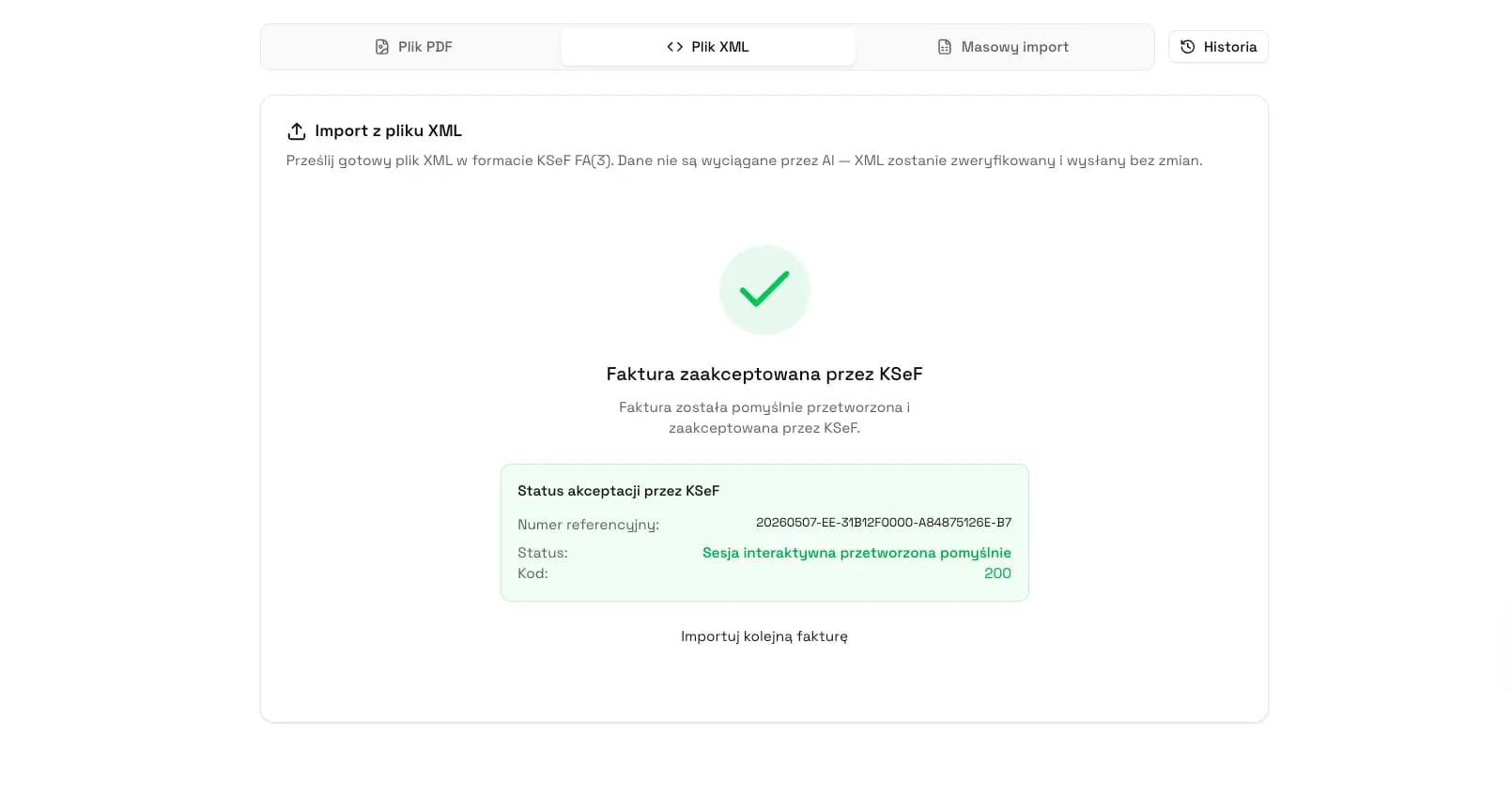
Organize invoices, statuses and accounting data
KSeFGPT helps work with KSeF invoices, FA(3) XML, UPO and document status in one process without replacing the company's tax decision.
Go to the invoices moduleFrequently Asked Questions
Does voluntary split payment mean that I must mark MPP in KSeF?
No, not automatically. As of July 9, 2026, you need to distinguish the statutory note mechanism podzielonej platnosci from the buyer's voluntary decision to pay with a split payment transfer message. Before marking the invoice, check the mandatory MPP conditions and your own facts.
What does the P_18A field mean in an FA(3) invoice?
P_18A indicates whether the invoice covers the split payment mechanism case described in the FA(3) schema: total amount due above PLN 15,000 or its equivalent in foreign currency, and goods or services listed in Annex 15 to the Polish VAT Act.
Does individual interpretation 0112-KDIL1-3.4012.185.2026.1.KM protect my company?
An individual interpretation generally protects the applicant and the facts or future event described by that applicant. It may be a useful interpretive signal for other companies, but it is not a universal permission to mark every invoice as MPP.
Can I mark MPP on an invoice just in case?
That is a risky approach. The MPP marking should follow from the transaction conditions, not from a desire to be safe in advance. If you are unsure, check the amount, Annex 15, party status and accounting documentation, or consult the case with an adviser.
Recommendation
If you want to go deeper without repeating the whole KSeF process, start with these four materials:
How to issue a VAT invoice in KSeF step by step - helps organize decisions before a regular sales invoice, including data, document type, validation and submission.
KSeF number on invoice - explains when the KSeF number is created and how not to confuse it with your own invoice number.
KSeF invoice payment term - shows how to separate issue date, receipt date and buyer-side settlements.
Sending invoices to KSeF - describes the technical submission process, statuses, UPO and pre-submission control.
Work with KSeF invoices in an organized process
KSeFGPT helps issue invoices, work with FA(3) XML, monitor statuses, UPO and accounting data without scattering decisions across emails and spreadsheets.
Go to KSeFGPTSources and Source Notes
Sources include official Eureka records, the FA(3) schema, the Polish VAT Act and MF materials on the e-Invoice structure. Sources were checked on July 9, 2026; Eureka record 692287 should be read in the original before making a tax decision for your own company.
- Individual interpretation 0112-KDIL1-3.4012.185.2026.1.KM, Eureka ID 692287
Ministerstwo Finansów / Eureka · accessed: July 9, 2026
Canonical record of the individual interpretation analyzed in this article. It includes the case content, applicant's position, authority assessment and reasoning, which must be read together.
- MF information on voluntary MPP in the KSeF era, Eureka ID 697614
Ministerstwo Finansów / Eureka · accessed: July 9, 2026
Official contextual MF information concerning voluntary split payment for KSeF invoices.
- FA(3) schema v1-0E
CIRF / Ministerstwo Finansów · accessed: July 9, 2026
Official FA(3) technical schema, including the description of element P_18A concerning the split payment mechanism.
- Polish Act on Tax on Goods and Services
Sejm RP / API ELI · accessed: July 9, 2026
Primary legal source for invoice elements and the split payment mechanism, especially Articles 106e and 108a.
- FA(3) e-Invoice structure
Ministerstwo Finansów / KSeF · accessed: July 9, 2026
Official information page on e-Invoice structures and KSeF technical documents.
Expert reviewed: Bogdan Mazurek
Tax adviser · July 9, 2026
The content was reviewed for a cautious distinction between mandatory MPP, voluntary split payment, the P_18A field in FA(3) and the limits of protection resulting from an individual interpretation.