How to invoice a company in the Netherlands
Does your Polish business supply services or ship goods to a Dutch customer? Learn when the buyer accounts for VAT, what a 0% intra-Community supply requires and how to deliver an invoice issued in KSeF.
Summary
To invoice a Dutch company from Poland, first establish the type of transaction. For a service covered by Article 28b of the Polish VAT Act and supplied to a taxable customer's business establishment in the Netherlands, you generally do not add Polish VAT; the customer accounts for the tax. Goods shipped from Poland to the Netherlands may qualify as an intra-Community supply, known as WDT in Poland, at 0% if separate conditions are met.
Collect the customer's legal name, address and the EU VAT ID appropriate to the transaction. A Dutch btw-id starts with NL. A VIES check confirms the registration status but does not replace the assessment of the service or evidence that goods reached the customer.
Having a foreign customer does not by itself exempt a Polish supplier from KSeF, Poland's national e-invoicing system. If you must issue the invoice in KSeF, do so and then provide that same invoice to the customer through an agreed channel, for example as a readable English PDF.
Your first invoice for a Dutch customer
The customer gives you an address in Amsterdam and asks for an invoice in euros. Before choosing a VAT rate, establish what you are selling, who is buying and where the transaction is taxable. This guide concerns a supplier established in Poland and ordinary business transactions, without advance payments or special schemes. It is based on legislation and official guidance checked on October 6, 2026.
Contents
Key takeaways
Agree the VAT treatment with the person handling your tax reporting before issuing the invoice. If you ship goods, also arrange who will provide the documents confirming delivery to the customer.
Confirm the invoice language, delivery address and any purchase order reference with the customer. This helps the document reach the right person without having to prepare its contents again.
What determines VAT on an invoice to a Dutch company?
Under the general rule in Article 28b, a service supplied to a taxable person for business purposes is taxable where that customer has established its business, provided the service is supplied to that establishment. If it is in the Netherlands and the Polish supplier has neither its business establishment nor an involved fixed establishment there, the buyer generally accounts for VAT. The Polish invoice uses reverse charge without adding Polish VAT. This treatment is separate from a 0% rate or a VAT exemption.
An ordinary intra-Community supply requires goods to actually leave Poland for another EU country as part of the supply. The scenario here concerns an active VAT taxpayer not using a sales exemption. To apply 0%, the buyer must provide an appropriate valid EU VAT ID, the supplier must be registered for EU VAT when filing the return, hold delivery evidence by the return deadline and meet the requirements for a correct recapitulative statement. A Dutch billing address alone is insufficient.
For transport by a carrier, the transport documents and cargo specification should together confirm delivery. Different documentary requirements apply to transport using your own vehicle. If evidence is missing by the reporting deadline, the relevant Article 42 rules apply; obtaining documents later may allow a correction.
Check the exceptions before applying the general services rule. A service supplied to the customer's fixed establishment in another country, services connected with immovable property or admission to an event attended in person may require a different place-of-supply assessment. The customer's Dutch business address does not settle these cases.
| Transaction | What the Polish invoice shows | What to establish |
|---|---|---|
| B2B service to a Dutch business establishment under Article 28b | No Polish VAT and a reverse charge annotation where the customer accounts for the tax. | The customer's taxable status, business purpose, place of supply and any exceptions. |
| Ordinary intra-Community supply from Poland to the Netherlands | A 0% rate once the Article 42 conditions are met. | Actual transport, appropriate EU VAT IDs, delivery evidence and the recapitulative statement. |
How do you check a Dutch company's details?
Ask for the full legal name, address, country and the identifier appropriate to the transaction. The Dutch btw-id used with customers and suppliers consists of NL, nine digits, the letter B and two further digits. The ob-nummer is used for communication with Belastingdienst, the Dutch tax administration. A KVK company registration number does not replace an EU VAT ID either.
When checking a Dutch VAT ID in VIES, select NL, enter the number and save the result with the date. VIES draws on national VAT registers. A valid result helps confirm registration for EU transactions; the service classification and conditions for an intra-Community supply require separate assessment.
An invalid result may mean that the number has not been activated for EU transactions or that registration is incomplete. Resolve the discrepancy with the customer and, where necessary, the relevant tax authority. If the service reports that data are unavailable, try again later. An outage is different from an invalid result.
Before your first such transaction, also check your own EU VAT registration in Poland. The requirement can apply to a business using a domestic VAT exemption when it supplies qualifying EU services. EU VAT registration and giving up a domestic VAT exemption are separate matters.
What goes on the invoice, and when must you issue it?
Enter the issue date, sequential invoice number, both parties' names and addresses, appropriate identifiers, the service or delivery date if different from the issue date, the description and scope of the service or quantity of goods, prices, values and amount due. For the transactions described here, use your Polish EU VAT ID with PL and the customer's appropriate EU VAT ID.
For a service whose VAT is accounted for by the customer, the Polish invoice must contain the annotation odwrotne obciążenie. You can also add reverse charge to help the customer understand it. Do not add Dutch VAT to the amount payable to the Polish supplier. An ordinary intra-Community supply uses its appropriate 0% treatment; the customer's accounting for an acquisition is not in itself a reason to add the reverse charge annotation.
Bank details, a payment deadline, an email address and a purchase order number may be useful to the customer, although they are not a universal set of mandatory invoice particulars under Article 106e. Agree them with the buyer. The guide to issuing and submitting a standard VAT invoice explains the general form; establish the tax treatment of your particular foreign transaction separately.
You can invoice in EUR. If Polish VAT is charged, its amount must be shown in Polish złoty. The exchange rate for tax reporting depends on the applicable rules and tax point; it is not always the rate from the day before the invoice.
For the ordinary cases covered here, the general issue deadline is the 15th day of the month following delivery or completion of the service. The payment deadline follows your agreement with the customer. Separately, file the VAT-UE recapitulative statement, generally by the 25th day of the month following the month in which the tax obligation arose. It covers intra-Community supplies and services meeting Article 100(1)(4): Article 28b services taxed in another EU country, with the customer liable for VAT and no exemption or 0% rate there. Issuing an invoice in KSeF does not replace this statement.
Prepare an invoice your customer can read
Enter company details, line items and currency in KSeFGPT. Review the VAT treatment and required annotations before submission.
Open KSeFGPTTwo examples with EUR 2,000 payable
Hypothetical service example: a Polish business supplies a software development service to a customer's business establishment in the Netherlands. Both parties have the appropriate EU VAT registration. Article 28b applies, no exception is involved, the supplier has no fixed establishment in the Netherlands and the service is neither exempt nor subject to 0% there. With an agreed price of EUR 2,000, no Polish VAT is added and EUR 2,000 is payable to the supplier. The invoice includes the reverse charge annotation; the customer accounts for VAT in the Netherlands.
Hypothetical goods example: an active Polish VAT taxpayer registered for EU VAT sells 100 units of ordinary goods at EUR 20 net each. The goods travel from Poland to a Dutch buyer with an appropriate valid EU VAT ID. The supplier holds delivery evidence by the return deadline and correctly reports the transaction in the recapitulative statement. With the Article 42 conditions met, the net value is 100 × EUR 20 = EUR 2,000, the VAT rate is 0%, Polish VAT is PLN 0 and the amount due is EUR 2,000.
The payable amount is identical, but the tax treatment and supporting documents differ. These examples do not calculate the customer's Dutch VAT or the reporting base in PLN. They illustrate how two different transactions should be described.
How do you issue in KSeF and deliver the invoice?
First establish the Polish supplier's obligation. A customer established in the Netherlands does not by itself take the invoice outside KSeF. The law provides exclusions and a transitional simplification until the end of 2026; eligibility depends on the supplier's circumstances and the conditions of the relevant provision.
For the foreign customer described here, agree how the invoice will be provided, for example as a PDF sent to a specified email address or uploaded to the customer's portal. Once an invoice issued online has been accepted, check that the version provided contains one QR code labelled with the KSeF number. Offline modes have separate marking rules.
Poland's Ministry of Finance permits an invoice visualization in another language or in two languages, provided its content matches the XML sent to KSeF. An English PDF presents the same invoice. Its language does not change the VAT treatment or amount and does not create another invoice. See the guide to KSeF invoices in English for more detail.
When an invoice is provided to this type of customer outside KSeF, Article 106na(4) makes actual receipt by the customer the receipt date. Assignment of a KSeF number does not replace delivery to the buyer. Keep information confirming delivery through the agreed channel.
What should you check in KSeFGPT before submission?
Enter buyer details directly in the invoice form. Select country NL and check the name, address and EU VAT ID. Where EU code and VAT EU are separate fields, put NL in the code field and only the remaining part of the identifier in the number field. Do not repeat the prefix. Select EUR if that is the currency agreed with the customer.
After changing the country, review the VAT treatment of every line again. Choosing an EU country may suggest 0% WDT even for a service line. For a service meeting Article 100(1)(4), the appropriate FA(3) designation is np II; a qualifying intra-Community supply uses the separate 0% WDT option. The country alone does not determine what you sold.
The rate code and reverse charge annotation are separate pieces of information. Before submission, check the required annotation in the document data. If it is missing or you cannot set it correctly, stop the submission and resolve the document with the person handling your tax reporting or application support.
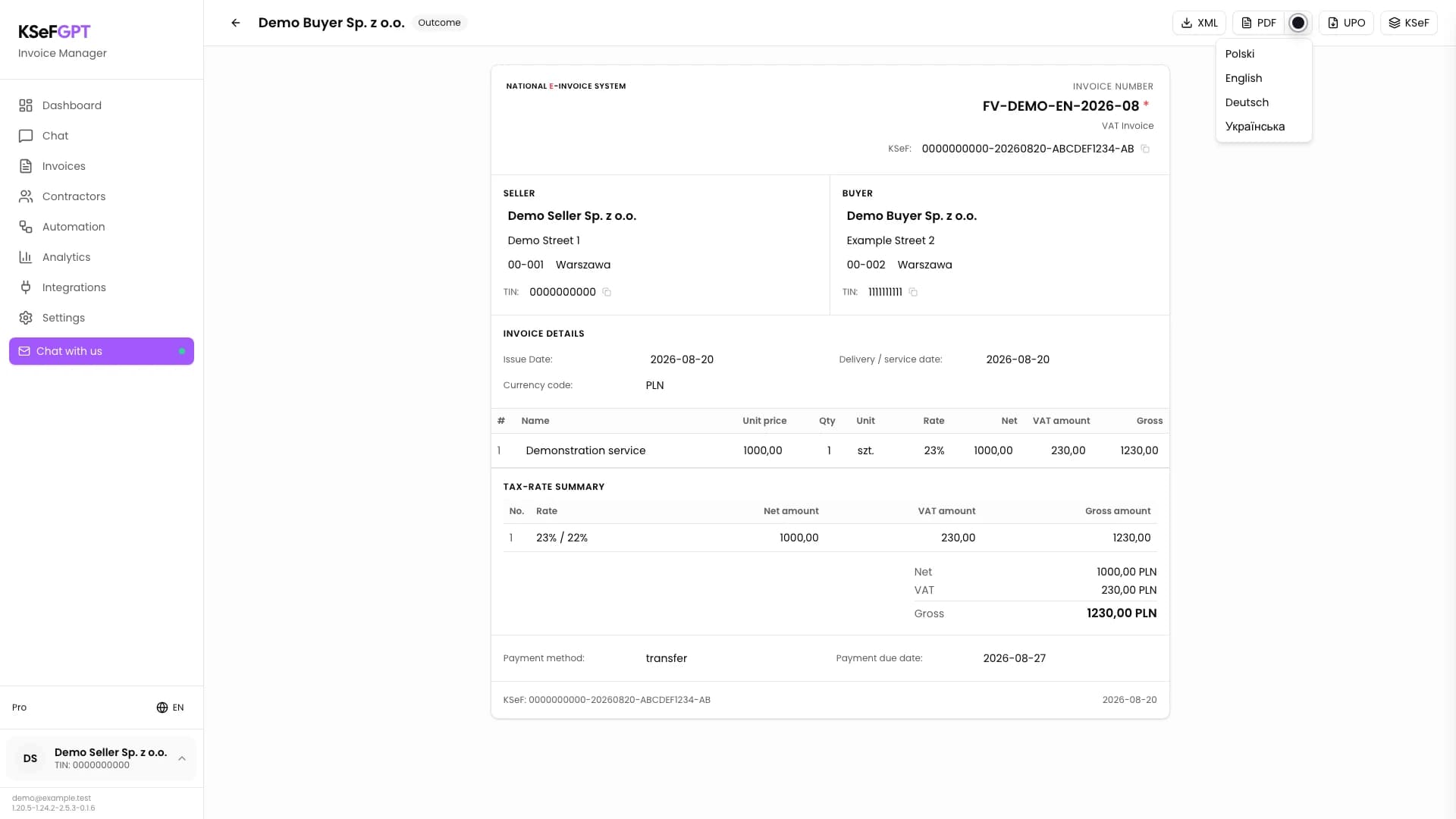
To prepare a readable version for the customer, open the menu next to PDF in the invoice details and select English. Check the downloaded file, including your own line descriptions, amounts and required markings. Then provide it through the agreed channel. The guide to downloading PDF, XML and UPO explains the individual actions.
The illustration shows the PDF language selector on a sample domestic Polish invoice. It is included only to locate the language menu and is not a model invoice for a Dutch customer.
Frequently asked questions
These answers concern a Polish business issuing an invoice to a business customer in the Netherlands.
Does every invoice to a Dutch company have 0% VAT?
No. An Article 28b service supplied by a Polish business to a Dutch customer's business establishment, with VAT accounted for by the customer, carries no Polish VAT and requires a reverse charge annotation. An ordinary intra-Community supply of goods from Poland to the Netherlands may use 0% after meeting Article 42 conditions, including EU VAT IDs, delivery evidence and the recapitulative statement. Other transactions need their own assessment.
Which number should a Dutch company provide for an invoice?
For the EU transaction described here, ask for the appropriate EU VAT ID. A Dutch btw-id consists of NL, nine digits, the letter B and two digits. Check its VIES status and retain the result. The ob-nummer is for communication with Belastingdienst, and a KVK registration number does not replace an EU VAT ID.
Must an invoice for a Dutch customer be in Dutch?
KSeF rules permit an invoice visualization in another language or a bilingual version if its content matches the XML data. Agree a language, such as English, with the customer. KSeFGPT offers English in the PDF menu. Before providing the file, check the downloaded document and its line descriptions.
Is sending a PDF without using KSeF enough?
If the Polish supplier must issue that invoice in KSeF, a PDF alone does not fulfil the obligation. The foreign customer receives the invoice through an agreed channel. For an online invoice accepted by the system, the visualization provided should contain a QR code with the KSeF number. Issuing outside KSeF depends on an applicable exclusion or transitional provision.
Recommended reading
How to issue and submit a standard VAT invoice in KSeFGPT Prepare a document and follow the general submission process.
How to download an invoice as PDF and XML, and retrieve UPO Retrieve invoice data, a readable visualization and the official receipt.
Can a KSeF invoice be in English? Prepare a version for a foreign recipient.
A German-language invoice for a German customer Explore a related guide to invoice language.
Keep invoices for international customers organised
Work with invoice data in KSeFGPT and provide your customer with a readable version in a supported language.
Go to KSeFGPTSources
Legislation and official guidance checked on October 6, 2026. This guide covers the ordinary transactions described between a Polish supplier and a business customer in the Netherlands.
- Polish VAT Act, consolidated text in Journal of Laws 2026, item 1263
Polish Journal of Laws, Sejm · accessed: 2026-10-06
Articles 13, 28b, 31a, 42, 97 and 100, together with invoicing and KSeF provisions. The basis for services, intra-Community supplies, invoice particulars, deadlines and actual receipt outside the system.
- EU VAT Directive 2006/112/EC
European Union, EUR-Lex · accessed: 2026-10-06
Articles 44 and 196 cover the place of supply for B2B services and the customer's VAT liability. Articles 138 and 226 address intra-Community supplies and invoicing.
- Belastingdienst on the btw-id and ob-nummer
Belastingdienst · accessed: 2026-10-06
The Dutch VAT ID format and the difference between the number used with customers and the number used with the tax administration.
- Checking an EU VAT number in VIES
European Commission, Your Europe · accessed: 2026-10-06
What a check result means, reasons for an invalid number, unavailable data and keeping evidence of the check.
- Polish Ministry of Finance guidance on KSeF invoice visualization and receipt
Polish Ministry of Finance · accessed: 2026-10-06
Official answers on visualization language, consistency with XML and agreed delivery of invoices to foreign customers.
- KSeF QR verification codes
Polish Ministry of Finance · accessed: 2026-10-06
One QR code labelled with the KSeF number for an accepted online invoice, and separate rules for offline modes.
- FA(3) information brochure, August 2026
Polish Ministry of Finance · accessed: 2026-10-06
Buyer identifiers, separate service and intra-Community supply designations, and the reverse charge annotation in the invoice structure.