Personal Investment Account (OKI) for business owners
See who can open OKI, how its exemptions and asset-value tax work, and what the rules mean for a person running a business in Poland.
Summary
The Polish Act on Personal Investment Accounts was signed on August 13, 2026. As verified on August 18, 2026, it had not yet been assigned a position in the Polish Journal of Laws. Its provisions are intended to take effect on January 1, 2027.
A Polish sole proprietor will be able to open OKI as an adult individual. OKI is not a business account and does not reverse the taxation of income previously earned through a business.
The asset-value tax rate for 2027 is intended to be 0.85%. The combined exemption threshold for qualifying assets will be PLN 100,000, including a threshold of up to PLN 25,000 for specified savings assets.
KSeF concerns the company's invoice flow. OKI is settled separately: the financial institution sends the required information to the tax office, and the taxpayer files the return through the Polish e-Tax Office.
What we currently know about OKI
The Personal Investment Account, known by its Polish acronym OKI, is intended to be a voluntary account for individuals that combines saving and investing within one statutory framework. Income from OKI assets is intended to be excluded from personal income tax. In return, an annual tax will apply to the average asset value above the relevant exemption.
As of August 18, 2026, the Act should not yet be described as being in force. The Sejm passed it, the Senate proposed no amendments, and the President signed it on August 13. Publication in the Journal of Laws is still required. The text of the Act identifies January 1, 2027 as its effective date.
Status: signed and awaiting publication in the Journal of Laws. Availability: individual banks, brokerage firms, funds and insurers still need to launch their own products. First settlement: if the provisions take effect as planned, it will cover 2027 and take place in 2028.
| Date | Stage | Meaning |
|---|---|---|
| May 5, 2026 | Government approved the bill | The government legislative process for OKI began. |
| July 3, 2026 | Sejm passed the Act | The vote was 427 in favour, 5 against and 1 abstention. |
| July 22, 2026 | Senate made no amendments | The text did not return to the Sejm with Senate amendments. |
| August 13, 2026 | President signed the Act | The official list published by the Chancellery of the President confirms the signature. |
| January 1, 2027 | Planned effective date | The date follows from Article 46 and requires prior publication. |
Table of contents
Key takeaways
The table below summarises the rules that matter most to a person who runs a business and is considering an OKI account.
| Point | Details |
|---|---|
| Individual, not business | OKI is opened by an adult individual. A sole proprietor signs the agreement personally, not on behalf of a separate enterprise. |
| Exemption threshold | The combined average value of qualifying assets covered by the exemption cannot exceed PLN 100,000. |
| Tax on value | The 0.85% rate in 2027 applies to the average asset value above the exemption, not to the investment profit. |
| Loss cannot be deducted | An OKI loss is not a tax loss under Polish personal income tax and does not reduce business income. |
| Separate settlements | KSeF concerns business invoices, while OKI information and the related return are handled by the financial institution, tax office and e-Tax Office. |
Who can open OKI and what assets it can hold
Only an individual who is at least 18 years old will be able to sign an OKI agreement. One investor may hold assets in a given account, but the same person may sign more than one agreement and maintain several OKI accounts with different institutions.
For a business owner, the distinction is straightforward. A person operating a Polish sole proprietorship may become an investor because they remain an individual. A limited company or another legal person cannot open OKI for itself. A shareholder or partner may invest privately in their own name.
Providers: a Polish bank, an investment firm, an investment fund, a voluntary pension fund or an authorised insurer. Account forms: a bank account, a securities account with a cash account, a fund register, an insurance-linked investment fund or an account in a voluntary pension fund. Documents: before signing, check the terms, fee schedule, available assets and valuation rules.
The Act permits OKI to hold cash, retail government bonds, fund units, shares, bonds and specified listed instruments, among other assets. This does not mean that every permitted instrument qualifies for the exemption. The catalogue of permitted assets must be distinguished from the tax treatment of each asset.
| Question | Answer | What it means for a business owner |
|---|---|---|
| Who signs the agreement? | An adult individual. | A sole proprietor signs personally, not on behalf of a separate business. |
| Can one person have several OKI accounts? | Yes, the Act permits more than one agreement. | Values and exemptions are nevertheless calculated jointly across all of the taxpayer's OKI accounts. |
| Can OKI be held jointly? | No, one OKI has one investor. | Spouses or business partners cannot maintain one joint OKI. |
| Can a company open OKI? | No, unless it is an individual. | A shareholder or partner may invest personally, but the account does not belong to the company. |
| Is every asset exempt? | No, the exemption covers statutory categories. | Check the instrument's classification, currency and product conditions before buying. |
How the PLN 25,000 and PLN 100,000 thresholds work
A common simplification is that PLN 100,000 can be contributed to OKI tax-free. The Act describes something different. PLN 100,000 is the maximum combined average value of qualifying assets covered by the asset-value tax exemption, not a contribution limit stated in the Act.
The first category covers up to PLN 25,000 of the average value of specified savings assets, including funds in a Polish-zloty bank account and retail government bonds. The second category covers qualifying investment assets. The combined exemption for both categories cannot exceed PLN 100,000.
Savings example: PLN 25,000 of qualifying savings assets and PLN 75,000 of qualifying investment assets fit within the combined threshold. Investment example: PLN 100,000 of qualifying investment assets may be exempt without a savings component. Incorrect example: PLN 25,000 plus an additional PLN 100,000 does not produce a PLN 125,000 exemption.
The calculation uses the average asset value during the year across all of the taxpayer's OKI accounts. Reducing the balance only on December 31 does not guarantee that no tax will arise. Indexation is intended to apply from 2030, with the first ministerial announcement due by November 30, 2029.
| Example | Savings assets | Investment assets | Combined exemption |
|---|---|---|---|
| Savings category only | PLN 25,000 | PLN 0 | PLN 25,000 |
| Both categories | PLN 25,000 | PLN 75,000 | PLN 100,000 |
| Investment category only | PLN 0 | PLN 100,000 | PLN 100,000 |
| Incorrect addition | PLN 25,000 | PLN 100,000 | A maximum of PLN 100,000, not PLN 125,000 |
| Non-qualifying assets | Depends on the instrument | Depends on the instrument | No automatic exemption merely because the asset is held in OKI |
How the asset-value tax works
Income and revenue from OKI assets are intended to be excluded from Polish personal income tax. Instead of taxing realised profit, the Act introduces an asset-value tax. Its base is the sum of average asset values across all of the taxpayer's OKI accounts after the relevant exemptions are applied.
The rate for 2027 is set by the Act at 0.85%. In later years, it is intended to equal 19% of the National Bank of Poland reference rate applicable on October 31 of the preceding year, subject to a minimum of 0.1%. The Minister of Finance is to announce the applicable rate by November 30.
Profit: the tax does not depend on whether the investor sold an asset at a profit. No transaction: simply holding assets above the exemption may create tax. Loss: a decline in value cannot be claimed as a personal income tax loss. Withdrawal: the Act does not require retirement age or a minimum holding period.
The financial institution is to send information to the tax office by the end of February of the following year. The taxpayer will receive the information and a prepared return in the e-Tax Office, file it from March 15 to May 31 and pay the tax by May 31. If the provisions take effect on January 1, 2027, the first standard settlement will cover 2027 and take place in 2028.
| Element | Rule | What a business owner should remember |
|---|---|---|
| 2027 rate | 0.85% | This is a tax on asset value, not on profit. |
| Rate in later years | 19% of the NBP reference rate on October 31, minimum 0.1% | The rate may change from year to year. |
| Institution's information | By the end of February of the following year | The competent tax office receives the information. |
| Tax return | From March 15 to May 31 | The return is filed through the Polish e-Tax Office. |
| Payment | By May 31 | The payment deadline is the same as the end of the filing period. |
| Loss | Not a tax loss under Polish personal income tax | It cannot reduce sole-proprietor income or other capital income. |
OKI for a business owner in practice
Assume that the owner of a service business issues an invoice, recognises business income and settles VAT and personal income tax under the rules applicable to the business. After meeting those obligations, the owner uses part of their own money to invest through OKI.
A later transfer to OKI does not reverse the income from the sale or change the invoice. The contribution does not become a business expense. The special OKI regime begins at the level of assets held in the account, not at the stage of an earlier sale of goods or services.
Business sale: evidenced by an invoice and accounting records. Transfer of own funds: evidenced by a bank statement, but it is not a sale. OKI transactions: documented by the financial institution. OKI tax: settled by the individual through the e-Tax Office. Costs and fees: they should not automatically be entered in the Polish revenue and expense ledger without analysing the specific facts.
Exceptions require care. If the taxpayer professionally trades financial instruments or the funds are connected with a company's settlements, individual accounting and tax analysis is necessary. For a typical sole proprietorship, it is clearest to keep private OKI documentation separate from business invoice records. The matrix below shows the appropriate document and settlement path for each event.
| Event | Document or information | Where it is settled | Does it require a KSeF invoice? |
|---|---|---|---|
| Sale of goods or services by a sole proprietor | Invoice and accounting documents | Business accounting, VAT and personal income tax | Yes, if the invoice is subject to the applicable KSeF rules |
| Transfer of own funds to OKI | Transfer confirmation or bank statement | Outside the invoicing process | No |
| Opening OKI | Agreement, terms and fee schedule | Individual's documentation | No |
| Purchase or sale of an OKI asset | Transaction confirmation and institution statement | Financial institution's records | No |
| Interest, dividend or investment result | Information from the institution | Special OKI regime | No |
| Annual OKI information | Information from the financial institution | Tax office and e-Tax Office | No |
| Tax return and payment | Return and payment confirmation | e-Tax Office | No |
How OKI differs from IKE and IKZE
OKI does not replace the Polish IKE or IKZE retirement accounts. All three are voluntary arrangements for individuals, but their tax benefits work differently. The main differences concern purpose, access to funds and the method of taxation.
OKI: withdrawal does not require retirement age or a minimum saving period, but the average value of qualifying assets above the exemption is taxed annually. IKE: exemption from capital income tax on withdrawal requires age and contribution-history conditions to be met. IKZE: contributions may be deducted from income under personal income tax rules, while a qualifying withdrawal is subject to a flat 10% tax.
Access to funds: OKI is intended to be the most flexible, but taxation does not wait until withdrawal. Purpose: IKE and IKZE are retirement arrangements, while OKI is a savings and investment account without a retirement condition. Limits: IKE and IKZE have annual contribution limits, while the key OKI threshold concerns the average value of assets covered by the exemption.
The choice should not be based on a single tax rate. Compare the investment horizon, liquidity, contribution limits, institution fees, available assets and your own tax position. The three accounts serve different purposes and should not be treated as automatic substitutes.
| Feature | OKI | IKE | IKZE |
|---|---|---|---|
| Main purpose | Flexible saving and investing | Long-term retirement saving | Long-term retirement saving with a contribution deduction |
| Access to preferential withdrawal | No age or minimum-period condition | Generally after age 60, or age 55 with pension entitlement, and after meeting the contribution condition | After age 65 and contributions in at least 5 calendar years |
| Tax mechanism | Annual tax on average asset value above the exemption | Capital income tax exemption on a qualifying withdrawal | Contribution deduction and 10% tax on a qualifying withdrawal |
| Key limit | Average value of qualifying assets covered by the exemption | Annual contribution limit | Annual contribution limit |
The key boundary for a business owner
The main risk is not confusing the names of investment products. It is confusing the consequences of a private investment decision with business obligations. OKI does not cause a sale made through a business to stop being business income. The preference applies to assets properly held in OKI and operates through a separate tax.
A Polish sole proprietor and the same person acting privately are not two separate legal persons. Even so, it is sensible to maintain a clear document trail: first the business invoice and settlement, then the transfer of own funds, followed by the financial institution's documentation and a separate return in the e-Tax Office.
This separation does not create a new tax preference, but it reduces accounting confusion. It helps demonstrate that an OKI contribution was not a business expense and that investment results were not automatically entered in the business books.
Before the first contribution, discuss the source of funds, transfer descriptions and document storage with an accountant. A tax adviser should assess unusual cases, particularly where the business professionally trades financial instruments or funds originate from a company.
Business invoices remain in KSeF
Using OKI does not create invoicing obligations. A contribution or withdrawal, a share purchase, a dividend and a portfolio valuation are not sales documented by a structured invoice. Providing a Polish NIP tax number in an OKI agreement also does not create a connection with KSeF.
The business process is different: an entrepreneur issues an invoice in a form or with AI Chat, sends it to KSeF and checks whether it was accepted. KSeF for freelancers and sole proprietors explains that process in more detail. Private OKI is settled separately through the financial institution, tax office and e-Tax Office.
The analysis of KSeF and JPK shows a similar boundary between separate obligations. In each case, identify which document is created, which system receives it and who is responsible for the settlement.
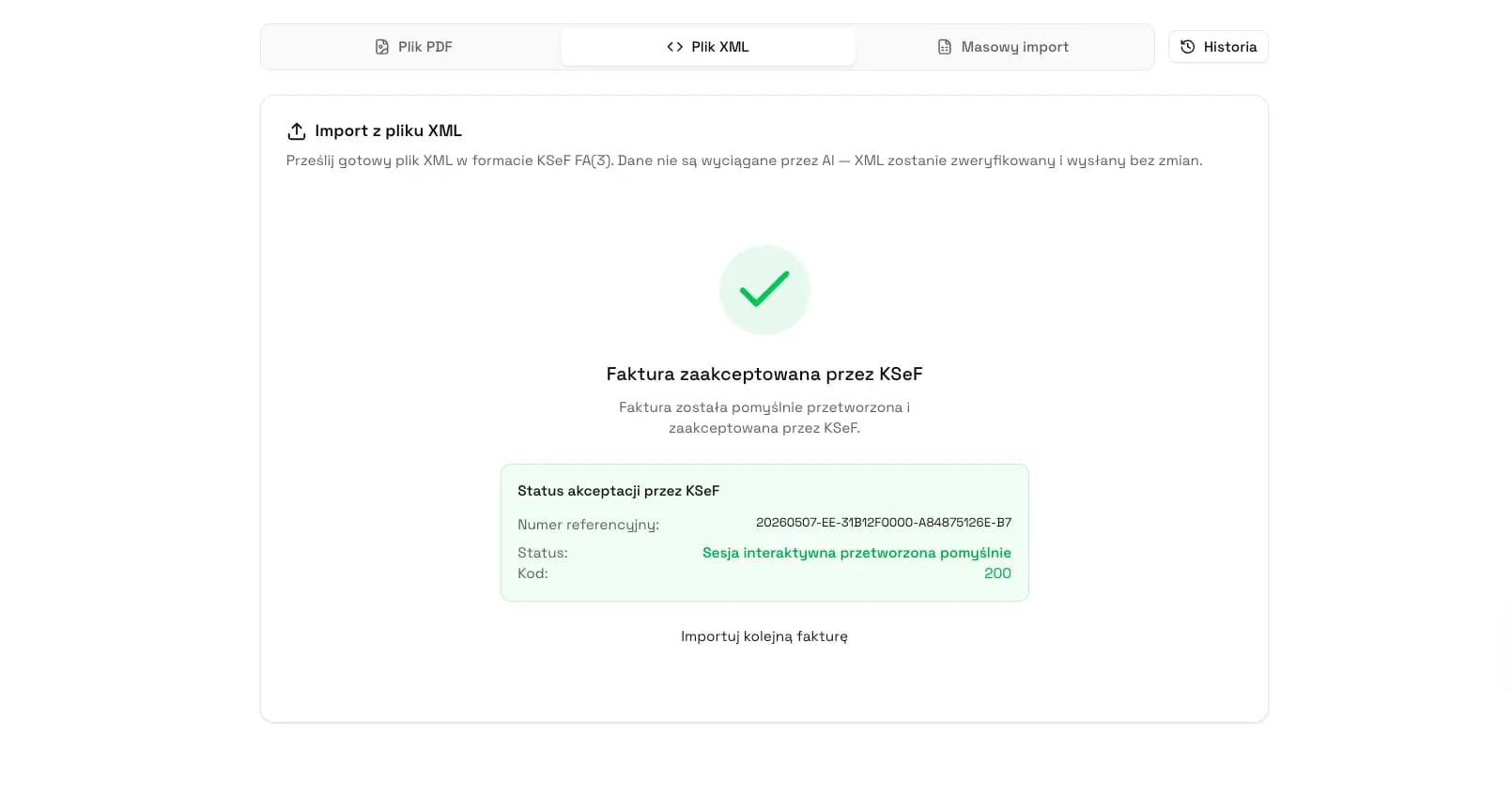
The view below shows a business invoice accepted by KSeF in KSeFGPT. It is not an OKI screen or an investment-account integration. It shows only the part of the business owner's finances that should remain separate from a private investment portfolio.
Organise your business invoice flow
OKI remains a private investment account. Use KSeFGPT to issue company invoices, send them to KSeF and check their status while keeping the two processes separate.
Open KSeFGPTFrequently asked questions
Can a Polish sole proprietor open an OKI?
Yes. An OKI agreement may be signed by an adult individual, and the Act does not exclude people who operate a sole proprietorship in Poland. The owner uses OKI as an individual, not as a separate business entity. A company that is a legal person cannot be an investor under the Act.
Is PLN 100,000 the OKI contribution limit?
No. PLN 100,000 is the maximum combined average value of qualifying assets covered by the asset-value tax exemption. The Act does not describe it as a contribution limit. Within that amount, no more than PLN 25,000 of the exemption may apply to specified savings assets.
Can an OKI loss reduce tax on business income?
No. The Act expressly provides that a loss related to OKI assets is not a tax loss under Polish personal income tax rules. It cannot reduce income from a sole proprietorship or other capital income. Asset-value tax may still arise in a year when the portfolio loses value.
Does opening or using OKI create KSeF invoicing obligations?
No. OKI is governed by separate rules and does not create invoicing obligations in KSeF. The financial institution sends the information required for the OKI tax settlement to the tax office, while the asset-value tax return is intended to be available and filed through the Polish e-Tax Office. A transfer of your own funds to OKI is neither a sale nor an invoice.
Recommended reading
KSeF for freelancers and sole proprietors - obligations and the practical invoice flow for self-employed people in Poland.
KSeF for small businesses - preparing processes, documents and tools in a small company.
KSeF and JPK - differences between two separate Polish tax-reporting systems.
Zondacrypto, KSeF and tax transparency - wider context for investment documentation and tax obligations.
Keep personal investments separate from business invoices
OKI can serve your private savings. Use KSeFGPT to issue company invoices, send them to KSeF and keep your business documentation organised.
Organise invoices in KSeFGPTSources
The legislative status, thresholds and deadlines were verified in official materials from the Polish Sejm, the President of Poland and the Polish government as of August 18, 2026.
- Government approves the bill on Personal Investment Accounts
Polish Ministry of Finance · accessed: August 18, 2026
The Ministry of Finance announcement of May 5, 2026 confirming approval of the bill by the Council of Ministers.
- Personal Investment Accounts bill, legislative process 2580
Sejm of the Republic of Poland · accessed: August 18, 2026
The official legislative history, Sejm stages, vote, Senate position and submission to the President.
- Act of July 3, 2026 on Personal Investment Accounts
Sejm of the Republic of Poland · accessed: August 18, 2026
The text passed by the Sejm after the third reading, covering OKI rules, tax, exemptions, reporting and the effective date.
- Acts signed in August 2026
Chancellery of the President of the Republic of Poland · accessed: August 18, 2026
The official list confirming that the OKI Act was signed on August 13, 2026.
- Information on the Act on Personal Investment Accounts
Chancellery of the President of the Republic of Poland · accessed: August 18, 2026
Official overview of OKI rules, assets, fees, tax, exemptions and settlement.
- Personal Investment Accounts - a new way to invest and save
Polish Ministry of Finance · accessed: August 18, 2026
The Ministry of Finance announcement of August 13, 2026 describing the purpose of OKI, thresholds, the 2027 rate and the estimated capital-market impact.
- Act on Individual Retirement Accounts and Individual Retirement Security Accounts
Journal of Laws of the Republic of Poland · accessed: August 18, 2026
The consolidated text used to compare the conditions of IKE and IKZE with OKI.
- National e-Invoice System
Polish Ministry of Finance · accessed: August 18, 2026
The official portal describing the scope of KSeF and the structured-invoice flow.